File Like a Pro: The Complete SSDI Application Process

SSDI application checklist

Why Preparation Makes or Breaks Your SSDI Application

An SSDI application checklist is your roadmap for one of the most complex government processes you’ll face. Here’s what you need to gather before you apply:

Essential Documents for Your SSDI Application:

  • Personal Information: Birth certificate, Social Security number, marriage/divorce records, banking details for direct deposit
  • Medical Evidence: Complete list of medical conditions, all healthcare providers’ contact information, medications, test results, and treatment dates
  • Work History: Detailed employment records for the past 15 years, including W-2 forms, tax returns, job duties, and earnings
  • Education & Training: School completion records, special education details, vocational training certificates

The stakes are high. Approximately 63% of initial SSDI applications are denied, and only 22% of first-time applicants get approved. The initial wait for a decision from the Social Security Administration is typically 3-5 months.

Most denials stem from preventable mistakes like incomplete forms, missing medical records, or gaps in work history. Proper preparation helps you avoid these pitfalls.

The SSA’s definition of disability is strict: you must be unable to do any substantial work (currently defined as earning $1,310 or more per month) because of a medical condition that’s lasted or will last at least one year, or result in death.

While the SSA can help gather records after you apply, providing complete and organized documents upfront dramatically improves your approval chances and speeds up the process.
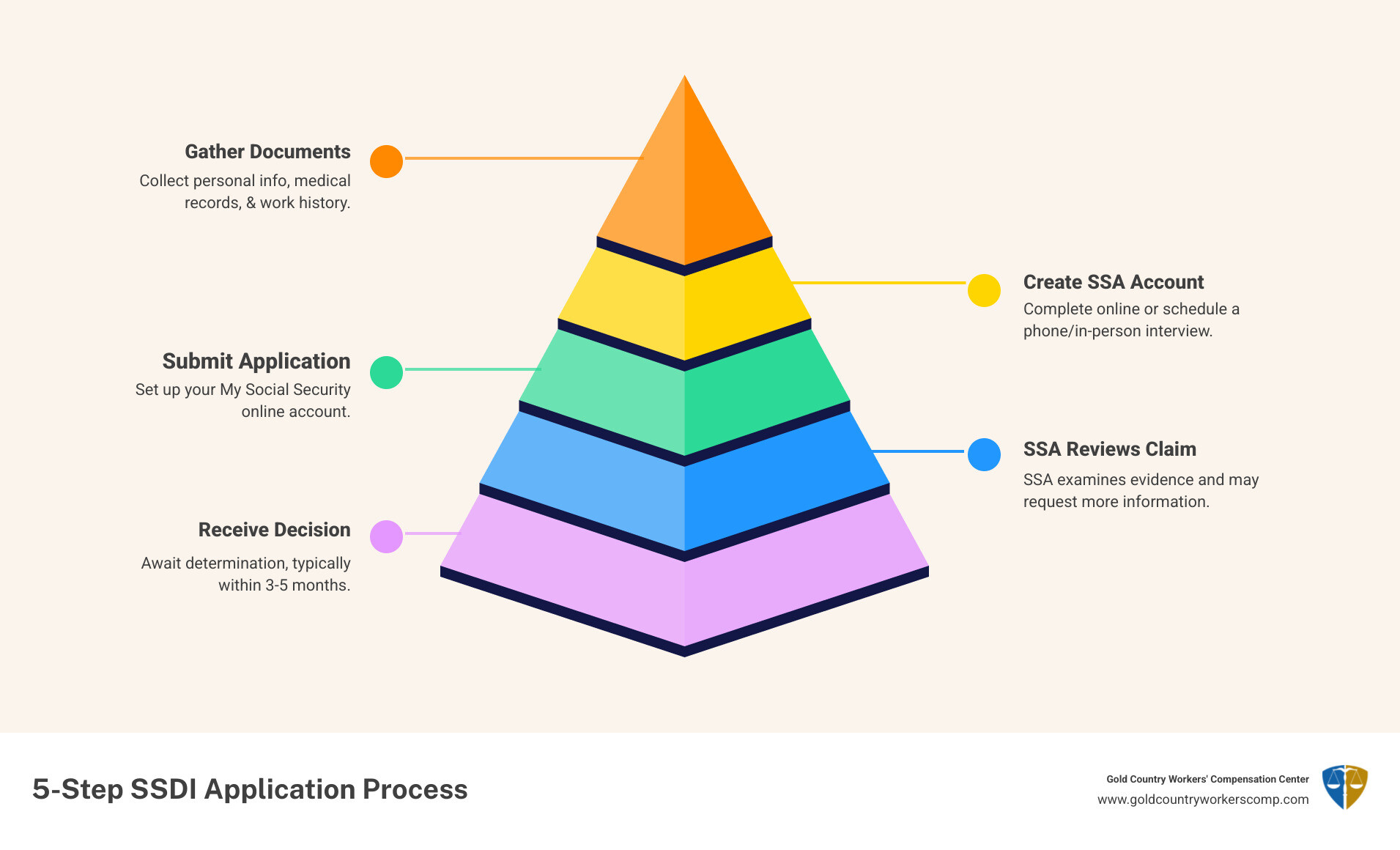
Infographic showing the 5-step SSDI application process: Step 1 - Gather documents using checklist (personal info, medical records, work history); Step 2 - Create my Social Security account; Step 3 - Complete online application or schedule interview; Step 4 - SSA reviews application and requests additional information; Step 5 - Receive decision (3-5 months). Shows 63% initial denial rate and 22% first-time acceptance rate statistics. - SSDI application checklist infographic pyramid-hierarchy-5-steps

Why a Thorough Checklist is Your First Step to Approval

The SSDI application process is notoriously complex. A thorough SSDI application checklist isn’t just helpful—it’s your lifeline. After nearly 50 years of experience, we’ve seen that proper preparation is what separates successful claims from denied ones.

The Social Security Administration requires solid evidence that you cannot perform Substantial Gainful Activity (SGA)—earning more than $1,310 per month—due to a medical condition that will last at least 12 months or is terminal. With only 22% of first-time applicants approved, most denials stem from preventable paperwork mistakes, not ineligibility.

Gathering all your information before you apply builds a compelling case, reduces delays from Requests for Information (RFIs), and gets you closer to the financial support you need.

The Purpose of an SSDI Application Checklist

Think of your SSDI application checklist as a GPS for navigating bureaucracy. Its purpose is to:

  • Organize information: It gives you one place to track scattered documents, from birth certificates to W-2s.
  • Prevent errors: Methodically working through a list prevents simple mistakes like transposed dates or missing signatures that can derail a strong application.
  • Speed up review: A complete, organized application allows SSA examiners to work efficiently, reducing the need for RFIs and potentially shortening the 3-5 month waiting period.
  • Build a strong case: Each item on the checklist helps tell your story, giving the SSA a full picture of how your disability affects your ability to work.
  • Reduce stress: A clear roadmap turns an overwhelming process into a series of manageable steps, putting you back in control.

Consequences of an Incomplete Application

When applications are incomplete, things go south fast. The consequences include:

  • Application rejection: The SSA may reject a seriously incomplete application, forcing you to start over.
  • Processing delays: Each Request for Information (RFI) for missing details can add weeks or months to the process.
  • Increased chance of denial: With a 63% initial denial rate, incomplete applications are a primary cause. Examiners can’t approve what they can’t verify, so they often default to denial.
  • Need for appeals: A denial leads to a lengthy appeals process, from reconsideration to hearings, all of which could have been avoided with a complete initial application.

Your Complete SSDI Application Checklist

This comprehensive SSDI application checklist is based on official SSA resources, including the Checklist for Online Adult Disability Application (June 2024) and the Adult Disability Starter Kit.

Checklist on a clipboard - SSDI application checklist

Gathering these documents before you apply will save you time and significantly improve your chances of approval.

Part 1: Personal and Household Information

This section covers who you are and the people in your life who may be affected by your claim. The SSA uses this to verify your identity, family situation, and potential benefit amount.

  • Birth certificate: A certified copy is best, but a U.S. passport can also work as proof of age.
  • Social Security Number (SSN): You will need your own SSN, as well as the SSNs for your current spouse and any minor children.
  • Proof of citizenship or alien status: If not a U.S. citizen, have your Permanent Resident Card number and other immigration documents ready.
  • Marriage and divorce records: Gather dates, places, and your spouse’s or former spouse’s SSN and dates of birth or death. This helps determine family eligibility for auxiliary benefits.
  • Children’s information: Full names, dates of birth, and SSNs for all children under 18, children under 19 still in high school, or adult children disabled before age 22.
  • Direct deposit information: Your checking or savings account number and your bank’s 9-digit routing number.
  • Alternate contact person: The name, address, and phone number of a friend or family member who knows about your medical conditions.

Part 2: Comprehensive Medical Evidence

This section is critical. Your medical evidence must prove you cannot work due to your medical conditions. Be thorough.

Medical records and prescription bottles - SSDI application checklist

  • List of medical conditions: List every illness, injury, and diagnosis that limits your ability to work. Be specific (e.g., type and stage of cancer), as the combination of conditions can be crucial.
  • Doctors and healthcare providers: For every provider (doctors, therapists, specialists), list their full name, address, phone number, and dates of your first and last visits.
  • Hospitals and clinics: Include the facility’s name, address, phone number, and your dates of admission and discharge for any ER visits, inpatient stays, or outpatient procedures.
  • Dates of treatments: Document all surgeries, procedures, and ongoing therapies with specific dates.
  • Medications and prescriptions: Create a complete list of current and past medications, noting what each is for and who prescribed it.
  • Medical tests and results: List all tests (X-rays, MRIs, blood work, etc.), including the type of test, when it was done, and who ordered it.
  • Other benefit records: If you’ve received Workers’ Compensation benefits, vocational rehabilitation, or other disability benefits, include claim numbers, settlement agreements, and payment amounts.

Note: The SSA can request medical records for you, but providing copies of what you already have can speed up the process. Do not pay to request records you don’t have; the SSA will obtain those at no cost to you.

Part 3: Work, Education, and Training History

Your work history explains what you can no longer do. This section is crucial, as SSDI eligibility depends on work credits earned through Social Security taxes.

  • Job history for the past 15 years: List every job (full-time, part-time, or self-employment) before your disability began.
  • Employer’s name, address, and phone number: Provide this for each position.
  • W-2 forms or tax returns: Have these for the current and past two years to verify earnings.
  • Job duties: For each job, detail your daily tasks, skills, tools used, and physical demands (lifting, standing, etc.). Crucially, explain why your medical condition now prevents you from performing these duties.
  • Pay rates: Include your gross wages per month or year for each job.
  • Education level: State the highest grade you completed, along with dates and locations.
  • Special education: If you received special education, include those details.
  • Job training or vocational school: List any specialized trade schools or vocational programs you’ve completed, with dates.

With your SSDI application checklist complete, it’s time to file. The SSA offers three flexible ways to apply.

  1. Apply online: The application at Apply Online for Disability Benefits lets you start, save, and return to your work. You’ll first need to create a secure ‘my Social Security’ account.
  2. Apply by phone: You can call the SSA’s toll-free number at 1-800-772-1213 (or 1-800-325-0778 for TTY) to apply over the phone.
  3. Apply in person: Call your local Social Security office to schedule an in-person appointment.

Having your organized SSDI application checklist beside you will make any application method flow smoothly.

What If You’re Missing Information?

A common question is whether to wait to apply if you’re missing documents. The answer is no: Don’t delay filing your application!

The SSA knows gathering records is challenging and is set up to help you after you file. Once you sign the medical release form, the SSA will work to obtain missing medical evidence directly from your providers at no cost to you.

If you know something is missing, inform the SSA representative. The most important thing is to get your application filed to establish your filing date.

A legal representative, like our team at Gold Country Workers’ Comp, can be invaluable here. With nearly 50 years of combined experience, we know which documents are critical upfront and can help you organize your file and work with the SSA to obtain the rest, preventing delays.

Starter Kits vs. Online Checklists: What’s the Difference?

The SSA provides several helpful resources that serve slightly different purposes:

Using these resources together provides the most complete preparation, leading to a more confident and less stressful application process.

Frequently Asked Questions about the SSDI Application

With nearly 50 years of experience helping Californians, we’ve heard the same questions time and again. Here are the most common concerns.

What are the key differences in the application for an adult versus a child?

Adult and child disability applications are quite different, starting with the programs. Adults typically apply for Social Security Disability Insurance (SSDI), which is based on work history. Children, who have no work history, usually apply for Supplemental Security Income (SSI), a needs-based program.

The eligibility standards also differ. For adults, the SSA assesses the ability to perform Substantial Gainful Activity (SGA). For children, the standard is whether an impairment causes “marked and severe functional limitations” that affect daily activities and development.

The SSA provides a specific Child Disability Starter Kit to help parents prepare, which focuses on a child’s schooling and medical history rather than employment.

What happens if my initial SSDI application is denied?

If you receive a denial letter, you’re in the majority—63% of initial applications are denied. This doesn’t mean you don’t qualify; it means you must begin the appeals process.

You have the right to appeal, and many who are initially denied win on appeal. The process has several stages:

  • Reconsideration: A new examiner reviews your case along with any new evidence you provide.
  • Hearing before an Administrative Law Judge (ALJ): This is often where cases turn around. You can present your case in person, bring witnesses, and have legal representation.
  • Further Appeals: Beyond the ALJ hearing, there is the Appeals Council Review and Federal Court Review.

Critically, you have only 60 days from receiving a denial letter to file your appeal. Missing this deadline can force you to start the entire application process over.

Absolutely. At Gold Country Workers’ Comp, our nearly 50 years of experience can be a significant advantage. We understand how overwhelming the SSDI application checklist is when you’re also managing a disability.

We help identify and obtain crucial medical records, ensure forms are completed correctly to meet SSA standards, communicate with the SSA on your behalf, and manage all critical deadlines to prevent your case from being derailed. Our assistance can reduce your stress and free you to focus on your health.

Our early intervention approach means there’s no initial consultation fee. We are committed to helping you achieve a positive outcome. Given the high initial denial rate, experienced legal representation can make all the difference.

Get Expert Help with Your SSDI Application

You now understand how detailed the SSDI application checklist is. When you’re managing a disability, navigating this bureaucracy is an added stress you don’t need.

Even with perfect preparation, the process is challenging. With a 63% initial denial rate and only 22% of first-time applicants approved, the odds can feel stacked against you. You don’t have to face this alone.

At Gold Country Workers’ Comp, we’ve spent nearly 50 years helping people in California with Workers’ Compensation and Disability/Social Security claims. Our team, led by Kim LaValley and Kyle Adamson, knows what the SSA is looking for and how to build a strong claim.

We believe in early intervention, which is why we offer a free initial consultation. Whether you’re just starting your SSDI application checklist in Roseville, responding to a request for information in Nevada City, or considering an appeal anywhere in California, we can help.

Our approach is to build the strongest possible case from the start. We help identify evidence gaps, ensure forms are accurate, communicate with the SSA, and manage all critical deadlines. We’ve helped countless individuals achieve a positive outcome.

Take the next step and let our experience work for you. Contact a California disability attorney for a free consultation today, and let’s get your SSDI application handled with the expertise and personal attention it deserves.

The Appeal Game: How to Overturn an SSDI Denial

social security disability appeals

Don’t Give Up: The Social Security Disability Appeals Process

Receiving a denial for your social security disability appeals application can be devastating. You’re not alone: the Social Security Administration (SSA) denies about two-thirds of initial applications. But don’t give up—you have the right to appeal.

Here’s a quick overview of the social security disability appeals process:

  1. Reconsideration: Your case is reviewed by a new examiner at the SSA.
  2. Hearing with an Administrative Law Judge (ALJ): You present your case to a judge.
  3. Appeals Council Review: The Appeals Council checks the ALJ’s decision for errors.
  4. Federal District Court Action: You can file a lawsuit in federal court.

A denial is not the end of the road, as many successful claims are initially denied. Administrative law judges overturn nearly half of the denials they review, so persistence is your best strategy. This guide will walk you through each step of the social security disability appeals process, giving you the knowledge to fight for the benefits you deserve.

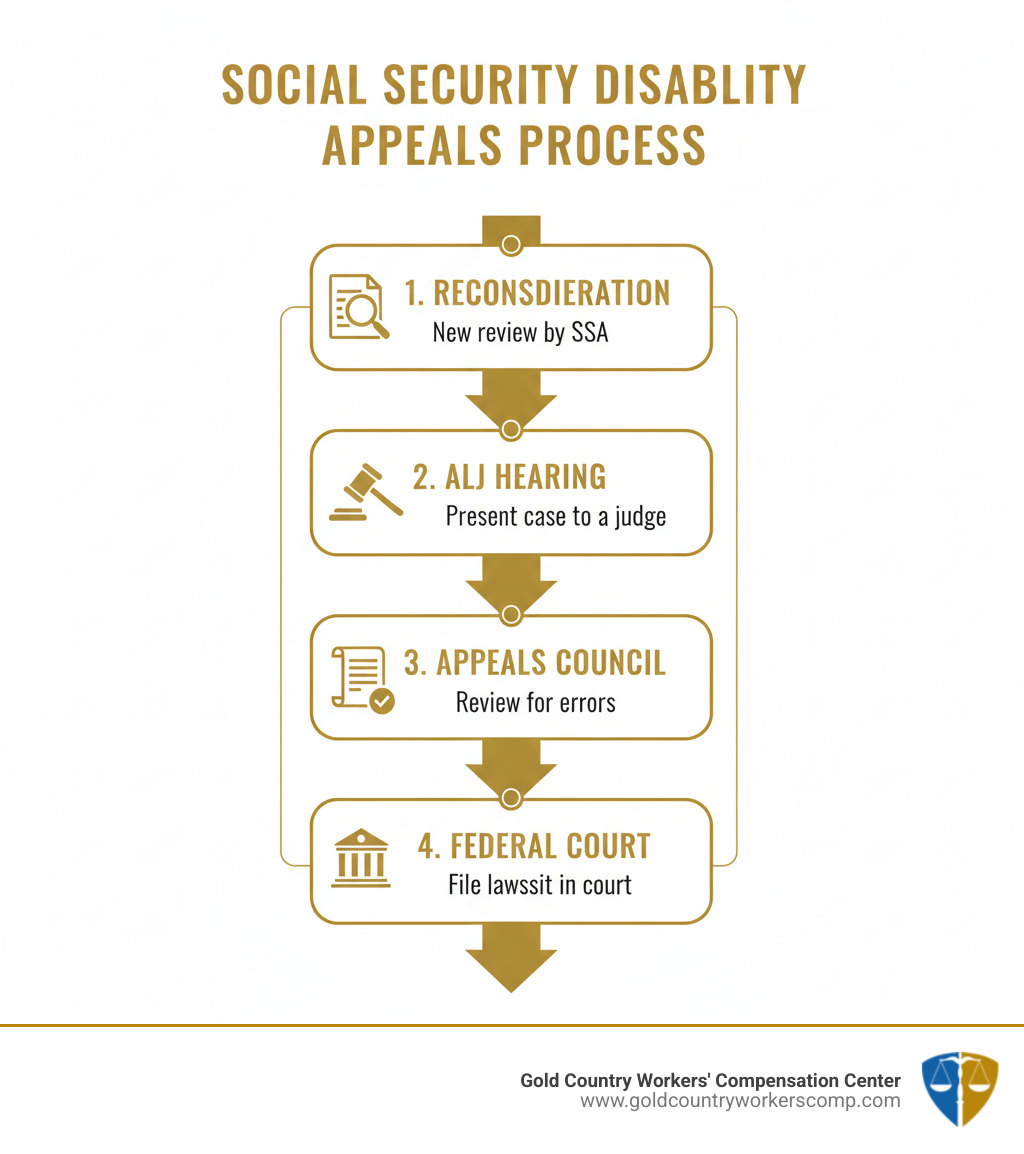
Infographic showing the four levels of the Social Security disability appeals process: Reconsideration, ALJ Hearing, Appeals Council, and Federal Court, with brief descriptions of what happens at each stage. - social security disability appeals infographic

First Move: Understanding Your Denial and Filing for Reconsideration

Calendar with a 60-day deadline circled - social security disability appeals

After receiving a denial letter, remember this is just the first hurdle in the social security disability appeals process. The most important thing is to act quickly. You have a strict 60-day deadline from the date you receive the denial notice to file an appeal. The Social Security Administration (SSA) assumes you receive the notice five days after the date on the letter, so your real deadline may be shorter. Missing this deadline could force you to start your application over, delaying benefits and reducing potential back pay.

You can file your appeal online, by mail, or by fax. For general guidance on filing online, refer to the SSA’s publication: How To File Your Disability Appeal Online. You can check your appeal’s status by logging into your “my Social Security” account at ssa.gov/myaccount.

What is a Reconsideration?

Reconsideration is the first appeal step, where the SSA gives your case a second look. A new examiner who was not involved in the first decision conducts a complete review of your claim, ensuring an unbiased perspective.

  • Medical Denials: If your claim was denied for medical reasons, a new examiner from a Disability Determination Services (DDS) office will review your original application, all submitted evidence, and any new medical information you provide.
  • Non-Medical Denials: If the denial was for non-medical reasons (e.g., income limits for SSI or work credits for SSDI), a different SSA employee will review your request to ensure the rules were applied correctly.

In both cases, the reviewer examines all evidence—old and new—to see if the initial decision was correct. The SSA will review the entire determination, even parts that were in your favor. If your benefits were stopped, specific benefit continuation rules might allow payments to continue during your appeal, but these have strict requirements.

How to File for Reconsideration

To file for reconsideration, you’ll need your personal information (name, SSN, contact info), the date you received your denial, and complete medical information. This includes contact details for all healthcare providers, dates of service, and a comprehensive medication list. Most importantly, gather any new evidence, such as recent medical records or test results.

You have several ways to submit your request:

Your goal is to present a clear picture of how your medical condition prevents you from working, supported by any new evidence that strengthens your claim.

The ALJ Hearing: Your Best Chance in the Social Security Disability Appeals Process

A professional, yet non-intimidating, hearing room setting - social security disability appeals

If your reconsideration is denied, the next step in the social security disability appeals process is a hearing before an Administrative Law Judge (ALJ). This is often your best chance to win. ALJs are known to overturn nearly half of the denials they review.

With a representative, your chances improve. Nationally, 56% of represented applicants receive benefits, compared to only 33% without. At Gold Country Workers’ Compensation Center, our clients see even higher approval rates: a remarkable 69%, well above the national average of 45%.

The ALJ assigned to your case is new to your file, bringing an unbiased perspective. The hearing is a private, non-adversarial proceeding. There is no opposing lawyer; the ALJ’s goal is to gather facts and make a fair decision. The judge will ask about your medical history, treatments, symptoms, daily life, and work history. This is your opportunity to explain, in your own words, how your disability affects your ability to work.

A medical expert or a vocational expert may also attend to provide testimony on your health conditions or your ability to perform other types of work. Their insights help the ALJ understand the full picture of your disability.

Preparing for Your ALJ Hearing

Preparation is essential for a successful ALJ hearing. We advise clients to review their case file, organize all evidence, and prepare their testimony to clearly explain their condition and its daily limitations.

You will receive a hearing notice at least 75 days in advance. Hearings can be in person, by phone, or via video. If you must travel more than 75 miles one way, the SSA may help with travel costs, which is beneficial for those in rural California areas like Nevada City or even those coming from Roseville.

If you cannot attend your scheduled hearing, you must notify the SSA in writing as soon as possible with a good reason. If the ALJ finds your reason insufficient, your request may be dismissed.

Key Evidence for Your social security disability appeals

The success of your social security disability appeals hinges on strong evidence. For your ALJ hearing, you should present:

  • Updated Medical Records: All recent doctor’s notes, hospital records, lab results, and imaging scans.
  • Doctor’s Reports: Detailed reports from your treating physicians stating your diagnosis, prognosis, and work-related limitations.
  • Function Reports: Forms describing your daily activities and how your symptoms interfere with them.
  • Witness Statements: Written statements from family, friends, or former employers describing how your disability affects you.
  • Expert Witness Testimony: In some cases, testimony from a physical therapist or rehabilitation specialist can clarify your functional limitations.
  • Submitting Evidence: You must submit all written evidence and objections no later than five business days before your hearing. Requests for subpoenas must be filed at least 10 business days before the hearing.

The more current and comprehensive your medical evidence, the stronger your case.

Advanced Strategy: Navigating Higher Levels of Appeal

If the ALJ denies your claim, the social security disability appeals process continues to the Appeals Council and, if necessary, Federal District Court. These higher levels have lower success rates and involve more complex legal arguments, but they are vital avenues to explore for your claim.

The Role of the Appeals Council

If the ALJ’s decision is unfavorable, you can ask the Appeals Council (AC) to review it. You have 60 days from receiving the ALJ’s denial to file this request. The AC acts as a quality control check, reviewing the decision for legal or factual errors.

The AC will examine your entire case file to determine if:

  • The ALJ made a legal mistake.
  • The decision was supported by substantial evidence.
  • There is new and important evidence that could change the outcome.

Submitting new evidence to the AC is difficult. It must be new, material (important to your case), relate to the period before the ALJ’s decision, and have a good chance of changing the outcome. It is always best to submit all evidence by the ALJ hearing stage.

The Appeals Council can:

  • Deny Review: This is the most common outcome, upholding the ALJ’s decision.
  • Grant Review and Issue a Decision: The AC may review the case and issue its own decision.
  • Remand the Case: The AC can send the case back to an ALJ for a new hearing if it finds a significant error.

You can request a review online via the SSA’s “AC iAppeal Online” process by selecting “Start an Appeal” at AC iAppeal Online, or you can mail Form HA-520.

Filing a Federal District Court Action

If the Appeals Council denies your review, your final step is to file a civil lawsuit in a U.S. Federal District Court. You have 60 days after receiving the AC’s decision to file this lawsuit (the SSA typically adds five days for mail delivery).

This stage involves complex federal civil law. Due to the complexity, an experienced legal team is essential. Our attorneys at Gold Country Workers’ Compensation Center are experienced in these intricate legal processes, ensuring your case is presented effectively in federal court.

Why Appealing is a Smarter Play Than Reapplying

After a denial, you may be tempted to start over with a new application instead of appealing. However, appealing your initial denial is almost always the smarter strategy.

Why is appealing better than reapplying? First, appealing preserves your original application date. This is critical for calculating your potential “back pay”—the benefits owed from your disability onset date until your approval. If you reapply, you establish a new, later application date, which can significantly reduce or even eliminate the back pay you might receive, potentially costing you thousands.

Additionally, there is a five-month waiting period for benefits after your disability onset date. If you appeal, this waiting period starts from your original claim’s onset. Reapplying triggers a new five-month waiting period after your new approval, further delaying financial support.

Appealing also saves time and effort. You are continuing an existing process, building on the evidence you’ve already submitted. Reapplying means starting from scratch—filling out all the forms and gathering all your records again, facing the same high initial denial rates.

By appealing, especially to the ALJ Hearing level, your chances of success improve dramatically. Many denials are overturned at this stage. By choosing to appeal, you are not just saving time and maximizing potential back pay; you are also significantly improving your odds of approval.

In summary, appealing allows you to:

  • Preserve your original application date to maximize back pay.
  • Avoid a new five-month waiting period for benefits.
  • Build on your existing application, saving time and effort.
  • Increase your chances of approval, especially at the ALJ hearing stage.

Frequently Asked Questions about social security disability appeals

How long does the appeals process typically take?

The timeline for the social security disability appeals process varies by stage, case complexity, and location. While there are no set timelines, you can generally expect:

  • Reconsideration: 3 to 5 months.
  • ALJ Hearing: A year or even longer, depending on the backlog at your local Office of Hearing Operations (OHO). Caseloads vary throughout California, from Grass Valley to Roseville.
  • Appeals Council or Federal Court: These higher levels can add many more months or even years to the process.

The entire appeals process can easily take a year or more. Patience and persistence are essential.

Can my benefits continue while my appeal is pending?

Yes, under certain circumstances, your benefits can continue during an appeal, particularly if the SSA has stopped your benefits.

If the SSA determines you are no longer disabled due to medical improvement (a “medical disability cessation”), you can request that your benefits continue. You must make this request in writing within 10 days of receiving the cessation notice—a critical deadline. Be aware that if you lose the appeal, you may have to repay these benefits.

For Supplemental Security Income (SSI), you may also be able to continue receiving payments if they were reduced or suspended for non-medical reasons. You must request reconsideration within 10 days of receiving that notice.

What are the advantages of working with a Social Security disability lawyer?

While not legally required, working with a disability lawyer significantly increases your chances of success. Nationally, applicants with representation are far more likely to be approved.

At Gold Country Workers’ Compensation Center, 95% of our clients recover benefits, and 69% are approved at the hearing level, compared to the national average of 45%. These statistics represent real people in Grass Valley, Nevada City, and Roseville who secured the benefits they needed.

A lawyer helps by:

  • Navigating Deadlines: The appeals process is full of critical deadlines for filing appeals and submitting evidence. We ensure nothing is missed.
  • Gathering Evidence: With nearly 50 years of experience, we know what medical evidence is most persuasive to the SSA and ALJs. We help you obtain detailed doctor’s reports and prepare compelling testimony.
  • Preparing for Hearings: We prepare you for what to expect from the ALJ, how to answer questions, and how to clearly explain your limitations.

Most importantly, we work on a contingency fee basis. You pay no fees unless we win your case. Our fee is capped by federal law (typically 25% of your back pay, up to a set maximum). This makes quality legal help accessible to everyone. At Gold Country Workers’ Compensation Center, Kim LaValley and Kyle Adamson believe early intervention makes all the difference.

Conclusion: Winning the Game with the Right Partner

The social security disability appeals process is a marathon, not a sprint. A denial is just the opening move, not the end of the game. As this guide has shown, persistence pays off, with nearly half of all denials being overturned at the ALJ hearing level.

Professional guidance dramatically improves your odds. People with representation at their hearing are significantly more likely to win. At Gold Country Workers’ Compensation Center, our track record reflects this: 95 percent of our clients successfully recover benefits, and our 69% approval rate at the hearing level is far above the national average of 45%.

Experience, preparation, and genuine care make the difference. With nearly 50 years of combined experience, Kim LaValley and Kyle Adamson understand the system in California, from Grass Valley and Nevada City to Roseville and the greater Sacramento area. We know that behind every claim is a person facing real challenges.

We believe everyone deserves a fighting chance, which is why we offer a free initial consultation and work on a contingency basis—we only get paid when you win. You take no financial risk by getting professional help; you make a smart investment in your future.

Don’t let a denial discourage you. Let us stand beside you, prepare your case, and advocate for your rights.

Get a free case evaluation for your disability appeal and let’s start building your path to success together.

Your Roseville SSI Benefits Lawyer A Partner for Your Claim

Roseville SSI benefits lawyer

A Roseville SSI benefits lawyer provides expert legal representation to help individuals steer the complex Supplemental Security Income (SSI) application and appeals process. This federal program is designed to secure disability benefits for those with limited income and resources who are elderly, blind, or disabled.

Quick Guide to Finding SSI Legal Help in Roseville:

  1. Free Consultations – Most SSI lawyers offer no-cost initial case evaluations
  2. No Upfront Fees – Payment only comes from your back pay if you win (capped at 25% or $6,000)
  3. Higher Success Rates – Legal representation significantly improves approval odds, especially at appeal hearings
  4. Local Expertise – Roseville attorneys understand Placer County procedures and local SSA office requirements
  5. Comprehensive Support – Help with applications, medical evidence, appeals, and ALJ hearings

If a disability prevents you from working, the financial strain can be overwhelming. The SSI system is a potential lifeline, but it’s notoriously difficult to steer. An initial application takes 3-5 months for a decision, and most are denied. The subsequent appeals process can stretch for 1-2 years, a period where financial and emotional stress can mount.

This is where a Roseville SSI benefits lawyer becomes an invaluable partner. Research shows that applicants with legal representation have a significantly higher success rate in their appeals and hearings. You don’t need money upfront to hire an SSI lawyer. They work on a contingency fee basis, meaning they only get paid if you win. Their fee is capped by law at 25% of your back pay or $6,000, whichever is less.

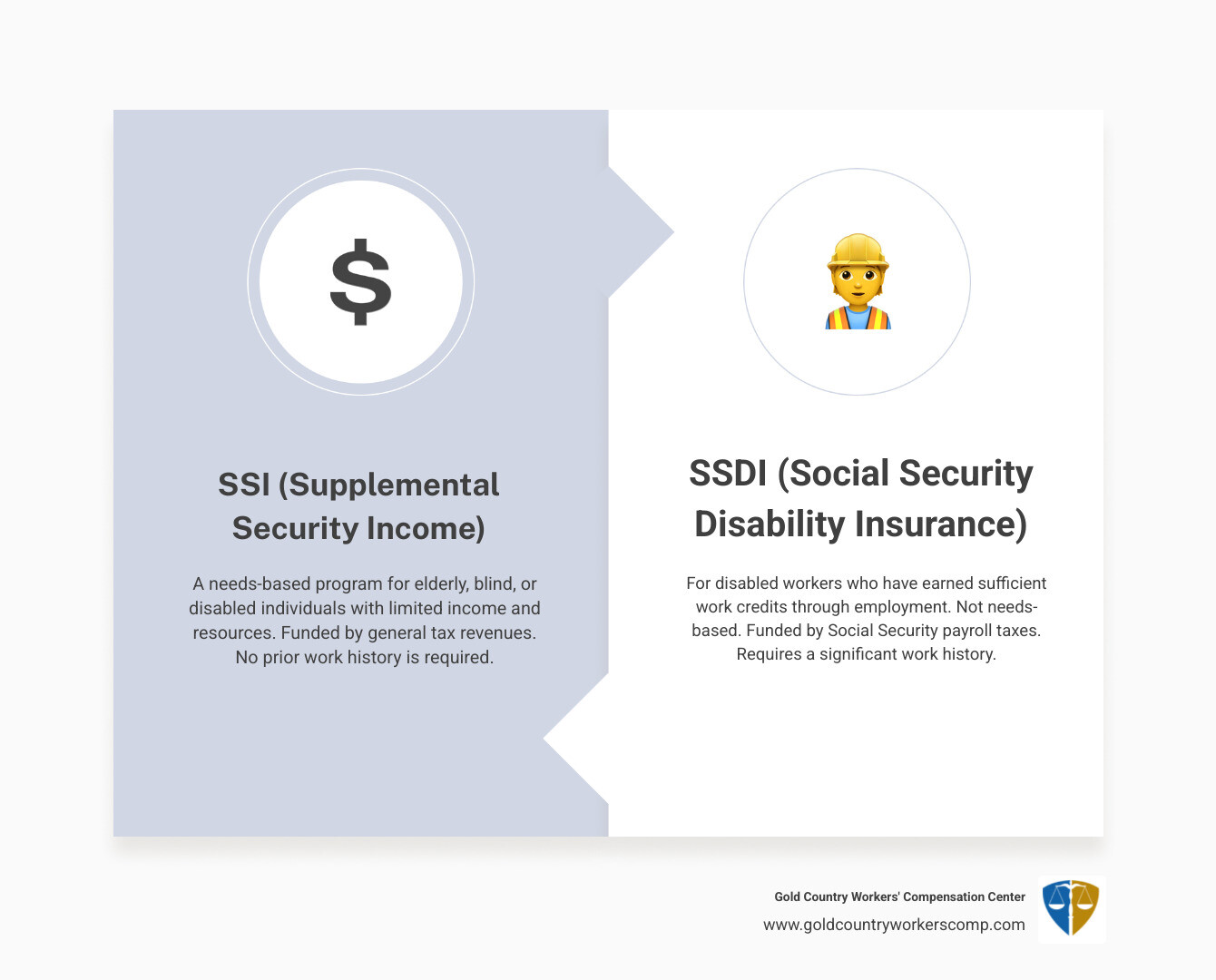
Infographic comparing SSI and SSDI: SSI is funded by general tax revenue, requires financial need, does not require work history, and serves elderly/blind/disabled individuals with limited resources. SSDI is funded by Social Security payroll taxes, does not require financial need, requires work credits from employment history, and serves disabled workers who paid into the system. - Roseville SSI benefits lawyer infographic comparison-2-items-formal

Understanding SSI: Eligibility and Key Differences in Roseville

Supplemental Security Income (SSI) is a federal program designed to help elderly, blind, or disabled individuals with limited income and resources. Unlike other Social Security programs, SSI is needs-based, meaning you don’t need a work history to qualify. This makes it a lifeline for many Roseville residents who haven’t been able to work consistently. At Gold Country Workers’ Compensation Center, we help people make sense of the Social Security Administration rules and determine their eligibility.

Who Qualifies for SSI Benefits?

The SSA considers several factors for SSI eligibility:

  • Age, Disability, or Blindness: You must be 65 or older, blind, or have a qualifying disability. A disability is a physical or mental impairment that prevents substantial gainful activity and is expected to last at least 12 months or result in death.
  • Limited Income and Resources: Your countable income and assets must fall below strict federal limits.
  • Citizenship and Residency: You must be a U.S. citizen or eligible noncitizen residing in the U.S.
  • Application: You must file an application and have it approved by the SSA.

A Roseville SSI benefits lawyer can ensure your application is complete and presents your case in the strongest possible light. For more details on local assistance, visit our page on Disability and Social Security Help in Roseville.

SSI vs. SSDI: What Roseville Applicants Need to Know

It’s crucial to understand the difference between SSI and Social Security Disability Insurance (SSDI). While both programs help people with disabilities, SSDI is an insurance program funded by payroll taxes that you pay into through work. SSI is a needs-based safety net funded by general tax revenues.

Criteria Supplemental Security Income (SSI) Social Security Disability Insurance (SSDI)
Funding Source General tax revenues Social Security payroll taxes
Financial Need Required (limited income/resources) Not required (based on work record)
Work History Not required Required (sufficient “work credits”)
Medicare Eligibility May qualify for Medicaid/Medi-Cal Eligible for Medicare after 24 months

Our Roseville SSI benefits lawyer team can help you determine which program fits your situation; some people even qualify for both.

Strict Income and Asset Limits for SSI

Because SSI is needs-based, the SSA imposes strict financial limits.

Countable income includes wages, pensions, unemployment, and even “in-kind” support like free food or shelter. The SSA excludes the first $20 of most income and the first $65 of earned income, plus half of the remainder. California also provides a state supplement to federal SSI payments.

Asset limits are critical. An individual’s countable resources cannot exceed $2,000, and a couple’s limit is $3,000. Not all assets count. Your primary home, one vehicle used for transportation, personal belongings, and household goods are typically excluded. However, cash, bank accounts, and investments do count. A mistake in reporting can lead to denial, making the guidance of a Roseville SSI benefits lawyer invaluable. For more information, you can consult resources like the Social Security Roseville CA office.

The SSI Application and Appeals Gauntlet: A Step-by-Step Guide

Applying for SSI benefits is a challenging process. The initial application takes 3-5 months for a decision, and if denied, the appeals process can last 1-2 years. This is a long time to wait when you’re dealing with a disability and financial hardship. Our firm can guide you through every step.

Person overwhelmed by stack of official-looking forms - Roseville SSI benefits lawyer

The Initial Application Process

A strong application is built on thorough documentation. You will need:

  • Medical Records: Objective proof of your disability, including doctor’s notes, lab results, imaging scans, and treatment plans.
  • Financial Records: Proof of your limited income and resources, such as bank statements and asset information.
  • Personal & Work Information: Your birth certificate, Social Security card, proof of citizenship, and a detailed work history for the past 15 years.

You can apply online, by phone, or in person at a local Social Security office. Our Roseville Social Security Office Appointments Guide can help you prepare for a visit. A Roseville SSI benefits lawyer can review your application to prevent common errors that cause delays or denials.

Common Challenges and Reasons for Denial

Most initial SSI applications are denied, often for fixable reasons:

  • Insufficient Medical Evidence: The SSA requires concrete, objective proof that your condition severely limits your ability to function.
  • Exceeding Financial Limits: Your income or assets are over the strict thresholds.
  • Application Errors: Incomplete forms, inconsistent information, or missing signatures.
  • Failure to Follow Prescribed Treatment: The SSA may conclude your condition isn’t severe if you don’t follow your doctor’s orders without a good, documented reason.
  • Disability Not Severe Enough: The SSA determines your condition doesn’t prevent you from performing any substantial gainful activity.

Properly documented claims for conditions like severe musculoskeletal disorders, mental health conditions (depression, PTSD), neurological disorders (MS, Parkinson’s), cancers, and cardiovascular diseases are often approved. The key is proving the severity of your limitations.

If denied, you have the right to appeal, but you must act within a strict 60-day deadline for each stage.

  1. Reconsideration: A different claims examiner reviews your file and any new evidence. Most reconsiderations are also denied, but this step is required to proceed.
  2. Administrative Law Judge (ALJ) Hearing: This is your best opportunity to win. You present your case in person to a judge, and your lawyer can argue on your behalf and question experts. Success rates are much higher at this stage, especially with legal representation.
  3. Appeals Council Review: If the ALJ denies your claim, you can ask the Appeals Council to review the decision for legal errors.
  4. Federal Court Review: The final step is filing a lawsuit in federal district court, a complex process that requires an experienced attorney.

Our Disability Claim Lawyer in Roseville services are designed to maximize your chances at every level of this process.

Why Partnering with a Roseville SSI Benefits Lawyer Maximizes Your Chances

Statistics show that applicants with legal representation have a much higher chance of winning their SSI claim, especially at the hearing level. The system is a maze of regulations and procedural requirements. A Roseville SSI benefits lawyer acts as your advocate and strategic partner, translating complex medical and legal information into a strong case. At Gold Country Workers’ Compensation Center, our motto is “We Win the Tough Ones,” reflecting our commitment to fighting for our clients.

Lawyer confidently speaking in a hearing room setting - Roseville SSI benefits lawyer

How a Roseville SSI benefits lawyer Can Help with Your Application

Hiring a lawyer from the start can prevent the common pitfalls that lead to initial denials. We help by:

  • Ensuring Accuracy: We review every form to catch errors that could delay or derail your claim.
  • Developing a Case Theory: We present your medical condition in a way that directly addresses the SSA’s legal standards for disability.
  • Handling Communications: We manage all correspondence with the SSA, ensuring timely responses and preventing you from missing crucial requests.
  • Meeting Deadlines: We track all timeframes, especially the critical 60-day deadline for appeals, so you never lose your rights.

For more on how we support clients, visit our Social Security Attorney in Roseville page.

The Lawyer’s Role in a Denied Claim Appeal

If your claim is denied, a lawyer’s role becomes even more critical. We manage the entire appeals process by:

  • Filing Appeals Correctly: We ensure all appeal requests are filed properly and on time.
  • Gathering New Evidence: We identify what’s missing from your file and work to obtain stronger medical records and supportive opinions from doctors.
  • Preparing You for the ALJ Hearing: We walk you through the hearing process, so you know what to expect and can testify with confidence.
  • Cross-Examining Experts: We challenge the testimony of vocational experts the SSA uses to argue that jobs exist for you.
  • Writing Legal Briefs: We submit detailed written arguments to the judge, summarizing the evidence and explaining why you meet the legal standard for disability.

Gathering Medical Evidence and Coordinating with Doctors

A serious diagnosis is not enough; you need the right medical evidence. The SSA needs to see how your condition limits your ability to function. We work with your doctors to obtain supportive medical opinions, often in the form of a Residual Functional Capacity (RFC) assessment. This document details your specific physical and mental limitations, such as how long you can stand, how much you can lift, and your ability to concentrate.

Many doctors are unfamiliar with the SSA’s specific documentation requirements. We bridge this gap by coordinating with your medical team to explain what information is needed. We then analyze these records and translate them into clear legal arguments that address the SSA’s criteria for determining disability. Strong, well-presented medical evidence is the foundation of a successful claim. For more on disability standards, visit the Social Security Disability Insurance website.

Finding Your Advocate and Understanding the Partnership

Choosing a Roseville SSI benefits lawyer is a critical decision. You are looking for an advocate who will partner with you through a long and often stressful process. At Gold Country Workers’ Compensation Center, we build partnerships based on trust, clear communication, and compassion.

Friendly handshake between a lawyer and a client - Roseville SSI benefits lawyer

How are SSI Lawyers Paid? The Contingency Fee Structure

The most common question is, “How much will this cost?” The answer is simple: you pay no upfront fees.

SSI lawyers work on a contingency fee basis, meaning we only get paid if we win your case. If your claim is approved, our fee is paid from your back pay—the past-due benefits owed to you. The Social Security Administration regulates these fees to protect you. The fee is capped at 25% of your retroactive benefits or $6,000, whichever is less. If you don’t win, you owe us no legal fee. This structure ensures everyone can afford quality legal help.

Finding a Reputable Roseville SSI benefits lawyer

When searching for the right advocate, look for:

  • Specialized Experience: Social Security disability law is a complex field. You want an attorney who focuses on these cases, not a general practitioner. Our firm has nearly 50 years of combined experience in this area.
  • Client Reviews: Read testimonials from past clients to learn about their experience with the lawyer’s communication, responsiveness, and results.
  • Credentials: Verify that the lawyer is licensed and in good standing with the State Bar of California.

Our team of Disability Attorneys in Roseville is dedicated to providing the effective representation you need.

What to Expect During Your Initial Consultation

We offer a no-cost initial consultation to make legal help accessible from day one. During this meeting, we will:

  • Listen to your story to understand your disability and how it impacts your life.
  • Review your financial situation to confirm you meet SSI’s needs-based criteria.
  • Explain the application or appeals process, including timelines and potential challenges.
  • Provide clear, straightforward advice about your options.

This meeting is about empowering you with information. There is no obligation to hire us.

Frequently Asked Questions about SSI Claims

We’ve heard countless questions from Roseville residents trying to understand the SSI process. Here are answers to some of the most common ones.

How long does the SSI application and appeal process take in Roseville?

The timeline for an SSI claim is rarely quick. The initial application process typically takes 3-5 months for a decision. If your claim is denied, the appeals process can take 1-2 years, largely due to backlogs at the SSA’s hearing offices. Factors like the complexity of your condition and how quickly your doctors provide records can affect this timeline. A Roseville SSI benefits lawyer can help avoid common delays and keep your case moving as efficiently as possible.

Does having a lawyer guarantee my SSI claim will be approved?

No attorney can ethically guarantee a specific outcome, as the final decision rests with the Social Security Administration. However, statistics are clear: applicants with legal representation have significantly higher success rates, especially at the Administrative Law Judge hearing. An experienced Roseville SSI benefits lawyer understands the SSA’s rules, knows what evidence is needed, and can make persuasive legal arguments on your behalf. Our role is to maximize your chances of success by building the strongest possible case.

Can I work while applying for or receiving SSI benefits?

Yes, but you must be very careful to follow the SSA’s strict earnings limits. The key concept is Substantial Gainful Activity (SGA), a monthly earnings amount that the SSA uses to determine if you are disabled. For 2024, the SGA limit is $1,550 per month for non-blind individuals. Earning over this amount can jeopardize your eligibility.

Even if you earn less than the SGA limit, your SSI payment will be reduced based on your income. The most critical rule is to report all income to the SSA promptly and accurately. Failure to report income can lead to overpayments that you must repay, penalties, or a loss of benefits. The rules are complex, and our team can help you understand them to avoid costly mistakes.

Conclusion

Securing Supplemental Security Income (SSI) benefits in Roseville can be a complex and frustrating journey. The process is long, the rules are strict, and a denial can feel devastating. But these benefits are a crucial lifeline, providing financial stability when a disability prevents you from working.

This is where experience matters. At Gold Country Workers’ Compensation Center, our team, led by Kim LaValley and Kyle Adamson, brings nearly 50 years of combined experience in Disability and Social Security law. We have helped countless residents of Roseville and surrounding California communities steer the system and secure the benefits they deserve.

We believe in early intervention and removing financial barriers to legal help. That’s why we offer a no-cost initial consultation to discuss your case and provide honest advice. Because we work on a contingency fee basis, you only pay a fee if we win your case.

You don’t have to face the SSA alone. Whether you are just starting your application or need to appeal a denial, our team is ready to fight for you. Take the first step toward securing your benefits and peace of mind.

Contact our Disability Law Firm in Roseville for a free consultation, and let a compassionate Roseville SSI benefits lawyer stand by your side.

Your Guide to Appealing SSDI: Finding the Right Lawyer

SSDI appeal lawyer

An SSDI appeal lawyer specializes in helping individuals steer the complex Social Security Disability Insurance appeals process after an initial claim denial. Here’s a quick guide to finding legal representation:

  • When to hire: After an initial denial, before an ALJ hearing, or for complex medical issues.
  • How they help: Gather medical evidence, meet strict deadlines, prepare testimony, and represent you at hearings.
  • Cost: Contingency fee basis (no fee unless you win), capped at 25% of back pay up to $7,200.
  • Success rates: Claimants with legal representation win benefits far more often than those without.
  • Timeline: Appeals can take 12-18 months or longer.

The statistics are sobering: the Social Security Administration (SSA) denies most initial SSDI claims, and many applicants wait over two years for payment. But a denial isn’t the end. The SSA often approves claims on appeal, which is where experienced legal guidance becomes critical.

The appeals process has four levels, each with strict 60-day deadlines. Missing a deadline or failing to submit the right evidence can jeopardize your benefits. For someone already struggling with a disability, the process can feel overwhelming.

The good news is you don’t have to face it alone. The right legal support significantly increases your chances of securing the benefits you’ve earned.

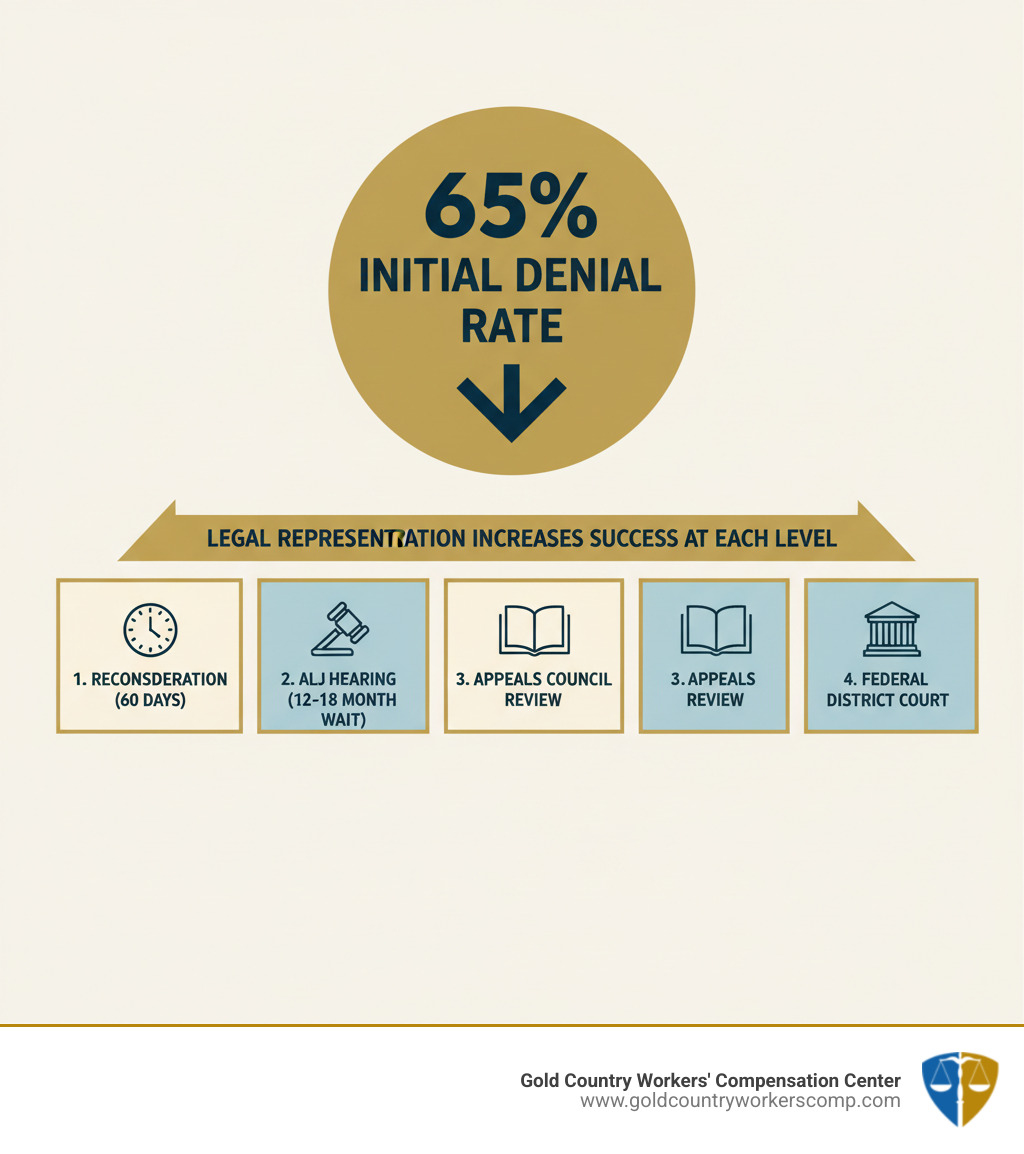
Infographic showing SSDI initial denial rate of 65% and the four-level appeals process: 1) Reconsideration within 60 days, 2) Administrative Law Judge hearing (12-18 month wait), 3) Appeals Council review, 4) Federal District Court, with notation that legal representation significantly increases success rates at each level - SSDI appeal lawyer infographic

Understanding Why Your SSDI Claim Was Denied

Receiving a denial letter is frustrating, but it doesn’t mean your case is hopeless. Most initial SSDI claims are denied, often for technical reasons rather than the reality of your condition. Understanding these reasons is the first step to building a successful appeal.

Common reasons for denial include:

  • Insufficient medical evidence: This is the top reason for denial. The SSA needs detailed proof of how your condition prevents you from working, not just a diagnosis. Your medical records must clearly spell out your functional limitations.
  • Technical issues: You might be denied if you haven’t earned enough work credits or if you’re earning above the Substantial Gainful Activity (SGA) limit.
  • Failure to follow treatment: If you stop seeing your doctor or taking medication without a documented reason (like cost or side effects), the SSA may deny your claim.
  • Condition not severe enough: Your condition may be debilitating, but if it doesn’t meet the SSA’s strict legal definition of disability, your claim will be denied.
  • Application errors: Missing information or mistakes on your application can sink your claim before it starts.

Most denials happen because the claim failed to prove the applicant meets the SSA’s legal definition of “disabled.” This is a critical distinction and where an SSDI appeal lawyer provides invaluable help.

The SSA’s Definition of Disability

The SSA’s definition of disability is strict. You are considered disabled only if you cannot engage in any “substantial gainful activity” (SGA) due to a medically determinable impairment that is expected to last at least 12 months or result in death.

Crucially, you must be unable to do not just your old job, but any other substantial work that exists in the national economy, considering your age, education, and experience. This high bar is why so many legitimate claims are initially denied.

The Five-Step Evaluation Process

Every SSDI claim goes through a five-step evaluation. Understanding where your claim failed helps build a stronger appeal.

Step 1: Are you working? The SSA checks if you’re earning above the SGA limit ($1,470 per month in 2024). If so, your claim is denied.

Step 2: Is your impairment severe? Your condition must significantly limit basic work activities. Insufficient medical evidence often leads to a denial at this step.

Step 3: Does your condition meet a Blue Book listing? The SSA’s “Listing of Impairments” (Blue Book) contains specific criteria for automatic approval. Meeting a listing is the fastest path to benefits, but the standards are very high.

Step 4: Can you do your past work? If you don’t meet a listing, the SSA assesses your “Residual Functional Capacity” (RFC) to see if you can perform any of your jobs from the past 15 years. If you can, you’re denied.

Step 5: Can you do any other work? If you can’t do your past work, the SSA determines if there is any other work in the national economy you could perform, given your RFC, age, education, and skills. If they decide you can adjust to other work, your claim is denied.

This process is technical and unforgiving. An SSDI appeal lawyer who knows these regulations can make the difference between denial and approval.

The Four Levels of the SSDI Appeals Process

If your initial claim is denied, don’t despair. The SSA has a structured appeals process, but you must act fast: you have only 60 days from the date you receive your denial letter to file an appeal. Missing this deadline can force you to start the entire application process over.

The appeals process has four levels:

flowchart showing the four levels of appeal - SSDI appeal lawyer

For more details, see the Social Security Administration’s official page at Non-Medical Appeal, Social Security.

Level 1: Reconsideration

This is a “second look” at your file by a new examiner. You can submit new evidence to fix gaps in your original application by filing Form SSA-561. While approval rates at this stage are low, it is a mandatory step in most states. You must go through it to move forward, so it’s important to submit the strongest case possible.

Level 2: Administrative Law Judge (ALJ) Hearing

This is often your best chance to win benefits, especially with an SSDI appeal lawyer. Unlike the previous paper reviews, you appear before a judge (in person or by video) to explain how your disability affects your life. The judge can ask questions and see the human side of your claim.

Preparing for this hearing is crucial. You will testify about your condition, symptoms, and work limitations. The hearing may also include a vocational expert (VE) and a medical expert (ME). Your lawyer can cross-examine these experts to challenge unfavorable testimony and highlight evidence that supports your case.

The biggest downside is the wait, which can be 12-18 months or longer. This time should be used to gather more medical evidence and prepare thoroughly.

Level 3: Appeals Council Review

If the ALJ denies your claim, you can ask the Appeals Council to review the decision. The Council does not re-evaluate your condition; it reviews the ALJ’s decision for legal or procedural errors. Did the judge apply the law correctly? Was the decision supported by the evidence?

You must request this review within 60 days. The Council can deny your request, send (remand) the case back to the ALJ for a new hearing, or, in rare cases, approve your benefits outright. The SSA provides an Appointed Representative Guide to Requesting Appeals Council Review with more details.

Level 4: Federal District Court

Your final option is to file a civil lawsuit in U.S. District Court. This is a complex legal step where you argue that the SSA’s final decision was legally flawed or not supported by substantial evidence. You are not presenting new medical evidence. These cases can take years and require an experienced attorney. While most cases are won at earlier stages, we can guide you through this final step if necessary.

The Critical Role of an SSDI Appeal Lawyer

Navigating the SSDI appeals process alone is incredibly difficult. The rules are complex, deadlines are strict, and a single mistake can derail your claim. This is where an SSDI appeal lawyer becomes essential.

Statistics show that claimants with legal representation win benefits far more often than those who go it alone. An experienced lawyer understands SSA regulations, knows what evidence is persuasive to judges, and can present your case in the language the system responds to. We develop a legal strategy custom to your situation to cut through the red tape and fight for the benefits you deserve.

lawyer and client reviewing documents - SSDI appeal lawyer

When Should You Hire an SSDI Appeal Lawyer?

The best time to hire a lawyer is often the moment you receive a denial letter, as the 60-day appeal clock starts ticking immediately. Other critical times include:

  • Before your ALJ hearing: This is your best chance for approval and where professional preparation and representation are most impactful.
  • If your medical situation is complex: A lawyer can translate your medical reality into the specific functional limitations the SSA needs to see.
  • When you feel overwhelmed: You’re already dealing with a disability. Let a professional handle the bureaucracy so you can focus on your health.

Benefits of Hiring an SSDI Appeal Lawyer

Working with an SSDI appeal lawyer provides concrete advantages:

  • We gather the right evidence: We know it’s not just about having medical records, but having the right information that details your functional limitations.
  • We meet every deadline: We track all deadlines to ensure your forms are filed correctly and on time.
  • We prepare you for your hearing: We help you practice articulating how your disability affects you and prepare you for a judge’s questions.
  • We challenge the experts: At your hearing, we can effectively cross-examine vocational and medical experts to expose flaws in their testimony.
  • We reduce your stress: We handle the bureaucratic maze, allowing you to focus on your health and family.

How Do SSDI Appeals Lawyers Charge for Their Services?

Hiring an SSDI appeal lawyer requires no upfront money. We work on a contingency fee basis, meaning we only get paid if you win your case. No win, no fee.

The fee is federally regulated by the Social Security Administration. It is capped at 25% of your back pay, with a maximum of $7,200. This fee is paid from your past-due benefits (the lump sum for the months you were disabled but not yet approved) and does not affect your ongoing monthly checks.

At Gold Country Workers’ Comp, we offer an initial consultation with no fee. This allows you to get expert guidance without financial risk. We are motivated to win because that’s the only way we get paid.

Building a Winning Appeal: Evidence and Strategy

Winning an SSDI appeal isn’t about luck; it’s about building a strong case with clear, consistent, and compelling evidence. The most common reason for denial is a lack of medical documentation that proves exactly how your condition prevents you from working.

medical records and a doctor's report - SSDI appeal lawyer

What Evidence Do You Need to Win?

A strong appeal is built on a foundation of solid evidence. As your SSDI appeal lawyer, we help you gather what’s needed:

  • Objective Medical Records: These are the backbone of your case and include MRIs, X-rays, CT scans, blood tests, surgical reports, and therapy notes.
  • Doctor’s Opinions and RFC Forms: A diagnosis isn’t enough. A Residual Functional Capacity (RFC) form completed by your doctor explains your specific limitations in a work setting (e.g., how long you can sit, stand, lift, or concentrate). This is critical.
  • Witness Statements: Testimony from a spouse, family member, or former coworker can add a powerful human dimension, helping a judge understand what your life is really like.
  • Personal Symptom Journal: Documenting your daily pain levels, medication side effects, and struggles creates a consistent record of your impairment over time.

How Does Age Factor into an SSDI Appeal?

Age is a significant factor in SSDI claims. The SSA’s “Grid Rules” (Medical-Vocational Guidelines) recognize that it becomes harder to adapt to new work as you get older. These rules can be the deciding factor in a case.

  • Under 50: The SSA generally assumes you can adapt to new types of work. Winning requires strong medical evidence of severe limitations.
  • Age 50-54 (“Closely approaching advanced age”): The rules become more favorable. The SSA acknowledges that learning new skills is harder, especially if you have limited education or non-transferable skills.
  • Age 55+ (“Advanced age”): Approval rates increase significantly. The SSA presumes your ability to adjust to new work is severely limited, particularly if you have a history of physical labor.

We use our understanding of these rules to build the strongest legal strategy for your case.

What if My Condition Worsened After the Denial?

If your health has deteriorated since your initial denial, this new information can significantly strengthen your appeal. It’s crucial to continue seeking medical treatment and documenting every change.

We will work with you to submit all new medical evidence that shows your condition has progressed and your functional capacity has declined. In some cases, we may argue for a later disability onset date or even explore reopening a prior claim. Ongoing medical evidence is vital for proving your case on appeal, and we ensure it becomes part of the story we tell on your behalf.

Frequently Asked Questions about SSDI Appeals

After nearly 50 years of helping clients with disability claims, we’ve answered a lot of questions. Here are some of the most common.

What is the difference between SSDI and SSI?

SSDI and SSI are both federal disability programs, but they have key differences. An SSDI appeal lawyer can help determine which you may be eligible for.

  • Social Security Disability Insurance (SSDI) is an earned benefit based on your work history and the Social Security (FICA) taxes you’ve paid. After 24 months on SSDI, you become eligible for Medicare.
  • Supplemental Security Income (SSI) is a needs-based program for those with limited income and assets, regardless of work history. To qualify, you must meet strict financial limits. SSI recipients usually qualify for Medicaid immediately.
Feature SSDI SSI
Based on Work history and Social Security taxes paid Financial need (low income and assets)
Benefit amount Varies based on your earnings history Standard federal rate (generally lower)
Health coverage Medicare after 24 months Medicaid (usually immediate)
Asset limits None (beyond SGA for work) Yes—$2,000 individual, $3,000 couple
Family benefits May cover eligible dependents Generally no dependent benefits

Some people with a low SSDI benefit may qualify for both programs, known as “concurrent benefits.”

This is a complex area of disability law. You cannot receive SSDI if drug addiction or alcoholism (DAA) is a “material contributing factor” to your disability. The key question the SSA asks is: Would you still be disabled if you stopped using drugs or alcohol?

If the answer is yes—because you have other serious, independent medical conditions (like severe arthritis or heart disease) that would prevent you from working even if you were sober—you may still qualify. Proving this requires careful documentation of your other conditions, separate from any substance use. An SSDI appeal lawyer can be critical in presenting this type of case effectively.

What is a ‘presumptive disability’?

“Presumptive disability” allows the SSA to fast-track payments for people with conditions so severe that approval is almost certain. If you qualify, you can start receiving SSI payments for up to six months while the SSA completes its full review.

This is reserved for the most serious conditions, such as total blindness, amputation of a leg at the hip, a terminal illness with a life expectancy of six months or less, or being confined to a bed or wheelchair. The goal is to provide a financial lifeline to those facing devastating circumstances without a long wait.

Conclusion: Your Path to Securing Benefits

A denial letter from the Social Security Administration is not the final word. It’s a step in a process designed with multiple levels of review. The appeals process exists because the SSA knows initial decisions aren’t always correct, and many genuinely disabled people are approved on appeal, especially with the right legal representation.

With nearly 50 years of combined experience in Disability and Social Security law, our team at Gold Country Workers’ Comp—including Kim LaValley and Kyle Adamson—has seen how a strong appeal can transform a denial into the financial security you deserve. We’ve successfully represented clients throughout California, from our home in Grass Valley to Roseville, Nevada City, and beyond.

Professional guidance is crucial. The difference between representing yourself and having an experienced SSDI appeal lawyer can be the difference between approval and denial. We offer early intervention with no initial consultation fee, so you can get expert help without upfront costs. We only get paid if you win, which means we’re invested in your success from day one.

Don’t face this complex system alone. The benefits you’ve earned are worth fighting for. Contact us today for a free consultation to discuss your SSDI appeal and learn the best path forward.

For more information on our services, including California workers’ compensation, visit our website. We are ready to help you achieve a positive outcome.

Sacramento’s SSD Superstars: Top Lawyers for Your Disability Claim

best social security disability lawyers near me sacramento ca

Why Finding the Right Sacramento SSD Lawyer Could Make or Break Your Claim

Finding the best social security disability lawyers near me sacramento ca can be the difference between approval and denial when a disabling condition prevents you from working. The application process is notoriously complex, denial rates are high, and navigating it alone puts your financial future at risk.

Here’s the reality: more than 60% of initial Social Security Disability applications are denied. This isn’t because most people don’t deserve benefits—it’s because the system is designed to be stringent, technical, and unforgiving of mistakes.

When you’re already struggling with a disability, the last thing you need is to fight a bureaucratic battle alone. A skilled Sacramento disability lawyer knows how to steer these challenges. They understand what local Administrative Law Judges look for, how to develop compelling medical evidence, and how to present your case in a way that gets results. Many experienced attorneys report success rates of 80-90% or higher—dramatically better than going it alone.

Crucially, Social Security Disability attorneys work on contingency, meaning you pay nothing unless you win. The fee is capped by federal law at 25% of your back pay or $7,200, whichever is less.

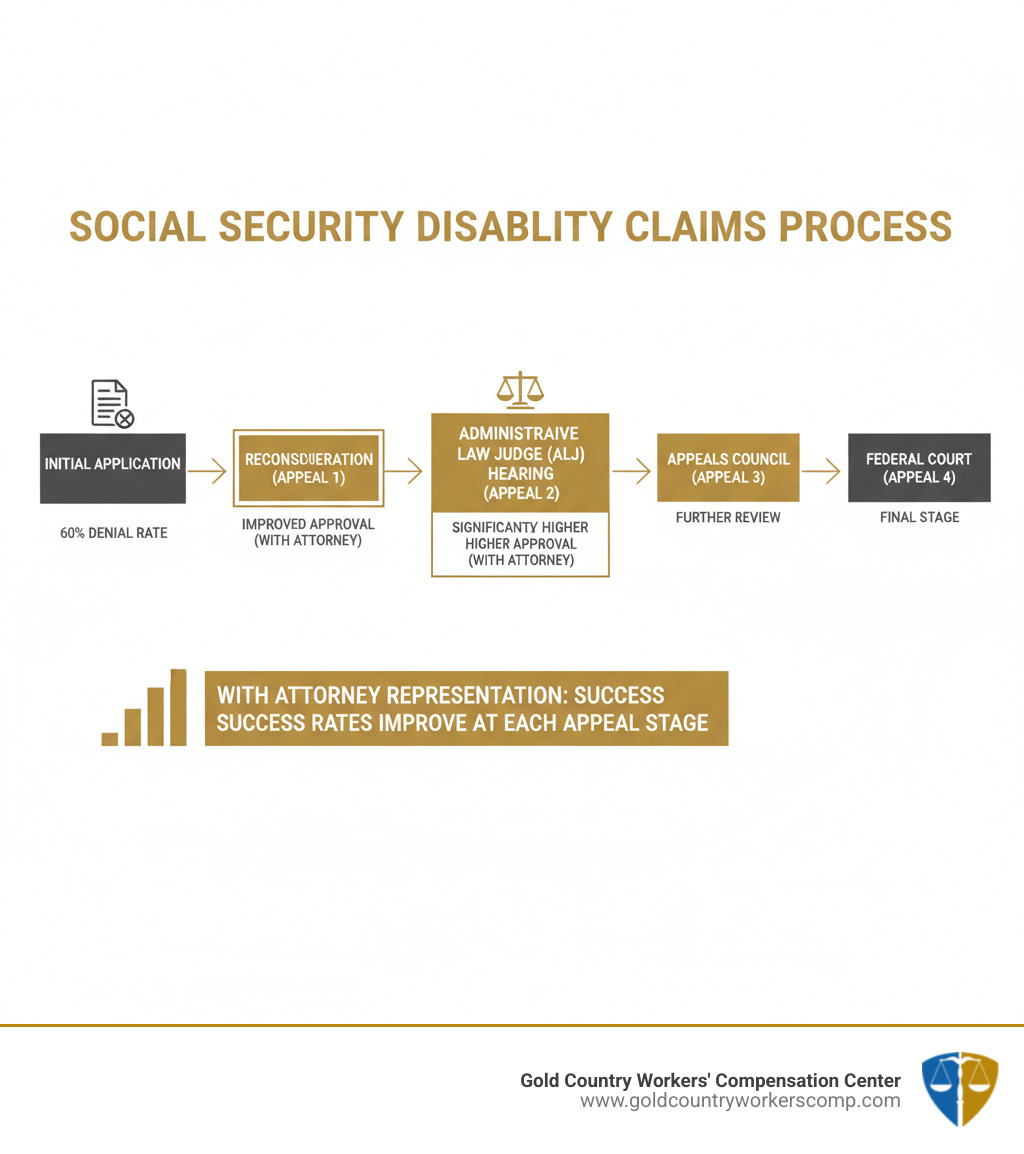
infographic showing social security disability claims process with 60% initial denial rate, appeal stages including reconsideration, administrative law judge hearing, appeals council, and federal court, with success rates improving at each stage with attorney representation - best social security disability lawyers near me sacramento ca infographic

Best social security disability lawyers near me sacramento ca definitions:

Understanding the SSD Landscape: SSDI vs. SSI

If you’re searching for the best social security disability lawyers near me sacramento ca, understand which program you’re applying for. The Social Security Administration (SSA) runs two main disability programs: Social Security Disability Insurance (SSDI) and Supplemental Security Income (SSI). Both provide financial support, but they have completely different eligibility rules. Applying for the wrong one can cause significant delays or denial.

Key Differences in Eligibility

Think of SSDI as an insurance policy you’ve paid into through Social Security taxes while working. Your eligibility depends on earning enough “work credits.” The number of credits you need is based on your age when your disability began.

SSI is a needs-based program for people with disabilities who have very limited income and resources, regardless of their work history. To qualify, your financial situation must meet strict federal guidelines.

Both programs share a core requirement: your disability must be severe enough to prevent you from performing Substantial Gainful Activity (SGA). This means your condition stops you from doing your previous job or adjusting to other work, and it must be expected to last at least 12 months or result in death.

Which Program is Right for You?

Your work history is the primary factor. If you’ve worked and paid Social Security taxes, SSDI is likely the correct program. If you have limited income and assets, SSI may be the right fit. It’s also possible to qualify for both programs simultaneously, which are known as “concurrent benefits.”

Getting this right on your application is challenging. An experienced lawyer can evaluate your work history, income, and resources to ensure your application is positioned for the best possible outcome from the start.

Criteria Social Security Disability Insurance (SSDI) Supplemental Security Income (SSI)
Funding Source Social Security taxes paid by workers, employers, and self-employed people General tax revenues (not Social Security taxes)
Eligibility Disabled, with sufficient work credits from past employment Disabled, blind, or aged (65+), with limited income and resources
Work History Required (based on age and disability onset) Not required
Financial Need Not based on income/assets (beyond SGA limits) Based on low income and resources
Associated Health Benefits Medicare (after a waiting period) Medicaid (typically immediately upon approval, depending on state)
Benefit Amount Varies based on lifetime average earnings Federally set, can be supplemented by state (e.g., California)
Family Benefits Possible for dependents Generally not available for family members (except eligible spouses)
Typical Applicant Individuals with a work history who can no longer work due to disability Low-income individuals with disabilities, or aged, or blind
Application Process SSA website, phone, or in-person SSA website, phone, or in-person
Appeals Process Reconsideration, ALJ Hearing, Appeals Council, Federal Court Reconsideration, ALJ Hearing, Appeals Council, Federal Court

The Social Security Disability Process in California

The path to getting Social Security Disability benefits in California is a marathon, not a sprint. Understanding the journey ahead—and its common pitfalls—can make all the difference.

The process begins with your initial application, filed online, by phone, or in person. This is where you provide comprehensive details about your medical condition, work history, and daily limitations. After you file, the initial decision typically takes three to six months.

Unfortunately, more than 60% of initial applications are denied. A denial is not the end of the road. It’s the start of the appeals process, which includes several stages:

  1. Reconsideration: A new SSA examiner reviews your case.
  2. Administrative Law Judge (ALJ) Hearing: This is a critical stage where over 50% of claims that reach this level are approved.
  3. Appeals Council: A review of the ALJ’s decision.
  4. Federal Court: The final stage of appeal.

Each stage is another chance to strengthen your case, but it also adds significant time to the process.

flowchart illustrating the social security disability application and appeals process - best social security disability lawyers near me sacramento ca

How Long Does the SSD Process Take in Sacramento?

Patience is essential. While an initial decision takes a few months, the appeals process can stretch the timeline considerably. An ALJ hearing, for example, can add 12 to 18 months or more due to backlogs. From start to finish, a case can take anywhere from several months to over two years.

The key takeaway? Don’t give up after an initial denial. Persistence pays off, especially with an experienced legal guide.

Common Reasons Your Claim Might Be Denied

Understanding why claims are denied can help you avoid common mistakes:

  • Missing medical records: The SSA needs complete, detailed medical evidence from your doctors to approve a claim.
  • Not meeting the definition of disability: The SSA may decide your condition isn’t severe enough or that you could perform other types of work.
  • Earning over the SGA limit: If you’re working and earning more than the Substantial Gainful Activity (SGA) threshold, the SSA will assume you are not disabled.
  • Not following doctor’s orders: Failing to follow prescribed treatment can lead the SSA to believe your condition isn’t as serious as you claim.
  • Application errors: Simple mistakes or incomplete forms can sink your claim before it gets a fair review.

Working with the best social security disability lawyers near me sacramento ca is crucial for avoiding these pitfalls and building a strong case from the start.

How a Top Sacramento Disability Lawyer Can Win Your Case

While the initial 60% denial rate seems daunting, the odds improve dramatically with an experienced disability lawyer. Many attorneys report success rates of 80-90% or higher. This isn’t luck—it’s the result of expertise and strategic case building.

A top Sacramento disability lawyer acts as your advocate and strategic partner. While non-attorney advocates can represent you, a licensed attorney has comprehensive legal training and can represent you at all levels of appeal, including federal court.

Your lawyer will start with a thorough case evaluation, identifying and strengthening potential weaknesses. They handle all communication with the SSA, manage deadlines, and work to maximize your back pay. Most importantly, they represent you at hearings, using their legal knowledge to build a winning case.

The Critical Role of Medical Evidence

The SSA requires objective proof of your disability. A lawyer is invaluable in this area, as they know exactly what kind of medical evidence is needed and how to obtain it. They work with your doctors to develop comprehensive records that paint a complete picture of your condition and its impact on your life.

This includes seeking detailed opinions from your physicians about your specific functional limitations—what you can and cannot do. Your lawyer translates complex medical information into terms the SSA understands, drawing a direct line between your diagnosis, your symptoms, and your inability to work.

For more information on how the SSA evaluates claims, visit the Social Security Administration’s Disability Benefits page.

The ALJ hearing is often the most critical stage of the process and where many cases are won. Your lawyer’s role here is indispensable.

  • Preparation: They will thoroughly prepare you for your testimony, helping you clearly articulate how your disability affects you.
  • Cross-Examination: The ALJ often calls on medical and vocational experts. Your lawyer will cross-examine these experts, challenging opinions that don’t align with your actual limitations.
  • Local Knowledge: Experienced Sacramento attorneys are often familiar with local ALJs and understand what they look for in a successful case.
  • Legal Argument: Your lawyer will present a compelling legal argument, tying all the evidence together to prove you meet the SSA’s strict definition of disability.

lawyer and client reviewing documents in an office setting - best social security disability lawyers near me sacramento ca

Your Checklist for Finding the Best Social Security Disability Lawyers Near Me Sacramento CA

Choosing the right legal partner is critical. When you’re looking for the best social security disability lawyers near me sacramento ca, focus on these key factors to find an advocate who will treat you with respect and fight for your case.

Factor 1: Verifiable Experience and Specialization

In Social Security Disability law, experience is paramount. Look for an attorney with 10+ years of dedicated experience who specializes exclusively in this field. A specialist stays current on all regulations and has a deep understanding of the system. Local Sacramento expertise is also a major advantage, as these lawyers are familiar with the tendencies of local SSA offices and Administrative Law Judges (ALJs).

Factor 2: A Strong Track Record and Positive Reviews

Results matter. A firm with a success rate over 80-90% demonstrates its effectiveness. Beyond statistics, read client testimonials and peer ratings on sites like Justia or Super Lawyers. Look for comments about clear communication, respect, and feeling heard. Positive reviews from both clients and peers are a strong indicator of a trustworthy and effective lawyer.

Factor 3: Understanding the Fee Structure for the best social security disability lawyers near me sacramento ca

Fortunately, you don’t need money upfront to hire a top disability lawyer. Nearly all work on a contingency fee basis, which is regulated by the SSA.

Here’s how it works: you pay nothing unless you win your case. The fee is 25% of your past-due benefits (or “back pay”), capped at $7,200. The SSA pays your attorney directly from your back pay award, so you never have to write a check. If you don’t win, you owe no attorney fees. This system ensures your lawyer is fully motivated to win your case.

At Gold Country Workers’ Comp Center, we’ve spent nearly 50 years helping people in situations just like yours. Our approach emphasizes early intervention and personalized attention, and we never charge for that initial consultation. Based in Grass Valley, just north of Sacramento, Kim LaValley and Kyle Adamson have built their practice on one simple principle: helping people resolve their issues with positive outcomes. If you’re searching for the best social security disability lawyers near me sacramento ca, we invite you to reach out. Let’s talk about your situation and explore how we can help.

Frequently Asked Questions about Sacramento SSD Claims

Navigating the SSD process brings up many questions. Here are answers to some of the most common concerns we hear.

What are the key qualifications for Social Security Disability benefits?

To qualify, you must meet several criteria:

  • Your medical condition must prevent you from performing Substantial Gainful Activity (SGA), meaning you cannot earn above a certain monthly income limit.
  • Your condition must be severe enough to significantly limit basic work activities like sitting, standing, lifting, or remembering.
  • Your disability must have lasted, or be expected to last, for at least 12 continuous months or result in death.
  • For SSDI, you need sufficient work credits from paying Social Security taxes.
  • For SSI, you must have limited income and financial resources.

What are some common disabling conditions that qualify for benefits?

While the diagnosis alone isn’t enough, many conditions can qualify if they are severe enough to prevent work. What matters is the functional limitation caused by the condition. Common examples include:

  • Musculoskeletal issues: Chronic back pain, degenerative disc disease, severe arthritis.
  • Mental health conditions: Severe depression, anxiety, PTSD, bipolar disorder.
  • Cancer: Especially advanced cases or those requiring intensive treatment.
  • Neurological disorders: Multiple sclerosis (MS), Parkinson’s disease, epilepsy, effects of a stroke.
  • Cardiovascular conditions: Congestive heart failure, coronary artery disease.
  • Autoimmune diseases: Lupus, rheumatoid arthritis, Crohn’s disease.

How can a lawyer help find the best social security disability lawyers near me sacramento ca?

This question is often about how a lawyer can help you win your claim. An experienced disability lawyer is your most powerful asset. They help by:

  • Ensuring your application is complete and accurate, avoiding common errors that lead to denial.
  • Gathering crucial medical evidence and working with your doctors to document your limitations effectively.
  • Managing the entire appeals process, from filing for reconsideration to representing you at your ALJ hearing.
  • Building a persuasive legal case by preparing you to testify, cross-examining experts, and arguing on your behalf.

Essentially, a lawyer takes the burden of navigating this complex system off your shoulders, dramatically increasing your chances of success. At firms like Gold Country Workers’ Comp, with nearly 50 years of experience, we fight for you every step of the way.

Conclusion: Take the Next Step Towards Securing Your Benefits

We understand how overwhelming this journey can feel. You’re dealing with a life-changing disability while facing a bureaucratic system that seems designed to say “no.” The high initial denial rate is a real barrier, but it’s one you don’t have to face alone.

The right legal representation can transform your chances. An experienced disability lawyer knows how to build a strong case, steer the appeals process, and advocate for you effectively. Look for a specialist with a proven track record, deep experience, and a commitment to their clients.

Don’t delay your claim. Time is critical. The sooner you get expert help, the sooner you can build a winning case and secure the benefits you need.

At Gold Country Workers’ Compensation Center, we’ve spent nearly 50 years helping people in Roseville, Nevada City, and throughout California. We believe in early intervention and never charge for an initial consultation.

Kim LaValley and Kyle Adamson are here to offer the strength, knowledge, and personalized attention your case deserves. If your claim has been denied or you’re just starting the process, reach out to us. Let’s discuss your situation and how we can help you secure your future.

Sacramento skyline at sunset - best social security disability lawyers near me sacramento ca

Find out more about our disability law firm services and take that first step toward securing your future today.