

Don’t Give Up: The Social Security Disability Appeals Process
Receiving a denial for your social security disability appeals application can be devastating. You’re not alone: the Social Security Administration (SSA) denies about two-thirds of initial applications. But don’t give up—you have the right to appeal.
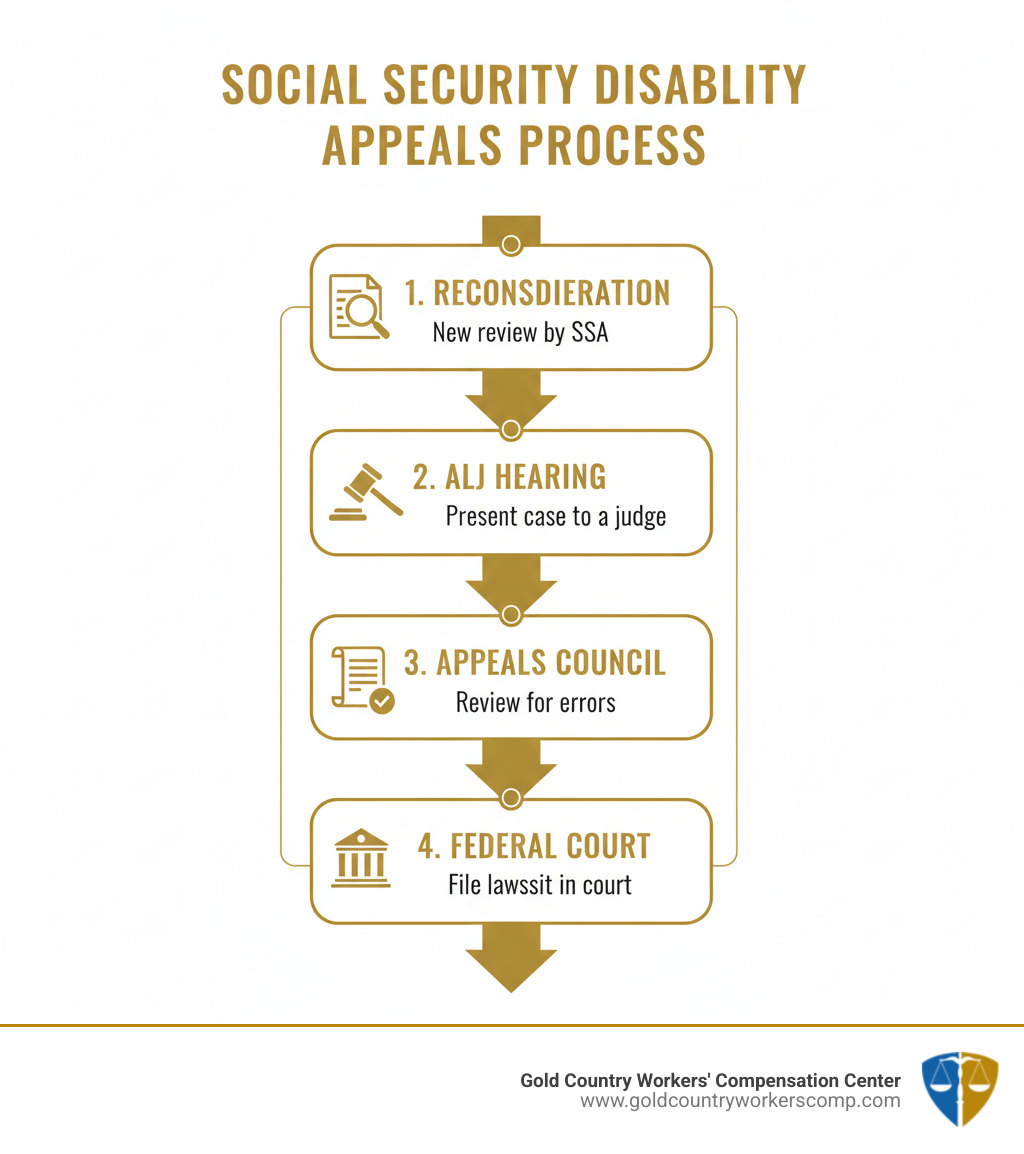
Here’s a quick overview of the social security disability appeals process:
- Reconsideration: Your case is reviewed by a new examiner at the SSA.
- Hearing with an Administrative Law Judge (ALJ): You present your case to a judge.
- Appeals Council Review: The Appeals Council checks the ALJ’s decision for errors.
- Federal District Court Action: You can file a lawsuit in federal court.
A denial is not the end of the road, as many successful claims are initially denied. Administrative law judges overturn nearly half of the denials they review, so persistence is your best strategy. This guide will walk you through each step of the social security disability appeals process, giving you the knowledge to fight for the benefits you deserve.
First Move: Understanding Your Denial and Filing for Reconsideration

After receiving a denial letter, remember this is just the first hurdle in the social security disability appeals process. The most important thing is to act quickly. You have a strict 60-day deadline from the date you receive the denial notice to file an appeal. The Social Security Administration (SSA) assumes you receive the notice five days after the date on the letter, so your real deadline may be shorter. Missing this deadline could force you to start your application over, delaying benefits and reducing potential back pay.
You can file your appeal online, by mail, or by fax. For general guidance on filing online, refer to the SSA’s publication: How To File Your Disability Appeal Online. You can check your appeal’s status by logging into your “my Social Security” account at ssa.gov/myaccount.
What is a Reconsideration?
Reconsideration is the first appeal step, where the SSA gives your case a second look. A new examiner who was not involved in the first decision conducts a complete review of your claim, ensuring an unbiased perspective.
- Medical Denials: If your claim was denied for medical reasons, a new examiner from a Disability Determination Services (DDS) office will review your original application, all submitted evidence, and any new medical information you provide.
- Non-Medical Denials: If the denial was for non-medical reasons (e.g., income limits for SSI or work credits for SSDI), a different SSA employee will review your request to ensure the rules were applied correctly.
In both cases, the reviewer examines all evidence—old and new—to see if the initial decision was correct. The SSA will review the entire determination, even parts that were in your favor. If your benefits were stopped, specific benefit continuation rules might allow payments to continue during your appeal, but these have strict requirements.
How to File for Reconsideration
To file for reconsideration, you’ll need your personal information (name, SSN, contact info), the date you received your denial, and complete medical information. This includes contact details for all healthcare providers, dates of service, and a comprehensive medication list. Most importantly, gather any new evidence, such as recent medical records or test results.
You have several ways to submit your request:
- Online: This is the quickest method. You can Start your disability reconsideration request online. To finish a saved application, Enter your re-entry number to finish your disability request. For non-medical reconsiderations, Start non-medical request.
- By Mail or Fax: Download and complete Form SSA-561-U2 (Request for Reconsideration). Mail or fax it to your local Social Security office. Use the Social Security Office Locator to Find your local Social Security office in California.
- By Phone: For assistance, call the SSA toll-free at 1-800-772-1213 (TTY: 1-800-325-0778).
Your goal is to present a clear picture of how your medical condition prevents you from working, supported by any new evidence that strengthens your claim.
The ALJ Hearing: Your Best Chance in the Social Security Disability Appeals Process

If your reconsideration is denied, the next step in the social security disability appeals process is a hearing before an Administrative Law Judge (ALJ). This is often your best chance to win. ALJs are known to overturn nearly half of the denials they review.
With a representative, your chances improve. Nationally, 56% of represented applicants receive benefits, compared to only 33% without. At Gold Country Workers’ Compensation Center, our clients see even higher approval rates: a remarkable 69%, well above the national average of 45%.
The ALJ assigned to your case is new to your file, bringing an unbiased perspective. The hearing is a private, non-adversarial proceeding. There is no opposing lawyer; the ALJ’s goal is to gather facts and make a fair decision. The judge will ask about your medical history, treatments, symptoms, daily life, and work history. This is your opportunity to explain, in your own words, how your disability affects your ability to work.
A medical expert or a vocational expert may also attend to provide testimony on your health conditions or your ability to perform other types of work. Their insights help the ALJ understand the full picture of your disability.
Preparing for Your ALJ Hearing
Preparation is essential for a successful ALJ hearing. We advise clients to review their case file, organize all evidence, and prepare their testimony to clearly explain their condition and its daily limitations.
You will receive a hearing notice at least 75 days in advance. Hearings can be in person, by phone, or via video. If you must travel more than 75 miles one way, the SSA may help with travel costs, which is beneficial for those in rural California areas like Nevada City or even those coming from Roseville.
If you cannot attend your scheduled hearing, you must notify the SSA in writing as soon as possible with a good reason. If the ALJ finds your reason insufficient, your request may be dismissed.
Key Evidence for Your social security disability appeals
The success of your social security disability appeals hinges on strong evidence. For your ALJ hearing, you should present:
- Updated Medical Records: All recent doctor’s notes, hospital records, lab results, and imaging scans.
- Doctor’s Reports: Detailed reports from your treating physicians stating your diagnosis, prognosis, and work-related limitations.
- Function Reports: Forms describing your daily activities and how your symptoms interfere with them.
- Witness Statements: Written statements from family, friends, or former employers describing how your disability affects you.
- Expert Witness Testimony: In some cases, testimony from a physical therapist or rehabilitation specialist can clarify your functional limitations.
- Submitting Evidence: You must submit all written evidence and objections no later than five business days before your hearing. Requests for subpoenas must be filed at least 10 business days before the hearing.
The more current and comprehensive your medical evidence, the stronger your case.
Advanced Strategy: Navigating Higher Levels of Appeal
If the ALJ denies your claim, the social security disability appeals process continues to the Appeals Council and, if necessary, Federal District Court. These higher levels have lower success rates and involve more complex legal arguments, but they are vital avenues to explore for your claim.
The Role of the Appeals Council
If the ALJ’s decision is unfavorable, you can ask the Appeals Council (AC) to review it. You have 60 days from receiving the ALJ’s denial to file this request. The AC acts as a quality control check, reviewing the decision for legal or factual errors.
The AC will examine your entire case file to determine if:
- The ALJ made a legal mistake.
- The decision was supported by substantial evidence.
- There is new and important evidence that could change the outcome.
Submitting new evidence to the AC is difficult. It must be new, material (important to your case), relate to the period before the ALJ’s decision, and have a good chance of changing the outcome. It is always best to submit all evidence by the ALJ hearing stage.
The Appeals Council can:
- Deny Review: This is the most common outcome, upholding the ALJ’s decision.
- Grant Review and Issue a Decision: The AC may review the case and issue its own decision.
- Remand the Case: The AC can send the case back to an ALJ for a new hearing if it finds a significant error.
You can request a review online via the SSA’s “AC iAppeal Online” process by selecting “Start an Appeal” at AC iAppeal Online, or you can mail Form HA-520.
Filing a Federal District Court Action
If the Appeals Council denies your review, your final step is to file a civil lawsuit in a U.S. Federal District Court. You have 60 days after receiving the AC’s decision to file this lawsuit (the SSA typically adds five days for mail delivery).
This stage involves complex federal civil law. Due to the complexity, an experienced legal team is essential. Our attorneys at Gold Country Workers’ Compensation Center are experienced in these intricate legal processes, ensuring your case is presented effectively in federal court.
Why Appealing is a Smarter Play Than Reapplying
After a denial, you may be tempted to start over with a new application instead of appealing. However, appealing your initial denial is almost always the smarter strategy.
Why is appealing better than reapplying? First, appealing preserves your original application date. This is critical for calculating your potential “back pay”—the benefits owed from your disability onset date until your approval. If you reapply, you establish a new, later application date, which can significantly reduce or even eliminate the back pay you might receive, potentially costing you thousands.
Additionally, there is a five-month waiting period for benefits after your disability onset date. If you appeal, this waiting period starts from your original claim’s onset. Reapplying triggers a new five-month waiting period after your new approval, further delaying financial support.
Appealing also saves time and effort. You are continuing an existing process, building on the evidence you’ve already submitted. Reapplying means starting from scratch—filling out all the forms and gathering all your records again, facing the same high initial denial rates.
By appealing, especially to the ALJ Hearing level, your chances of success improve dramatically. Many denials are overturned at this stage. By choosing to appeal, you are not just saving time and maximizing potential back pay; you are also significantly improving your odds of approval.
In summary, appealing allows you to:
- Preserve your original application date to maximize back pay.
- Avoid a new five-month waiting period for benefits.
- Build on your existing application, saving time and effort.
- Increase your chances of approval, especially at the ALJ hearing stage.
Frequently Asked Questions about social security disability appeals
How long does the appeals process typically take?
The timeline for the social security disability appeals process varies by stage, case complexity, and location. While there are no set timelines, you can generally expect:
- Reconsideration: 3 to 5 months.
- ALJ Hearing: A year or even longer, depending on the backlog at your local Office of Hearing Operations (OHO). Caseloads vary throughout California, from Grass Valley to Roseville.
- Appeals Council or Federal Court: These higher levels can add many more months or even years to the process.
The entire appeals process can easily take a year or more. Patience and persistence are essential.
Can my benefits continue while my appeal is pending?
Yes, under certain circumstances, your benefits can continue during an appeal, particularly if the SSA has stopped your benefits.
If the SSA determines you are no longer disabled due to medical improvement (a “medical disability cessation”), you can request that your benefits continue. You must make this request in writing within 10 days of receiving the cessation notice—a critical deadline. Be aware that if you lose the appeal, you may have to repay these benefits.
For Supplemental Security Income (SSI), you may also be able to continue receiving payments if they were reduced or suspended for non-medical reasons. You must request reconsideration within 10 days of receiving that notice.
What are the advantages of working with a Social Security disability lawyer?
While not legally required, working with a disability lawyer significantly increases your chances of success. Nationally, applicants with representation are far more likely to be approved.
At Gold Country Workers’ Compensation Center, 95% of our clients recover benefits, and 69% are approved at the hearing level, compared to the national average of 45%. These statistics represent real people in Grass Valley, Nevada City, and Roseville who secured the benefits they needed.
A lawyer helps by:
- Navigating Deadlines: The appeals process is full of critical deadlines for filing appeals and submitting evidence. We ensure nothing is missed.
- Gathering Evidence: With nearly 50 years of experience, we know what medical evidence is most persuasive to the SSA and ALJs. We help you obtain detailed doctor’s reports and prepare compelling testimony.
- Preparing for Hearings: We prepare you for what to expect from the ALJ, how to answer questions, and how to clearly explain your limitations.
Most importantly, we work on a contingency fee basis. You pay no fees unless we win your case. Our fee is capped by federal law (typically 25% of your back pay, up to a set maximum). This makes quality legal help accessible to everyone. At Gold Country Workers’ Compensation Center, Kim LaValley and Kyle Adamson believe early intervention makes all the difference.
Conclusion: Winning the Game with the Right Partner
The social security disability appeals process is a marathon, not a sprint. A denial is just the opening move, not the end of the game. As this guide has shown, persistence pays off, with nearly half of all denials being overturned at the ALJ hearing level.
Professional guidance dramatically improves your odds. People with representation at their hearing are significantly more likely to win. At Gold Country Workers’ Compensation Center, our track record reflects this: 95 percent of our clients successfully recover benefits, and our 69% approval rate at the hearing level is far above the national average of 45%.
Experience, preparation, and genuine care make the difference. With nearly 50 years of combined experience, Kim LaValley and Kyle Adamson understand the system in California, from Grass Valley and Nevada City to Roseville and the greater Sacramento area. We know that behind every claim is a person facing real challenges.
We believe everyone deserves a fighting chance, which is why we offer a free initial consultation and work on a contingency basis—we only get paid when you win. You take no financial risk by getting professional help; you make a smart investment in your future.
Don’t let a denial discourage you. Let us stand beside you, prepare your case, and advocate for your rights.
Get a free case evaluation for your disability appeal and let’s start building your path to success together.


