

When Your SSDI Claim is Denied: Why You Need the Right Legal Support
An SSDI appeal lawyer specializes in helping individuals steer the complex Social Security Disability Insurance appeals process after an initial claim denial. Here’s a quick guide to finding legal representation:
- When to hire: After an initial denial, before an ALJ hearing, or for complex medical issues.
- How they help: Gather medical evidence, meet strict deadlines, prepare testimony, and represent you at hearings.
- Cost: Contingency fee basis (no fee unless you win), capped at 25% of back pay up to $7,200.
- Success rates: Claimants with legal representation win benefits far more often than those without.
- Timeline: Appeals can take 12-18 months or longer.
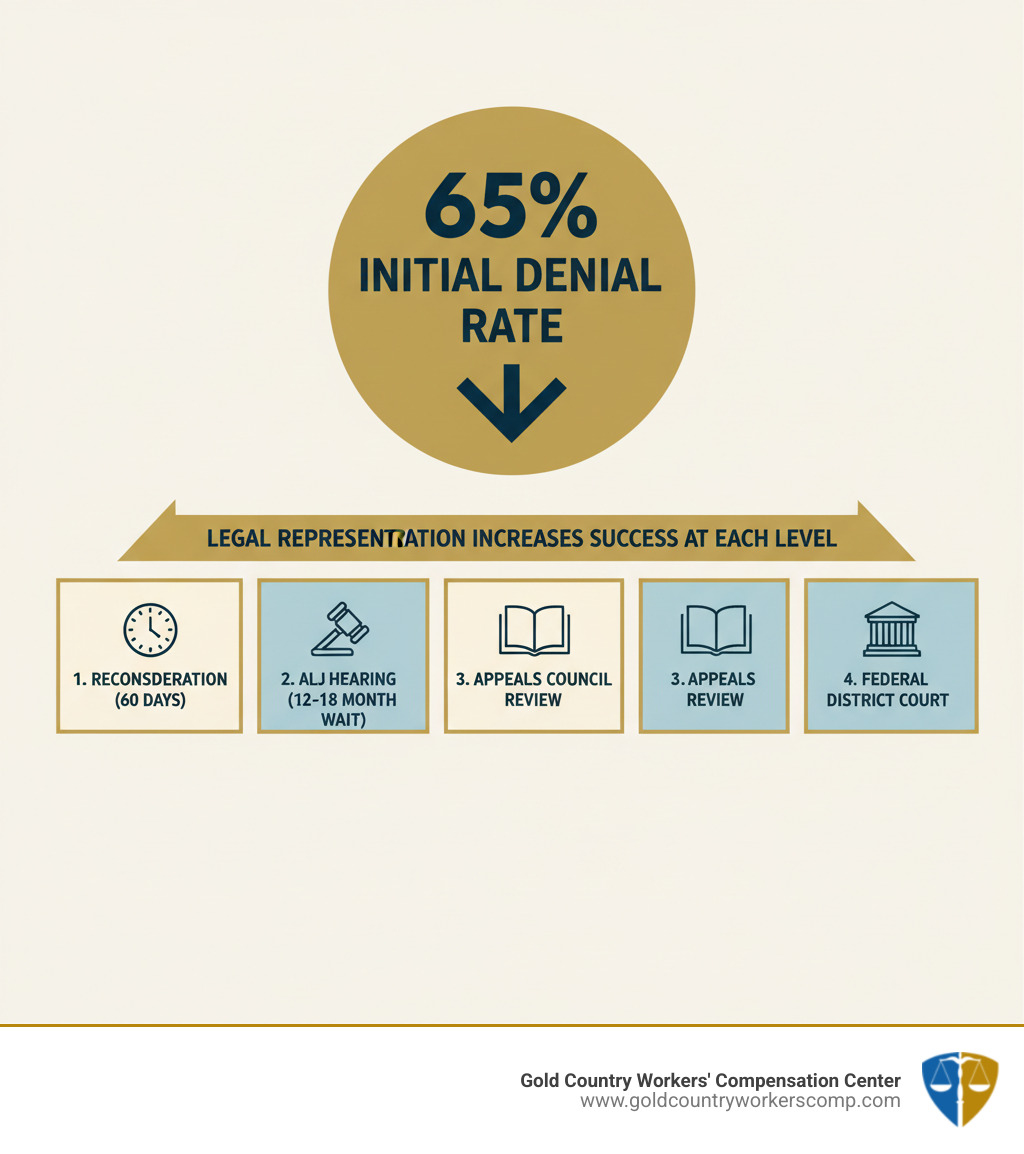
The statistics are sobering: the Social Security Administration (SSA) denies most initial SSDI claims, and many applicants wait over two years for payment. But a denial isn’t the end. The SSA often approves claims on appeal, which is where experienced legal guidance becomes critical.
The appeals process has four levels, each with strict 60-day deadlines. Missing a deadline or failing to submit the right evidence can jeopardize your benefits. For someone already struggling with a disability, the process can feel overwhelming.
The good news is you don’t have to face it alone. The right legal support significantly increases your chances of securing the benefits you’ve earned.
Understanding Why Your SSDI Claim Was Denied
Receiving a denial letter is frustrating, but it doesn’t mean your case is hopeless. Most initial SSDI claims are denied, often for technical reasons rather than the reality of your condition. Understanding these reasons is the first step to building a successful appeal.
Common reasons for denial include:
- Insufficient medical evidence: This is the top reason for denial. The SSA needs detailed proof of how your condition prevents you from working, not just a diagnosis. Your medical records must clearly spell out your functional limitations.
- Technical issues: You might be denied if you haven’t earned enough work credits or if you’re earning above the Substantial Gainful Activity (SGA) limit.
- Failure to follow treatment: If you stop seeing your doctor or taking medication without a documented reason (like cost or side effects), the SSA may deny your claim.
- Condition not severe enough: Your condition may be debilitating, but if it doesn’t meet the SSA’s strict legal definition of disability, your claim will be denied.
- Application errors: Missing information or mistakes on your application can sink your claim before it starts.
Most denials happen because the claim failed to prove the applicant meets the SSA’s legal definition of “disabled.” This is a critical distinction and where an SSDI appeal lawyer provides invaluable help.
The SSA’s Definition of Disability
The SSA’s definition of disability is strict. You are considered disabled only if you cannot engage in any “substantial gainful activity” (SGA) due to a medically determinable impairment that is expected to last at least 12 months or result in death.
Crucially, you must be unable to do not just your old job, but any other substantial work that exists in the national economy, considering your age, education, and experience. This high bar is why so many legitimate claims are initially denied.
The Five-Step Evaluation Process
Every SSDI claim goes through a five-step evaluation. Understanding where your claim failed helps build a stronger appeal.
Step 1: Are you working? The SSA checks if you’re earning above the SGA limit ($1,470 per month in 2024). If so, your claim is denied.
Step 2: Is your impairment severe? Your condition must significantly limit basic work activities. Insufficient medical evidence often leads to a denial at this step.
Step 3: Does your condition meet a Blue Book listing? The SSA’s “Listing of Impairments” (Blue Book) contains specific criteria for automatic approval. Meeting a listing is the fastest path to benefits, but the standards are very high.
Step 4: Can you do your past work? If you don’t meet a listing, the SSA assesses your “Residual Functional Capacity” (RFC) to see if you can perform any of your jobs from the past 15 years. If you can, you’re denied.
Step 5: Can you do any other work? If you can’t do your past work, the SSA determines if there is any other work in the national economy you could perform, given your RFC, age, education, and skills. If they decide you can adjust to other work, your claim is denied.
This process is technical and unforgiving. An SSDI appeal lawyer who knows these regulations can make the difference between denial and approval.
The Four Levels of the SSDI Appeals Process
If your initial claim is denied, don’t despair. The SSA has a structured appeals process, but you must act fast: you have only 60 days from the date you receive your denial letter to file an appeal. Missing this deadline can force you to start the entire application process over.
The appeals process has four levels:
For more details, see the Social Security Administration’s official page at Non-Medical Appeal, Social Security.
Level 1: Reconsideration
This is a “second look” at your file by a new examiner. You can submit new evidence to fix gaps in your original application by filing Form SSA-561. While approval rates at this stage are low, it is a mandatory step in most states. You must go through it to move forward, so it’s important to submit the strongest case possible.
Level 2: Administrative Law Judge (ALJ) Hearing
This is often your best chance to win benefits, especially with an SSDI appeal lawyer. Unlike the previous paper reviews, you appear before a judge (in person or by video) to explain how your disability affects your life. The judge can ask questions and see the human side of your claim.
Preparing for this hearing is crucial. You will testify about your condition, symptoms, and work limitations. The hearing may also include a vocational expert (VE) and a medical expert (ME). Your lawyer can cross-examine these experts to challenge unfavorable testimony and highlight evidence that supports your case.
The biggest downside is the wait, which can be 12-18 months or longer. This time should be used to gather more medical evidence and prepare thoroughly.
Level 3: Appeals Council Review
If the ALJ denies your claim, you can ask the Appeals Council to review the decision. The Council does not re-evaluate your condition; it reviews the ALJ’s decision for legal or procedural errors. Did the judge apply the law correctly? Was the decision supported by the evidence?
You must request this review within 60 days. The Council can deny your request, send (remand) the case back to the ALJ for a new hearing, or, in rare cases, approve your benefits outright. The SSA provides an Appointed Representative Guide to Requesting Appeals Council Review with more details.
Level 4: Federal District Court
Your final option is to file a civil lawsuit in U.S. District Court. This is a complex legal step where you argue that the SSA’s final decision was legally flawed or not supported by substantial evidence. You are not presenting new medical evidence. These cases can take years and require an experienced attorney. While most cases are won at earlier stages, we can guide you through this final step if necessary.
The Critical Role of an SSDI Appeal Lawyer
Navigating the SSDI appeals process alone is incredibly difficult. The rules are complex, deadlines are strict, and a single mistake can derail your claim. This is where an SSDI appeal lawyer becomes essential.
Statistics show that claimants with legal representation win benefits far more often than those who go it alone. An experienced lawyer understands SSA regulations, knows what evidence is persuasive to judges, and can present your case in the language the system responds to. We develop a legal strategy custom to your situation to cut through the red tape and fight for the benefits you deserve.

When Should You Hire an SSDI Appeal Lawyer?
The best time to hire a lawyer is often the moment you receive a denial letter, as the 60-day appeal clock starts ticking immediately. Other critical times include:
- Before your ALJ hearing: This is your best chance for approval and where professional preparation and representation are most impactful.
- If your medical situation is complex: A lawyer can translate your medical reality into the specific functional limitations the SSA needs to see.
- When you feel overwhelmed: You’re already dealing with a disability. Let a professional handle the bureaucracy so you can focus on your health.
Benefits of Hiring an SSDI Appeal Lawyer
Working with an SSDI appeal lawyer provides concrete advantages:
- We gather the right evidence: We know it’s not just about having medical records, but having the right information that details your functional limitations.
- We meet every deadline: We track all deadlines to ensure your forms are filed correctly and on time.
- We prepare you for your hearing: We help you practice articulating how your disability affects you and prepare you for a judge’s questions.
- We challenge the experts: At your hearing, we can effectively cross-examine vocational and medical experts to expose flaws in their testimony.
- We reduce your stress: We handle the bureaucratic maze, allowing you to focus on your health and family.
How Do SSDI Appeals Lawyers Charge for Their Services?
Hiring an SSDI appeal lawyer requires no upfront money. We work on a contingency fee basis, meaning we only get paid if you win your case. No win, no fee.
The fee is federally regulated by the Social Security Administration. It is capped at 25% of your back pay, with a maximum of $7,200. This fee is paid from your past-due benefits (the lump sum for the months you were disabled but not yet approved) and does not affect your ongoing monthly checks.
At Gold Country Workers’ Comp, we offer an initial consultation with no fee. This allows you to get expert guidance without financial risk. We are motivated to win because that’s the only way we get paid.
Building a Winning Appeal: Evidence and Strategy
Winning an SSDI appeal isn’t about luck; it’s about building a strong case with clear, consistent, and compelling evidence. The most common reason for denial is a lack of medical documentation that proves exactly how your condition prevents you from working.

What Evidence Do You Need to Win?
A strong appeal is built on a foundation of solid evidence. As your SSDI appeal lawyer, we help you gather what’s needed:
- Objective Medical Records: These are the backbone of your case and include MRIs, X-rays, CT scans, blood tests, surgical reports, and therapy notes.
- Doctor’s Opinions and RFC Forms: A diagnosis isn’t enough. A Residual Functional Capacity (RFC) form completed by your doctor explains your specific limitations in a work setting (e.g., how long you can sit, stand, lift, or concentrate). This is critical.
- Witness Statements: Testimony from a spouse, family member, or former coworker can add a powerful human dimension, helping a judge understand what your life is really like.
- Personal Symptom Journal: Documenting your daily pain levels, medication side effects, and struggles creates a consistent record of your impairment over time.
How Does Age Factor into an SSDI Appeal?
Age is a significant factor in SSDI claims. The SSA’s “Grid Rules” (Medical-Vocational Guidelines) recognize that it becomes harder to adapt to new work as you get older. These rules can be the deciding factor in a case.
- Under 50: The SSA generally assumes you can adapt to new types of work. Winning requires strong medical evidence of severe limitations.
- Age 50-54 (“Closely approaching advanced age”): The rules become more favorable. The SSA acknowledges that learning new skills is harder, especially if you have limited education or non-transferable skills.
- Age 55+ (“Advanced age”): Approval rates increase significantly. The SSA presumes your ability to adjust to new work is severely limited, particularly if you have a history of physical labor.
We use our understanding of these rules to build the strongest legal strategy for your case.
What if My Condition Worsened After the Denial?
If your health has deteriorated since your initial denial, this new information can significantly strengthen your appeal. It’s crucial to continue seeking medical treatment and documenting every change.
We will work with you to submit all new medical evidence that shows your condition has progressed and your functional capacity has declined. In some cases, we may argue for a later disability onset date or even explore reopening a prior claim. Ongoing medical evidence is vital for proving your case on appeal, and we ensure it becomes part of the story we tell on your behalf.
Frequently Asked Questions about SSDI Appeals
After nearly 50 years of helping clients with disability claims, we’ve answered a lot of questions. Here are some of the most common.
What is the difference between SSDI and SSI?
SSDI and SSI are both federal disability programs, but they have key differences. An SSDI appeal lawyer can help determine which you may be eligible for.
- Social Security Disability Insurance (SSDI) is an earned benefit based on your work history and the Social Security (FICA) taxes you’ve paid. After 24 months on SSDI, you become eligible for Medicare.
- Supplemental Security Income (SSI) is a needs-based program for those with limited income and assets, regardless of work history. To qualify, you must meet strict financial limits. SSI recipients usually qualify for Medicaid immediately.
| Feature | SSDI | SSI |
|---|---|---|
| Based on | Work history and Social Security taxes paid | Financial need (low income and assets) |
| Benefit amount | Varies based on your earnings history | Standard federal rate (generally lower) |
| Health coverage | Medicare after 24 months | Medicaid (usually immediate) |
| Asset limits | None (beyond SGA for work) | Yes—$2,000 individual, $3,000 couple |
| Family benefits | May cover eligible dependents | Generally no dependent benefits |
Some people with a low SSDI benefit may qualify for both programs, known as “concurrent benefits.”
Can I get SSDI if my disability is related to alcoholism or drug addiction?
This is a complex area of disability law. You cannot receive SSDI if drug addiction or alcoholism (DAA) is a “material contributing factor” to your disability. The key question the SSA asks is: Would you still be disabled if you stopped using drugs or alcohol?
If the answer is yes—because you have other serious, independent medical conditions (like severe arthritis or heart disease) that would prevent you from working even if you were sober—you may still qualify. Proving this requires careful documentation of your other conditions, separate from any substance use. An SSDI appeal lawyer can be critical in presenting this type of case effectively.
What is a ‘presumptive disability’?
“Presumptive disability” allows the SSA to fast-track payments for people with conditions so severe that approval is almost certain. If you qualify, you can start receiving SSI payments for up to six months while the SSA completes its full review.
This is reserved for the most serious conditions, such as total blindness, amputation of a leg at the hip, a terminal illness with a life expectancy of six months or less, or being confined to a bed or wheelchair. The goal is to provide a financial lifeline to those facing devastating circumstances without a long wait.
Conclusion: Your Path to Securing Benefits
A denial letter from the Social Security Administration is not the final word. It’s a step in a process designed with multiple levels of review. The appeals process exists because the SSA knows initial decisions aren’t always correct, and many genuinely disabled people are approved on appeal, especially with the right legal representation.
With nearly 50 years of combined experience in Disability and Social Security law, our team at Gold Country Workers’ Comp—including Kim LaValley and Kyle Adamson—has seen how a strong appeal can transform a denial into the financial security you deserve. We’ve successfully represented clients throughout California, from our home in Grass Valley to Roseville, Nevada City, and beyond.
Professional guidance is crucial. The difference between representing yourself and having an experienced SSDI appeal lawyer can be the difference between approval and denial. We offer early intervention with no initial consultation fee, so you can get expert help without upfront costs. We only get paid if you win, which means we’re invested in your success from day one.
Don’t face this complex system alone. The benefits you’ve earned are worth fighting for. Contact us today for a free consultation to discuss your SSDI appeal and learn the best path forward.
For more information on our services, including California workers’ compensation, visit our website. We are ready to help you achieve a positive outcome.


