Workers’ Comp and SSDI Together: How the Offset Actually Works

Workers' Comp and SSDI Together: How the Offset Actually Works — Gold Country Workers Comp Center, Nevada City California

Two Systems That Don’t Talk to Each Other — Until They Do

Workers’ compensation and Social Security Disability are entirely separate programs. One is a California system for work-related injuries. The other is a federal insurance program based on your earnings record, and it doesn’t care how you became disabled.

You can qualify for both. Plenty of seriously injured workers do.

What surprises people is that qualifying for both doesn’t mean receiving both in full. Federal law limits the combined total, and the mechanism — the offset — is one of the least understood pieces of either system. It’s also one where decisions made in the workers’ compensation case can change what you receive for years.

The 80% Rule

Since the 1965 Social Security Amendments, federal law has required that disability insurance benefits be reduced when the worker also receives workers’ compensation, so the combined amount does not exceed 80% of the worker’s average current earnings before the disability began.

“Average current earnings” is a defined term with its own calculation methods — it is not simply your last paycheck, and which method applies can materially change the ceiling.

The structure is straightforward even if the arithmetic isn’t: add the two benefits together, compare to 80% of average current earnings, and reduce the excess.

What Counts Toward the Ceiling

Not everything you receive is treated the same way in this calculation, and the details matter.

Periodic workers’ compensation payments — temporary disability checks arriving on a schedule — are the straightforward case. They count, and the offset adjusts accordingly.

Beyond that, the treatment of a particular payment depends on what it actually represents. Amounts genuinely attributable to medical expenses, legal fees, and case costs are treated differently from wage-replacement payments. This is not a technicality to wave at — it is the reason the wording of a settlement can change what you keep for years afterward, which is the subject of the next section.

The Part That Actually Moves the Number: Lump-Sum Settlements

This is where the offset stops being abstract.

When a workers’ compensation case resolves through a lump sum, Social Security doesn’t simply ignore it because it arrived all at once. The lump sum can be prorated — converted to a monthly rate reflecting what would have been paid had the settlement not been made — and that monthly rate feeds the offset calculation.

The consequence: a settlement signed today can affect your Social Security benefits for years.

And critically, how the settlement is documented affects how it’s prorated. Settlement language addressing what the sum represents, what portion covers attorney’s fees and case costs, what portion is allocated to medical treatment rather than wage replacement, and the period over which the payment is intended to be spread can all bear on the offset calculation.

Which produces the single most important practical point in this article:

Settlement language should be drafted with the Social Security consequences in mind — before signing, not after. A workers’ compensation settlement negotiated with no attention to the SSDI side can quietly cost more in reduced federal benefits than it gained in the settlement itself. That’s not a hypothetical failure mode; it’s a common one, and it’s largely invisible until the reduction notice arrives.

When the Offset Ends

  • When the workers’ compensation payments end, the offset based on them generally ends.
  • At full retirement age, disability benefits convert to retirement benefits and the workers’ compensation offset generally does not continue.
  • If average current earnings are recalculated, the ceiling can change.

Should You Apply for SSDI While Your Comp Case Is Open?

Frequently yes — but coordinate the two rather than running them separately.

Reasons to apply without waiting:

  • SSDI has its own deadlines, including insured-status requirements that can expire. Waiting can cost eligibility outright.
  • SSDI takes a long time. Initial decisions, reconsideration, and a hearing can span a very long stretch. Starting late means waiting late.
  • Your medical record is being built right now in the comp case, and much of it supports the SSDI claim.

Reasons to coordinate rather than silo:

  • Statements in one case can be used in the other. Descriptions of your work capacity need to be accurate and consistent, because inconsistencies get exploited.
  • The comp settlement affects the SSDI offset, per the section above.
  • The medical evidence that wins an SSDI claim is not identical to what drives a comp rating, and evidence can be developed to serve both.

This is the practical case for having one firm handle both. When the comp attorney and the disability attorney are different people who have never spoken, the coordination that protects you simply doesn’t happen — and the offset is exactly where that failure shows up.

Frequently Asked Questions

Can I get workers’ comp and SSDI at the same time?

Yes. They’re separate programs with separate eligibility. The offset limits the combined total you keep.

What’s the 80% rule?

Federal law generally caps combined workers’ compensation and Social Security disability benefits at 80% of average current earnings before disability, reducing the excess.

Will my lump-sum settlement reduce my SSDI?

It can. Lump sums may be prorated to a monthly rate for offset purposes, and how the settlement is documented affects the calculation. Address this before signing.

Does the offset last forever?

No. It generally ends when the workers’ compensation payments end, and does not generally continue past full retirement age.

Do I need separate lawyers for each case?

You don’t, and there are real advantages to not having them. The two cases share medical evidence and interact at settlement.

Handle Them Together

Most firms do workers’ compensation or Social Security Disability. This one has done both for decades — which matters most at exactly the moment described above, when a comp settlement is on the table and nobody has calculated what it does to the federal benefit.

Kim LaValley and Kyle Adamson represent injured and disabled workers throughout Nevada County, Placer County, and the Sacramento region. If you have a comp claim, a disability claim, or both, call 530-362-7188. There’s no charge for the conversation.

More about our California workers’ compensation and California disability practices.


This article is general information about California workers’ compensation and federal Social Security Disability law and is not legal advice. The offset calculation, and the question of how it applies to a particular California claim, depend on facts specific to your case. Do not make settlement decisions based on this article. Speak with an attorney who handles both systems. Authoritative sources: the Social Security Administration and the California Division of Workers’ Compensation.

Working While on SSDI in 2026: SGA Limits and the Trial Work Period

Working While on SSDI in 2026: SGA Limits and the Trial Work Period — Gold Country Workers Comp Center, Nevada City California

The Question People Are Afraid to Ask

You’re receiving Social Security Disability. A former coworker offers you a few hours a week, or you find something part-time you can physically manage, and immediately the fear arrives: if I earn anything, do I lose everything?

A lot of people never ask, and simply don’t work — losing income they could have safely earned. Others work without reporting it and end up with an overpayment notice for tens of thousands of dollars.

Both outcomes are avoidable. Social Security has rules specifically designed to let you test your ability to work. They just aren’t well explained.

Substantial Gainful Activity: the 2026 Numbers

The core concept is substantial gainful activity — SGA. Earning above the SGA threshold generally indicates you’re able to work at a level inconsistent with disability.

For 2026:

  • $1,690 per month — non-blind individuals
  • $2,830 per month — individuals who are blind

These figures adjust annually. Earnings below the threshold generally don’t jeopardize benefits — which is the part most people don’t realize. There is real room to work.

Social Security updates these amounts every year. Before you rely on a specific figure, confirm the current threshold at ssa.gov.

Two refinements that work in your favor:

  • Impairment-related work expenses. Costs you incur because of your disability in order to work can sometimes be deducted from countable earnings, bringing you under the threshold even when gross pay is above it.
  • Subsidies and special conditions. If your employer pays you more than the actual value of your work — extra supervision, reduced duties, accommodations beyond the ordinary — the countable amount may be less than your paycheck.

The Trial Work Period: Nine Months to Find Out

This is the provision worth understanding in detail, because it’s more generous than people expect.

The trial work period lets you test your ability to work for up to nine months within a rolling 60-month window, keeping your full SSDI benefit regardless of how much you earn in those months.

In 2026, a month counts as a trial work month when earnings exceed $1,210.

Three things to hold onto:

  1. The nine months don’t have to be consecutive. They’re counted within the rolling 60-month window.
  2. During a trial work month, earnings don’t reduce your benefit. Even substantial earnings.
  3. The point is to let you try without gambling your entire benefit on whether your body cooperates.

After the nine trial work months are used, an extended period of eligibility follows, during which benefits can be reinstated for months your earnings fall below SGA without filing a whole new application. There are also expedited reinstatement provisions if benefits end because of work and your condition then prevents you from continuing.

The system genuinely is built to let you attempt a return to work. The catch is that the rules are intricate and the consequences of misunderstanding them land on you.

Report Everything. This Is the One That Bites.

If you take one thing from this article: report your work to Social Security.

Report when you start, report your earnings, report changes in hours or pay, and keep copies of what you reported and when.

The reason is overpayments. When Social Security pays you more than you were entitled to — usually because work activity wasn’t reported, or was reported and processed late — it will seek that money back. Frequently years later. Frequently in five figures. Frequently from someone with no ability to repay it.

An overpayment notice is a genuinely serious event. There are avenues — requesting reconsideration if you believe it’s wrong, requesting a waiver if the overpayment wasn’t your fault and repayment would be unfair, or negotiating a payment rate. All are time-limited, which means an overpayment notice is something to act on immediately rather than set aside.

Careful reporting is dramatically easier than fixing an overpayment afterward.

If You Receive SSI, the Rules Are Different

Everything above describes SSDI — the insurance program based on your work record.

SSI is a needs-based program, and it treats earnings very differently: income reduces the benefit on a formula rather than through a trial work period, and resource limits apply. If you receive SSI, or both, don’t apply SSDI work rules to your situation.

People routinely conflate the two programs, and the resulting mistakes are expensive.

Frequently Asked Questions

Can I work while on SSDI?

Yes, within limits. Earnings below the SGA threshold generally don’t jeopardize benefits, and the trial work period allows nine months of higher earnings within a rolling 60-month window.

What is the 2026 SGA amount?

$1,690 per month for non-blind individuals and $2,830 per month for individuals who are blind.

What if my disability prevents me from continuing?

The extended period of eligibility and expedited reinstatement provisions exist for exactly that situation. Get advice promptly rather than reapplying from scratch.

Do I report work even if it’s under SGA?

Yes. Report the work activity regardless. Reporting protects you; silence creates overpayments.

I got an overpayment notice. What now?

Act quickly. Reconsideration and waiver are both available in appropriate cases, and both are time-limited.

Ask Before You Start, Not After

The workers who get this right are the ones who called before accepting the job. The ones who call after an overpayment notice are working a much harder problem.

Kim LaValley and Kyle Adamson have handled Social Security Disability matters for clients throughout Nevada County, Placer County, and the Sacramento region for decades. If you’re considering going back to work — or you’ve received an overpayment notice — call 530-362-7188. The consultation is free.

More about our California Social Security Disability practice.


This article is general information about Social Security Disability and is not legal advice. Program rules, thresholds, and deadlines change, and SSI rules differ substantially from SSDI. For advice about your situation, speak with a disability attorney. Authoritative source: the Social Security Administration.

File Like a Pro: The Complete SSDI Application Process

SSDI application checklist

Why Preparation Makes or Breaks Your SSDI Application

An SSDI application checklist is your roadmap for one of the most complex government processes you’ll face. Here’s what you need to gather before you apply:

Essential Documents for Your SSDI Application:

  • Personal Information: Birth certificate, Social Security number, marriage/divorce records, banking details for direct deposit
  • Medical Evidence: Complete list of medical conditions, all healthcare providers’ contact information, medications, test results, and treatment dates
  • Work History: Detailed employment records for the past 15 years, including W-2 forms, tax returns, job duties, and earnings
  • Education & Training: School completion records, special education details, vocational training certificates

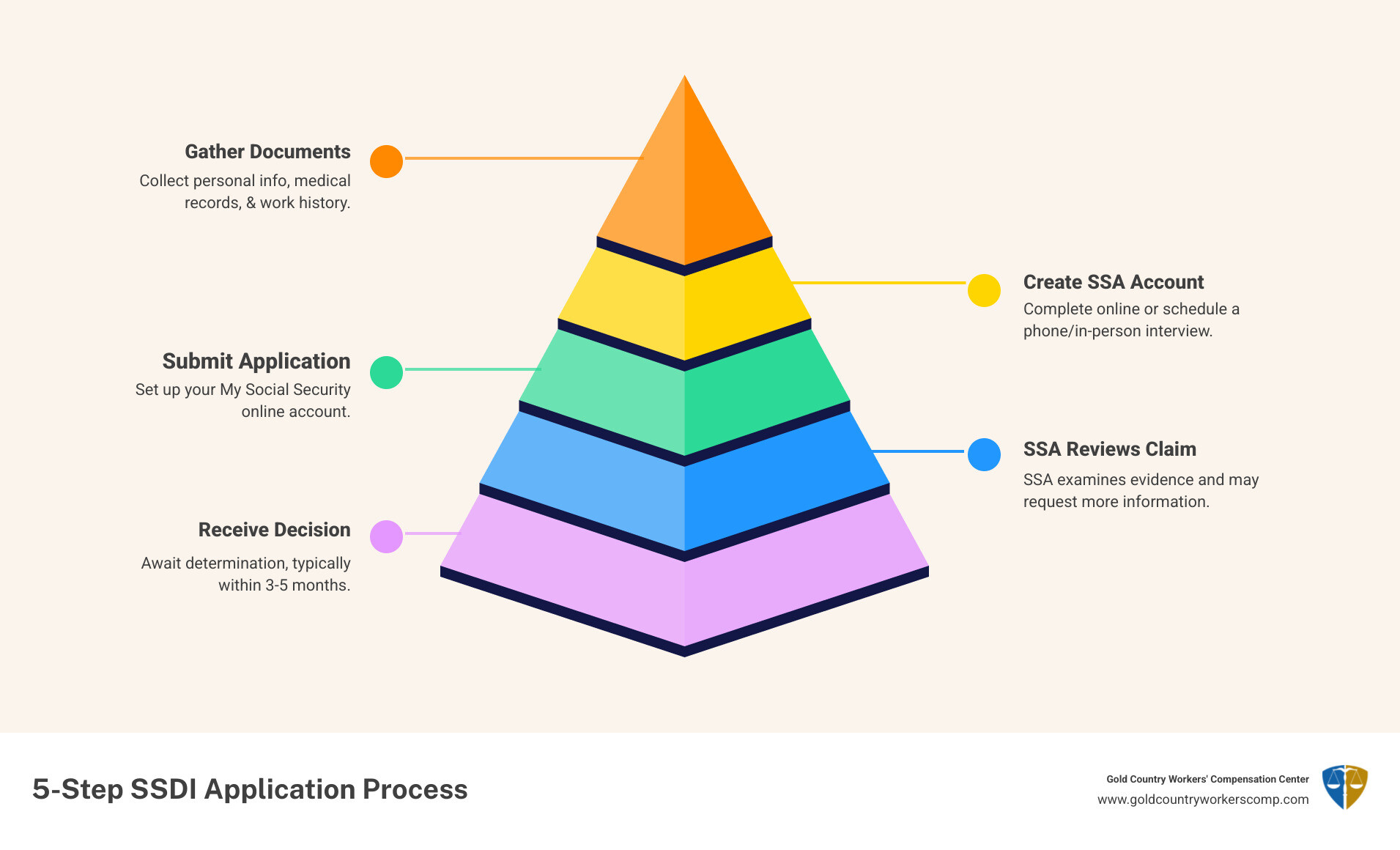
The stakes are high. Approximately 63% of initial SSDI applications are denied, and only 22% of first-time applicants get approved. The initial wait for a decision from the Social Security Administration is typically 3-5 months.

Most denials stem from preventable mistakes like incomplete forms, missing medical records, or gaps in work history. Proper preparation helps you avoid these pitfalls.

The SSA’s definition of disability is strict: you must be unable to do any substantial work (currently defined as earning $1,310 or more per month) because of a medical condition that’s lasted or will last at least one year, or result in death.

While the SSA can help gather records after you apply, providing complete and organized documents upfront dramatically improves your approval chances and speeds up the process.

Infographic showing the 5-step SSDI application process: Step 1 - Gather documents using checklist (personal info, medical records, work history); Step 2 - Create my Social Security account; Step 3 - Complete online application or schedule interview; Step 4 - SSA reviews application and requests additional information; Step 5 - Receive decision (3-5 months). Shows 63% initial denial rate and 22% first-time acceptance rate statistics. - SSDI application checklist infographic pyramid-hierarchy-5-steps

Why a Thorough Checklist is Your First Step to Approval

The SSDI application process is notoriously complex. A thorough SSDI application checklist isn’t just helpful—it’s your lifeline. After nearly 50 years of experience, we’ve seen that proper preparation is what separates successful claims from denied ones.

The Social Security Administration requires solid evidence that you cannot perform Substantial Gainful Activity (SGA)—earning more than $1,310 per month—due to a medical condition that will last at least 12 months or is terminal. With only 22% of first-time applicants approved, most denials stem from preventable paperwork mistakes, not ineligibility.

Gathering all your information before you apply builds a compelling case, reduces delays from Requests for Information (RFIs), and gets you closer to the financial support you need.

The Purpose of an SSDI Application Checklist

Think of your SSDI application checklist as a GPS for navigating bureaucracy. Its purpose is to:

  • Organize information: It gives you one place to track scattered documents, from birth certificates to W-2s.
  • Prevent errors: Methodically working through a list prevents simple mistakes like transposed dates or missing signatures that can derail a strong application.
  • Speed up review: A complete, organized application allows SSA examiners to work efficiently, reducing the need for RFIs and potentially shortening the 3-5 month waiting period.
  • Build a strong case: Each item on the checklist helps tell your story, giving the SSA a full picture of how your disability affects your ability to work.
  • Reduce stress: A clear roadmap turns an overwhelming process into a series of manageable steps, putting you back in control.

Consequences of an Incomplete Application

When applications are incomplete, things go south fast. The consequences include:

  • Application rejection: The SSA may reject a seriously incomplete application, forcing you to start over.
  • Processing delays: Each Request for Information (RFI) for missing details can add weeks or months to the process.
  • Increased chance of denial: With a 63% initial denial rate, incomplete applications are a primary cause. Examiners can’t approve what they can’t verify, so they often default to denial.
  • Need for appeals: A denial leads to a lengthy appeals process, from reconsideration to hearings, all of which could have been avoided with a complete initial application.

Your Complete SSDI Application Checklist

This comprehensive SSDI application checklist is based on official SSA resources, including the Checklist for Online Adult Disability Application (June 2024) and the Adult Disability Starter Kit.

Checklist on a clipboard - SSDI application checklist

Gathering these documents before you apply will save you time and significantly improve your chances of approval.

Part 1: Personal and Household Information

This section covers who you are and the people in your life who may be affected by your claim. The SSA uses this to verify your identity, family situation, and potential benefit amount.

  • Birth certificate: A certified copy is best, but a U.S. passport can also work as proof of age.
  • Social Security Number (SSN): You will need your own SSN, as well as the SSNs for your current spouse and any minor children.
  • Proof of citizenship or alien status: If not a U.S. citizen, have your Permanent Resident Card number and other immigration documents ready.
  • Marriage and divorce records: Gather dates, places, and your spouse’s or former spouse’s SSN and dates of birth or death. This helps determine family eligibility for auxiliary benefits.
  • Children’s information: Full names, dates of birth, and SSNs for all children under 18, children under 19 still in high school, or adult children disabled before age 22.
  • Direct deposit information: Your checking or savings account number and your bank’s 9-digit routing number.
  • Alternate contact person: The name, address, and phone number of a friend or family member who knows about your medical conditions.

Part 2: Comprehensive Medical Evidence

This section is critical. Your medical evidence must prove you cannot work due to your medical conditions. Be thorough.

Medical records and prescription bottles - SSDI application checklist

  • List of medical conditions: List every illness, injury, and diagnosis that limits your ability to work. Be specific (e.g., type and stage of cancer), as the combination of conditions can be crucial.
  • Doctors and healthcare providers: For every provider (doctors, therapists, specialists), list their full name, address, phone number, and dates of your first and last visits.
  • Hospitals and clinics: Include the facility’s name, address, phone number, and your dates of admission and discharge for any ER visits, inpatient stays, or outpatient procedures.
  • Dates of treatments: Document all surgeries, procedures, and ongoing therapies with specific dates.
  • Medications and prescriptions: Create a complete list of current and past medications, noting what each is for and who prescribed it.
  • Medical tests and results: List all tests (X-rays, MRIs, blood work, etc.), including the type of test, when it was done, and who ordered it.
  • Other benefit records: If you’ve received Workers’ Compensation benefits, vocational rehabilitation, or other disability benefits, include claim numbers, settlement agreements, and payment amounts.

Note: The SSA can request medical records for you, but providing copies of what you already have can speed up the process. Do not pay to request records you don’t have; the SSA will obtain those at no cost to you.

Part 3: Work, Education, and Training History

Your work history explains what you can no longer do. This section is crucial, as SSDI eligibility depends on work credits earned through Social Security taxes.

  • Job history for the past 15 years: List every job (full-time, part-time, or self-employment) before your disability began.
  • Employer’s name, address, and phone number: Provide this for each position.
  • W-2 forms or tax returns: Have these for the current and past two years to verify earnings.
  • Job duties: For each job, detail your daily tasks, skills, tools used, and physical demands (lifting, standing, etc.). Crucially, explain why your medical condition now prevents you from performing these duties.
  • Pay rates: Include your gross wages per month or year for each job.
  • Education level: State the highest grade you completed, along with dates and locations.
  • Special education: If you received special education, include those details.
  • Job training or vocational school: List any specialized trade schools or vocational programs you’ve completed, with dates.

With your SSDI application checklist complete, it’s time to file. The SSA offers three flexible ways to apply.

  1. Apply online: The application at Apply Online for Disability Benefits lets you start, save, and return to your work. You’ll first need to create a secure ‘my Social Security’ account.
  2. Apply by phone: You can call the SSA’s toll-free number at 1-800-772-1213 (or 1-800-325-0778 for TTY) to apply over the phone.
  3. Apply in person: Call your local Social Security office to schedule an in-person appointment.

Having your organized SSDI application checklist beside you will make any application method flow smoothly.

What If You’re Missing Information?

A common question is whether to wait to apply if you’re missing documents. The answer is no: Don’t delay filing your application!

The SSA knows gathering records is challenging and is set up to help you after you file. Once you sign the medical release form, the SSA will work to obtain missing medical evidence directly from your providers at no cost to you.

If you know something is missing, inform the SSA representative. The most important thing is to get your application filed to establish your filing date.

A legal representative, like our team at Gold Country Workers’ Comp, can be invaluable here. With nearly 50 years of combined experience, we know which documents are critical upfront and can help you organize your file and work with the SSA to obtain the rest, preventing delays.

Starter Kits vs. Online Checklists: What’s the Difference?

The SSA provides several helpful resources that serve slightly different purposes:

Using these resources together provides the most complete preparation, leading to a more confident and less stressful application process.

Frequently Asked Questions about the SSDI Application

With nearly 50 years of experience helping Californians, we’ve heard the same questions time and again. Here are the most common concerns.

What are the key differences in the application for an adult versus a child?

Adult and child disability applications are quite different, starting with the programs. Adults typically apply for Social Security Disability Insurance (SSDI), which is based on work history. Children, who have no work history, usually apply for Supplemental Security Income (SSI), a needs-based program.

The eligibility standards also differ. For adults, the SSA assesses the ability to perform Substantial Gainful Activity (SGA). For children, the standard is whether an impairment causes “marked and severe functional limitations” that affect daily activities and development.

The SSA provides a specific Child Disability Starter Kit to help parents prepare, which focuses on a child’s schooling and medical history rather than employment.

What happens if my initial SSDI application is denied?

If you receive a denial letter, you’re in the majority—63% of initial applications are denied. This doesn’t mean you don’t qualify; it means you must begin the appeals process.

You have the right to appeal, and many who are initially denied win on appeal. The process has several stages:

  • Reconsideration: A new examiner reviews your case along with any new evidence you provide.
  • Hearing before an Administrative Law Judge (ALJ): This is often where cases turn around. You can present your case in person, bring witnesses, and have legal representation.
  • Further Appeals: Beyond the ALJ hearing, there is the Appeals Council Review and Federal Court Review.

Critically, you have only 60 days from receiving a denial letter to file your appeal. Missing this deadline can force you to start the entire application process over.

Absolutely. At Gold Country Workers’ Comp, our nearly 50 years of experience can be a significant advantage. We understand how overwhelming the SSDI application checklist is when you’re also managing a disability.

We help identify and obtain crucial medical records, ensure forms are completed correctly to meet SSA standards, communicate with the SSA on your behalf, and manage all critical deadlines to prevent your case from being derailed. Our assistance can reduce your stress and free you to focus on your health.

Our early intervention approach means there’s no initial consultation fee. We are committed to helping you achieve a positive outcome. Given the high initial denial rate, experienced legal representation can make all the difference.

Get Expert Help with Your SSDI Application

You now understand how detailed the SSDI application checklist is. When you’re managing a disability, navigating this bureaucracy is an added stress you don’t need.

Even with perfect preparation, the process is challenging. With a 63% initial denial rate and only 22% of first-time applicants approved, the odds can feel stacked against you. You don’t have to face this alone.

At Gold Country Workers’ Comp, we’ve spent nearly 50 years helping people in California with Workers’ Compensation and Disability/Social Security claims. Our team, led by Kim LaValley and Kyle Adamson, knows what the SSA is looking for and how to build a strong claim.

We believe in early intervention, which is why we offer a free initial consultation. Whether you’re just starting your SSDI application checklist in Roseville, responding to a request for information in Nevada City, or considering an appeal anywhere in California, we can help.

Our approach is to build the strongest possible case from the start. We help identify evidence gaps, ensure forms are accurate, communicate with the SSA, and manage all critical deadlines. We’ve helped countless individuals achieve a positive outcome.

Take the next step and let our experience work for you. Contact a California disability attorney for a free consultation today, and let’s get your SSDI application handled with the expertise and personal attention it deserves.

The Appeal Game: How to Overturn an SSDI Denial

social security disability appeals

Don’t Give Up: The Social Security Disability Appeals Process

Receiving a denial for your social security disability appeals application can be devastating. You’re not alone: the Social Security Administration (SSA) denies about two-thirds of initial applications. But don’t give up—you have the right to appeal.

Here’s a quick overview of the social security disability appeals process:

  1. Reconsideration: Your case is reviewed by a new examiner at the SSA.
  2. Hearing with an Administrative Law Judge (ALJ): You present your case to a judge.
  3. Appeals Council Review: The Appeals Council checks the ALJ’s decision for errors.
  4. Federal District Court Action: You can file a lawsuit in federal court.

A denial is not the end of the road, as many successful claims are initially denied. Administrative law judges overturn nearly half of the denials they review, so persistence is your best strategy. This guide will walk you through each step of the social security disability appeals process, giving you the knowledge to fight for the benefits you deserve.
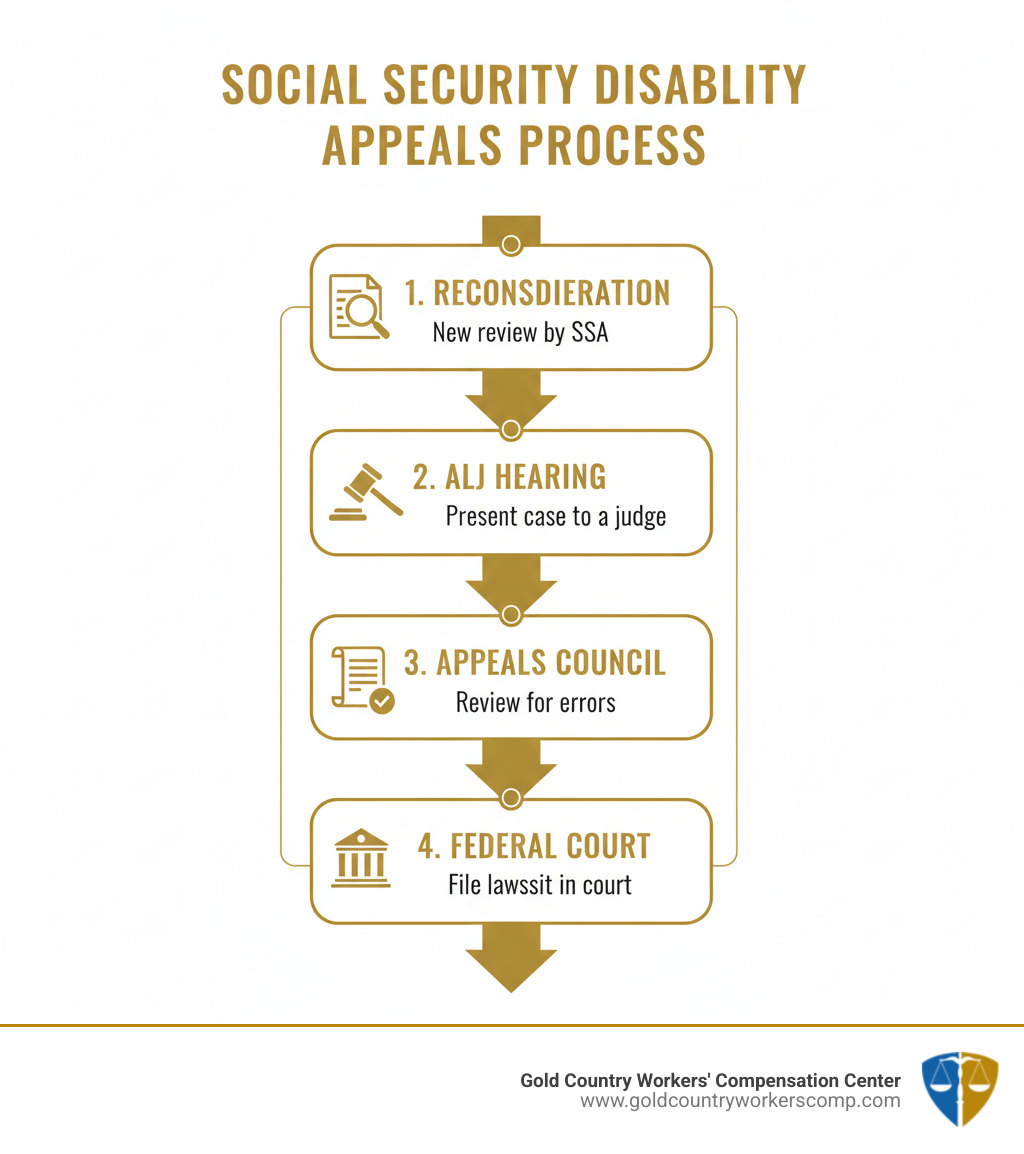
Infographic showing the four levels of the Social Security disability appeals process: Reconsideration, ALJ Hearing, Appeals Council, and Federal Court, with brief descriptions of what happens at each stage. - social security disability appeals infographic

First Move: Understanding Your Denial and Filing for Reconsideration

Calendar with a 60-day deadline circled - social security disability appeals

After receiving a denial letter, remember this is just the first hurdle in the social security disability appeals process. The most important thing is to act quickly. You have a strict 60-day deadline from the date you receive the denial notice to file an appeal. The Social Security Administration (SSA) assumes you receive the notice five days after the date on the letter, so your real deadline may be shorter. Missing this deadline could force you to start your application over, delaying benefits and reducing potential back pay.

You can file your appeal online, by mail, or by fax. For general guidance on filing online, refer to the SSA’s publication: How To File Your Disability Appeal Online. You can check your appeal’s status by logging into your “my Social Security” account at ssa.gov/myaccount.

What is a Reconsideration?

Reconsideration is the first appeal step, where the SSA gives your case a second look. A new examiner who was not involved in the first decision conducts a complete review of your claim, ensuring an unbiased perspective.

  • Medical Denials: If your claim was denied for medical reasons, a new examiner from a Disability Determination Services (DDS) office will review your original application, all submitted evidence, and any new medical information you provide.
  • Non-Medical Denials: If the denial was for non-medical reasons (e.g., income limits for SSI or work credits for SSDI), a different SSA employee will review your request to ensure the rules were applied correctly.

In both cases, the reviewer examines all evidence—old and new—to see if the initial decision was correct. The SSA will review the entire determination, even parts that were in your favor. If your benefits were stopped, specific benefit continuation rules might allow payments to continue during your appeal, but these have strict requirements.

How to File for Reconsideration

To file for reconsideration, you’ll need your personal information (name, SSN, contact info), the date you received your denial, and complete medical information. This includes contact details for all healthcare providers, dates of service, and a comprehensive medication list. Most importantly, gather any new evidence, such as recent medical records or test results.

You have several ways to submit your request:

Your goal is to present a clear picture of how your medical condition prevents you from working, supported by any new evidence that strengthens your claim.

The ALJ Hearing: Your Best Chance in the Social Security Disability Appeals Process

A professional, yet non-intimidating, hearing room setting - social security disability appeals

If your reconsideration is denied, the next step in the social security disability appeals process is a hearing before an Administrative Law Judge (ALJ). This is often your best chance to win. ALJs are known to overturn nearly half of the denials they review.

With a representative, your chances improve. Nationally, 56% of represented applicants receive benefits, compared to only 33% without. At Gold Country Workers’ Compensation Center, our clients see even higher approval rates: a remarkable 69%, well above the national average of 45%.

The ALJ assigned to your case is new to your file, bringing an unbiased perspective. The hearing is a private, non-adversarial proceeding. There is no opposing lawyer; the ALJ’s goal is to gather facts and make a fair decision. The judge will ask about your medical history, treatments, symptoms, daily life, and work history. This is your opportunity to explain, in your own words, how your disability affects your ability to work.

A medical expert or a vocational expert may also attend to provide testimony on your health conditions or your ability to perform other types of work. Their insights help the ALJ understand the full picture of your disability.

Preparing for Your ALJ Hearing

Preparation is essential for a successful ALJ hearing. We advise clients to review their case file, organize all evidence, and prepare their testimony to clearly explain their condition and its daily limitations.

You will receive a hearing notice at least 75 days in advance. Hearings can be in person, by phone, or via video. If you must travel more than 75 miles one way, the SSA may help with travel costs, which is beneficial for those in rural California areas like Nevada City or even those coming from Roseville.

If you cannot attend your scheduled hearing, you must notify the SSA in writing as soon as possible with a good reason. If the ALJ finds your reason insufficient, your request may be dismissed.

Key Evidence for Your social security disability appeals

The success of your social security disability appeals hinges on strong evidence. For your ALJ hearing, you should present:

  • Updated Medical Records: All recent doctor’s notes, hospital records, lab results, and imaging scans.
  • Doctor’s Reports: Detailed reports from your treating physicians stating your diagnosis, prognosis, and work-related limitations.
  • Function Reports: Forms describing your daily activities and how your symptoms interfere with them.
  • Witness Statements: Written statements from family, friends, or former employers describing how your disability affects you.
  • Expert Witness Testimony: In some cases, testimony from a physical therapist or rehabilitation specialist can clarify your functional limitations.
  • Submitting Evidence: You must submit all written evidence and objections no later than five business days before your hearing. Requests for subpoenas must be filed at least 10 business days before the hearing.

The more current and comprehensive your medical evidence, the stronger your case.

Advanced Strategy: Navigating Higher Levels of Appeal

If the ALJ denies your claim, the social security disability appeals process continues to the Appeals Council and, if necessary, Federal District Court. These higher levels have lower success rates and involve more complex legal arguments, but they are vital avenues to explore for your claim.

The Role of the Appeals Council

If the ALJ’s decision is unfavorable, you can ask the Appeals Council (AC) to review it. You have 60 days from receiving the ALJ’s denial to file this request. The AC acts as a quality control check, reviewing the decision for legal or factual errors.

The AC will examine your entire case file to determine if:

  • The ALJ made a legal mistake.
  • The decision was supported by substantial evidence.
  • There is new and important evidence that could change the outcome.

Submitting new evidence to the AC is difficult. It must be new, material (important to your case), relate to the period before the ALJ’s decision, and have a good chance of changing the outcome. It is always best to submit all evidence by the ALJ hearing stage.

The Appeals Council can:

  • Deny Review: This is the most common outcome, upholding the ALJ’s decision.
  • Grant Review and Issue a Decision: The AC may review the case and issue its own decision.
  • Remand the Case: The AC can send the case back to an ALJ for a new hearing if it finds a significant error.

You can request a review online via the SSA’s “AC iAppeal Online” process by selecting “Start an Appeal” at AC iAppeal Online, or you can mail Form HA-520.

Filing a Federal District Court Action

If the Appeals Council denies your review, your final step is to file a civil lawsuit in a U.S. Federal District Court. You have 60 days after receiving the AC’s decision to file this lawsuit (the SSA typically adds five days for mail delivery).

This stage involves complex federal civil law. Due to the complexity, an experienced legal team is essential. Our attorneys at Gold Country Workers’ Compensation Center are experienced in these intricate legal processes, ensuring your case is presented effectively in federal court.

Why Appealing is a Smarter Play Than Reapplying

After a denial, you may be tempted to start over with a new application instead of appealing. However, appealing your initial denial is almost always the smarter strategy.

Why is appealing better than reapplying? First, appealing preserves your original application date. This is critical for calculating your potential “back pay”—the benefits owed from your disability onset date until your approval. If you reapply, you establish a new, later application date, which can significantly reduce or even eliminate the back pay you might receive, potentially costing you thousands.

Additionally, there is a five-month waiting period for benefits after your disability onset date. If you appeal, this waiting period starts from your original claim’s onset. Reapplying triggers a new five-month waiting period after your new approval, further delaying financial support.

Appealing also saves time and effort. You are continuing an existing process, building on the evidence you’ve already submitted. Reapplying means starting from scratch—filling out all the forms and gathering all your records again, facing the same high initial denial rates.

By appealing, especially to the ALJ Hearing level, your chances of success improve dramatically. Many denials are overturned at this stage. By choosing to appeal, you are not just saving time and maximizing potential back pay; you are also significantly improving your odds of approval.

In summary, appealing allows you to:

  • Preserve your original application date to maximize back pay.
  • Avoid a new five-month waiting period for benefits.
  • Build on your existing application, saving time and effort.
  • Increase your chances of approval, especially at the ALJ hearing stage.

Frequently Asked Questions about social security disability appeals

How long does the appeals process typically take?

The timeline for the social security disability appeals process varies by stage, case complexity, and location. While there are no set timelines, you can generally expect:

  • Reconsideration: 3 to 5 months.
  • ALJ Hearing: A year or even longer, depending on the backlog at your local Office of Hearing Operations (OHO). Caseloads vary throughout California, from Grass Valley to Roseville.
  • Appeals Council or Federal Court: These higher levels can add many more months or even years to the process.

The entire appeals process can easily take a year or more. Patience and persistence are essential.

Can my benefits continue while my appeal is pending?

Yes, under certain circumstances, your benefits can continue during an appeal, particularly if the SSA has stopped your benefits.

If the SSA determines you are no longer disabled due to medical improvement (a “medical disability cessation”), you can request that your benefits continue. You must make this request in writing within 10 days of receiving the cessation notice—a critical deadline. Be aware that if you lose the appeal, you may have to repay these benefits.

For Supplemental Security Income (SSI), you may also be able to continue receiving payments if they were reduced or suspended for non-medical reasons. You must request reconsideration within 10 days of receiving that notice.

What are the advantages of working with a Social Security disability lawyer?

While not legally required, working with a disability lawyer significantly increases your chances of success. Nationally, applicants with representation are far more likely to be approved.

At Gold Country Workers’ Compensation Center, 95% of our clients recover benefits, and 69% are approved at the hearing level, compared to the national average of 45%. These statistics represent real people in Grass Valley, Nevada City, and Roseville who secured the benefits they needed.

A lawyer helps by:

  • Navigating Deadlines: The appeals process is full of critical deadlines for filing appeals and submitting evidence. We ensure nothing is missed.
  • Gathering Evidence: With nearly 50 years of experience, we know what medical evidence is most persuasive to the SSA and ALJs. We help you obtain detailed doctor’s reports and prepare compelling testimony.
  • Preparing for Hearings: We prepare you for what to expect from the ALJ, how to answer questions, and how to clearly explain your limitations.

Most importantly, we work on a contingency fee basis. You pay no fees unless we win your case. Our fee is capped by federal law (typically 25% of your back pay, up to a set maximum). This makes quality legal help accessible to everyone. At Gold Country Workers’ Compensation Center, Kim LaValley and Kyle Adamson believe early intervention makes all the difference.

Conclusion: Winning the Game with the Right Partner

The social security disability appeals process is a marathon, not a sprint. A denial is just the opening move, not the end of the game. As this guide has shown, persistence pays off, with nearly half of all denials being overturned at the ALJ hearing level.

Professional guidance dramatically improves your odds. People with representation at their hearing are significantly more likely to win. At Gold Country Workers’ Compensation Center, our track record reflects this: 95 percent of our clients successfully recover benefits, and our 69% approval rate at the hearing level is far above the national average of 45%.

Experience, preparation, and genuine care make the difference. With nearly 50 years of combined experience, Kim LaValley and Kyle Adamson understand the system in California, from Grass Valley and Nevada City to Roseville and the greater Sacramento area. We know that behind every claim is a person facing real challenges.

We believe everyone deserves a fighting chance, which is why we offer a free initial consultation and work on a contingency basis—we only get paid when you win. You take no financial risk by getting professional help; you make a smart investment in your future.

Don’t let a denial discourage you. Let us stand beside you, prepare your case, and advocate for your rights.

Get a free case evaluation for your disability appeal and let’s start building your path to success together.

Your Roseville SSI Benefits Lawyer A Partner for Your Claim

Roseville SSI benefits lawyer

A Roseville SSI benefits lawyer provides expert legal representation to help individuals steer the complex Supplemental Security Income (SSI) application and appeals process. This federal program is designed to secure disability benefits for those with limited income and resources who are elderly, blind, or disabled.

Quick Guide to Finding SSI Legal Help in Roseville:

  1. Free Consultations – Most SSI lawyers offer no-cost initial case evaluations
  2. No Upfront Fees – Payment only comes from your back pay if you win (capped at 25% or $6,000)
  3. Higher Success Rates – Legal representation significantly improves approval odds, especially at appeal hearings
  4. Local Expertise – Roseville attorneys understand Placer County procedures and local SSA office requirements
  5. Comprehensive Support – Help with applications, medical evidence, appeals, and ALJ hearings

If a disability prevents you from working, the financial strain can be overwhelming. The SSI system is a potential lifeline, but it’s notoriously difficult to steer. An initial application takes 3-5 months for a decision, and most are denied. The subsequent appeals process can stretch for 1-2 years, a period where financial and emotional stress can mount.

This is where a Roseville SSI benefits lawyer becomes an invaluable partner. Research shows that applicants with legal representation have a significantly higher success rate in their appeals and hearings. You don’t need money upfront to hire an SSI lawyer. They work on a contingency fee basis, meaning they only get paid if you win. Their fee is capped by law at 25% of your back pay or $6,000, whichever is less.

Infographic comparing SSI and SSDI: SSI is funded by general tax revenue, requires financial need, does not require work history, and serves elderly/blind/disabled individuals with limited resources. SSDI is funded by Social Security payroll taxes, does not require financial need, requires work credits from employment history, and serves disabled workers who paid into the system. - Roseville SSI benefits lawyer infographic comparison-2-items-formal

Understanding SSI: Eligibility and Key Differences in Roseville

Supplemental Security Income (SSI) is a federal program designed to help elderly, blind, or disabled individuals with limited income and resources. Unlike other Social Security programs, SSI is needs-based, meaning you don’t need a work history to qualify. This makes it a lifeline for many Roseville residents who haven’t been able to work consistently. At Gold Country Workers’ Compensation Center, we help people make sense of the Social Security Administration rules and determine their eligibility.

Who Qualifies for SSI Benefits?

The SSA considers several factors for SSI eligibility:

  • Age, Disability, or Blindness: You must be 65 or older, blind, or have a qualifying disability. A disability is a physical or mental impairment that prevents substantial gainful activity and is expected to last at least 12 months or result in death.
  • Limited Income and Resources: Your countable income and assets must fall below strict federal limits.
  • Citizenship and Residency: You must be a U.S. citizen or eligible noncitizen residing in the U.S.
  • Application: You must file an application and have it approved by the SSA.

A Roseville SSI benefits lawyer can ensure your application is complete and presents your case in the strongest possible light. For more details on local assistance, visit our page on Disability and Social Security Help in Roseville.

SSI vs. SSDI: What Roseville Applicants Need to Know

It’s crucial to understand the difference between SSI and Social Security Disability Insurance (SSDI). While both programs help people with disabilities, SSDI is an insurance program funded by payroll taxes that you pay into through work. SSI is a needs-based safety net funded by general tax revenues.

Criteria Supplemental Security Income (SSI) Social Security Disability Insurance (SSDI)
Funding Source General tax revenues Social Security payroll taxes
Financial Need Required (limited income/resources) Not required (based on work record)
Work History Not required Required (sufficient “work credits”)
Medicare Eligibility May qualify for Medicaid/Medi-Cal Eligible for Medicare after 24 months

Our Roseville SSI benefits lawyer team can help you determine which program fits your situation; some people even qualify for both.

Strict Income and Asset Limits for SSI

Because SSI is needs-based, the SSA imposes strict financial limits.

Countable income includes wages, pensions, unemployment, and even “in-kind” support like free food or shelter. The SSA excludes the first $20 of most income and the first $65 of earned income, plus half of the remainder. California also provides a state supplement to federal SSI payments.

Asset limits are critical. An individual’s countable resources cannot exceed $2,000, and a couple’s limit is $3,000. Not all assets count. Your primary home, one vehicle used for transportation, personal belongings, and household goods are typically excluded. However, cash, bank accounts, and investments do count. A mistake in reporting can lead to denial, making the guidance of a Roseville SSI benefits lawyer invaluable. For more information, you can consult resources like the Social Security Roseville CA office.

The SSI Application and Appeals Gauntlet: A Step-by-Step Guide

Applying for SSI benefits is a challenging process. The initial application takes 3-5 months for a decision, and if denied, the appeals process can last 1-2 years. This is a long time to wait when you’re dealing with a disability and financial hardship. Our firm can guide you through every step.

Person overwhelmed by stack of official-looking forms - Roseville SSI benefits lawyer

The Initial Application Process

A strong application is built on thorough documentation. You will need:

  • Medical Records: Objective proof of your disability, including doctor’s notes, lab results, imaging scans, and treatment plans.
  • Financial Records: Proof of your limited income and resources, such as bank statements and asset information.
  • Personal & Work Information: Your birth certificate, Social Security card, proof of citizenship, and a detailed work history for the past 15 years.

You can apply online, by phone, or in person at a local Social Security office. Our Roseville Social Security Office Appointments Guide can help you prepare for a visit. A Roseville SSI benefits lawyer can review your application to prevent common errors that cause delays or denials.

Common Challenges and Reasons for Denial

Most initial SSI applications are denied, often for fixable reasons:

  • Insufficient Medical Evidence: The SSA requires concrete, objective proof that your condition severely limits your ability to function.
  • Exceeding Financial Limits: Your income or assets are over the strict thresholds.
  • Application Errors: Incomplete forms, inconsistent information, or missing signatures.
  • Failure to Follow Prescribed Treatment: The SSA may conclude your condition isn’t severe if you don’t follow your doctor’s orders without a good, documented reason.
  • Disability Not Severe Enough: The SSA determines your condition doesn’t prevent you from performing any substantial gainful activity.

Properly documented claims for conditions like severe musculoskeletal disorders, mental health conditions (depression, PTSD), neurological disorders (MS, Parkinson’s), cancers, and cardiovascular diseases are often approved. The key is proving the severity of your limitations.

If denied, you have the right to appeal, but you must act within a strict 60-day deadline for each stage.

  1. Reconsideration: A different claims examiner reviews your file and any new evidence. Most reconsiderations are also denied, but this step is required to proceed.
  2. Administrative Law Judge (ALJ) Hearing: This is your best opportunity to win. You present your case in person to a judge, and your lawyer can argue on your behalf and question experts. Success rates are much higher at this stage, especially with legal representation.
  3. Appeals Council Review: If the ALJ denies your claim, you can ask the Appeals Council to review the decision for legal errors.
  4. Federal Court Review: The final step is filing a lawsuit in federal district court, a complex process that requires an experienced attorney.

Our Disability Claim Lawyer in Roseville services are designed to maximize your chances at every level of this process.

Why Partnering with a Roseville SSI Benefits Lawyer Maximizes Your Chances

Statistics show that applicants with legal representation have a much higher chance of winning their SSI claim, especially at the hearing level. The system is a maze of regulations and procedural requirements. A Roseville SSI benefits lawyer acts as your advocate and strategic partner, translating complex medical and legal information into a strong case. At Gold Country Workers’ Compensation Center, our motto is “We Win the Tough Ones,” reflecting our commitment to fighting for our clients.

Lawyer confidently speaking in a hearing room setting - Roseville SSI benefits lawyer

How a Roseville SSI benefits lawyer Can Help with Your Application

Hiring a lawyer from the start can prevent the common pitfalls that lead to initial denials. We help by:

  • Ensuring Accuracy: We review every form to catch errors that could delay or derail your claim.
  • Developing a Case Theory: We present your medical condition in a way that directly addresses the SSA’s legal standards for disability.
  • Handling Communications: We manage all correspondence with the SSA, ensuring timely responses and preventing you from missing crucial requests.
  • Meeting Deadlines: We track all timeframes, especially the critical 60-day deadline for appeals, so you never lose your rights.

For more on how we support clients, visit our Social Security Attorney in Roseville page.

The Lawyer’s Role in a Denied Claim Appeal

If your claim is denied, a lawyer’s role becomes even more critical. We manage the entire appeals process by:

  • Filing Appeals Correctly: We ensure all appeal requests are filed properly and on time.
  • Gathering New Evidence: We identify what’s missing from your file and work to obtain stronger medical records and supportive opinions from doctors.
  • Preparing You for the ALJ Hearing: We walk you through the hearing process, so you know what to expect and can testify with confidence.
  • Cross-Examining Experts: We challenge the testimony of vocational experts the SSA uses to argue that jobs exist for you.
  • Writing Legal Briefs: We submit detailed written arguments to the judge, summarizing the evidence and explaining why you meet the legal standard for disability.

Gathering Medical Evidence and Coordinating with Doctors

A serious diagnosis is not enough; you need the right medical evidence. The SSA needs to see how your condition limits your ability to function. We work with your doctors to obtain supportive medical opinions, often in the form of a Residual Functional Capacity (RFC) assessment. This document details your specific physical and mental limitations, such as how long you can stand, how much you can lift, and your ability to concentrate.

Many doctors are unfamiliar with the SSA’s specific documentation requirements. We bridge this gap by coordinating with your medical team to explain what information is needed. We then analyze these records and translate them into clear legal arguments that address the SSA’s criteria for determining disability. Strong, well-presented medical evidence is the foundation of a successful claim. For more on disability standards, visit the Social Security Disability Insurance website.

Finding Your Advocate and Understanding the Partnership

Choosing a Roseville SSI benefits lawyer is a critical decision. You are looking for an advocate who will partner with you through a long and often stressful process. At Gold Country Workers’ Compensation Center, we build partnerships based on trust, clear communication, and compassion.

Friendly handshake between a lawyer and a client - Roseville SSI benefits lawyer

How are SSI Lawyers Paid? The Contingency Fee Structure

The most common question is, “How much will this cost?” The answer is simple: you pay no upfront fees.

SSI lawyers work on a contingency fee basis, meaning we only get paid if we win your case. If your claim is approved, our fee is paid from your back pay—the past-due benefits owed to you. The Social Security Administration regulates these fees to protect you. The fee is capped at 25% of your retroactive benefits or $6,000, whichever is less. If you don’t win, you owe us no legal fee. This structure ensures everyone can afford quality legal help.

Finding a Reputable Roseville SSI benefits lawyer

When searching for the right advocate, look for:

  • Specialized Experience: Social Security disability law is a complex field. You want an attorney who focuses on these cases, not a general practitioner. Our firm has nearly 50 years of combined experience in this area.
  • Client Reviews: Read testimonials from past clients to learn about their experience with the lawyer’s communication, responsiveness, and results.
  • Credentials: Verify that the lawyer is licensed and in good standing with the State Bar of California.

Our team of Disability Attorneys in Roseville is dedicated to providing the effective representation you need.

What to Expect During Your Initial Consultation

We offer a no-cost initial consultation to make legal help accessible from day one. During this meeting, we will:

  • Listen to your story to understand your disability and how it impacts your life.
  • Review your financial situation to confirm you meet SSI’s needs-based criteria.
  • Explain the application or appeals process, including timelines and potential challenges.
  • Provide clear, straightforward advice about your options.

This meeting is about empowering you with information. There is no obligation to hire us.

Frequently Asked Questions about SSI Claims

We’ve heard countless questions from Roseville residents trying to understand the SSI process. Here are answers to some of the most common ones.

How long does the SSI application and appeal process take in Roseville?

The timeline for an SSI claim is rarely quick. The initial application process typically takes 3-5 months for a decision. If your claim is denied, the appeals process can take 1-2 years, largely due to backlogs at the SSA’s hearing offices. Factors like the complexity of your condition and how quickly your doctors provide records can affect this timeline. A Roseville SSI benefits lawyer can help avoid common delays and keep your case moving as efficiently as possible.

Does having a lawyer guarantee my SSI claim will be approved?

No attorney can ethically guarantee a specific outcome, as the final decision rests with the Social Security Administration. However, statistics are clear: applicants with legal representation have significantly higher success rates, especially at the Administrative Law Judge hearing. An experienced Roseville SSI benefits lawyer understands the SSA’s rules, knows what evidence is needed, and can make persuasive legal arguments on your behalf. Our role is to maximize your chances of success by building the strongest possible case.

Can I work while applying for or receiving SSI benefits?

Yes, but you must be very careful to follow the SSA’s strict earnings limits. The key concept is Substantial Gainful Activity (SGA), a monthly earnings amount that the SSA uses to determine if you are disabled. For 2024, the SGA limit is $1,550 per month for non-blind individuals. Earning over this amount can jeopardize your eligibility.

Even if you earn less than the SGA limit, your SSI payment will be reduced based on your income. The most critical rule is to report all income to the SSA promptly and accurately. Failure to report income can lead to overpayments that you must repay, penalties, or a loss of benefits. The rules are complex, and our team can help you understand them to avoid costly mistakes.

Conclusion

Securing Supplemental Security Income (SSI) benefits in Roseville can be a complex and frustrating journey. The process is long, the rules are strict, and a denial can feel devastating. But these benefits are a crucial lifeline, providing financial stability when a disability prevents you from working.

This is where experience matters. At Gold Country Workers’ Compensation Center, our team, led by Kim LaValley and Kyle Adamson, brings nearly 50 years of combined experience in Disability and Social Security law. We have helped countless residents of Roseville and surrounding California communities steer the system and secure the benefits they deserve.

We believe in early intervention and removing financial barriers to legal help. That’s why we offer a no-cost initial consultation to discuss your case and provide honest advice. Because we work on a contingency fee basis, you only pay a fee if we win your case.

You don’t have to face the SSA alone. Whether you are just starting your application or need to appeal a denial, our team is ready to fight for you. Take the first step toward securing your benefits and peace of mind.

Contact our Disability Law Firm in Roseville for a free consultation, and let a compassionate Roseville SSI benefits lawyer stand by your side.