

Why Understanding Disability Benefits Eligibility Matters
Disability benefits eligibility determines if you can access financial support when a medical condition stops you from working. Understanding if you qualify is the first step.
Quick Eligibility Overview:
- US Programs (SSDI/SSI): You must have a disability expected to last 12+ months or result in death, meet work credit requirements (for SSDI), and fall below income/asset limits (for SSI).
- Canadian Programs (CPP-D/CDB/ODSP): You need a severe and prolonged disability, meet contribution requirements (CPP-D), or demonstrate financial need (ODSP).
- Key Requirements: Medical evidence, inability to perform substantial gainful work, and meeting specific program thresholds.
Studies show a 20-year-old worker has a 1-in-4 chance of becoming disabled before retirement age. When this happens, workers face a confusing maze of programs like Social Security Disability Insurance (SSDI), Supplemental Security Income (SSI), the Canada Pension Plan Disability benefits (CPP-D), and the Ontario Disability Support Program (ODSP). Each has unique rules and definitions of “disability.”
This guide simplifies the process. Whether you’re in the United States or Canada, we’ll explain the core eligibility requirements, what qualifies or disqualifies you, and how to steer the application. You’ll learn about work credits, income limits, medical evidence, and the appeals process.
The path to benefits doesn’t have to be overwhelming. With the right information, you can determine your eligibility and move forward with confidence.
Understanding the Core Concepts of Disability
Before determining your disability benefits eligibility, you must understand what “disability” means to government agencies. A medical diagnosis alone is not enough; what matters is how your condition impacts your ability to work and earn a living.
Programs like Social Security Disability Insurance (SSDI) and Supplemental Security Income (SSI) in the US, or the Canada Pension Plan Disability (CPP-D) in Canada, have specific definitions. The common thread is that your disability must be severe enough to prevent meaningful work. In the US, this means you cannot engage in “substantial gainful activity.” In Canada, your disability must be “severe and prolonged.” Both systems require strong medical evidence to support your claim.
Understanding these concepts—what qualifies as a disability, how work history is factored, and which income limits apply—is key to identifying the right program and building a strong case.
What is a “Disability” for Benefits Purposes?
The US Social Security Administration (SSA) defines disability as a total disability, not a partial or temporary one. To qualify, your condition must:
- Prevent you from doing “substantial gainful activity” (work that earns above a certain monthly amount).
- Stop you from performing the work you did previously.
- Prevent you from adjusting to other types of work.
- Have lasted or be expected to last for at least 12 consecutive months, or be expected to result in death.
The 12-month duration rule is critical. A serious but short-term condition will not qualify.
In Canada, the CPP-D requires a disability to be both severe and prolonged. “Severe” means you are regularly unable to do any substantially gainful work. “Prolonged” means the disability is long-term, of indefinite duration, or likely to result in death.
Both systems prioritize functional limitations over diagnoses. You must show how your condition prevents you from performing basic work activities like standing, lifting, concentrating, or following instructions. Medical evidence is the foundation of your claim.
The Role of Work and Income
Your work history and earnings are crucial for disability benefits eligibility, particularly for SSDI in the US.
Substantial Gainful Activity (SGA) is a key concept. The SSA sets a monthly income limit; earning above it generally disqualifies you. For 2025, the SGA limit is $1,620 per month for non-blind individuals ($2,700 for blind individuals). These figures are adjusted annually, so always check the current amounts on the SSA’s disability qualifications page.
For SSDI, work history requirements are based on “work credits” earned by paying Social Security taxes. In 2025, you get one credit for every $1,810 in wages, up to four per year. The number of credits needed depends on your age at disability onset. Most people need 40 credits, with 20 earned in the last 10 years (the “20/40 Rule”). Younger workers have lower credit requirements. You can check your work history on the SSA website.
For Canada’s CPP-D, you must have made sufficient contributions to the Canada Pension Plan. Generally, this means contributing in four of the last six years, though some exceptions apply. The principle is the same: a recent history of contributions is required.
Navigating US Disability Benefits Eligibility (SSDI & SSI)
In California, the Social Security Administration (SSA) manages two key federal disability programs: Social Security Disability Insurance (SSDI) and Supplemental Security Income (SSI). Understanding their differences is vital for determining your disability benefits eligibility.

SSDI is an insurance program you pay into via payroll taxes. SSI is a needs-based program for those with limited income, resources, and work history. Both require you to meet the SSA’s strict definition of disability, but the financial qualifications are very different. The application process for both involves submitting detailed medical, work, and personal information online, by phone, or at a local SSA office.
Key Factors in US Disability Benefits Eligibility
SSDI eligibility depends on work credits earned by paying Social Security taxes. In 2025, you earn one credit for every $1,810 in wages, up to four per year. The SSA uses two tests:
- Recent Work Test: For most adults, this requires earning 20 credits in the 10 years before your disability began (the “5 of last 10 years rule”).
- Duration of Work Test: This looks at your lifetime earnings. The total credits needed depends on your age, but those 31 or older generally need 40 credits. Younger workers need fewer.
Age can also be a factor for SSI, as individuals 65 or older may qualify based on age and financial need alone. You can review your earnings and credit history by logging into your account at https://secure.ssa.gov/RIL/SiView.action.
The SSA’s 5-Step Evaluation Process
The SSA uses a five-step process to evaluate every claim:
Step 1: Are you working? If you are earning more than the Substantial Gainful Activity (SGA) limit ($1,620/month in 2025), your claim will likely be denied.
Step 2: Is your condition severe? Your condition must significantly limit your ability to perform basic work activities like walking, lifting, or concentrating for at least 12 months.
Step 3: Is your condition on the list? The SSA maintains a Listing of Impairments. If your condition meets or medically equals a listing, you are approved.
Step 4: Can you do your past work? If your condition doesn’t meet a listing, the SSA assesses if you can perform any of your past jobs from the last 15 years.
Step 5: Can you do any other work? The SSA considers your age, education, experience, and limitations to see if there are other jobs in the national economy you could do. If not, you are found disabled.
Comparing SSDI and SSI
Though both programs are for disabled individuals, their funding and rules differ significantly.
SSDI:
- Funded by: Social Security taxes.
- Eligibility: Based on your work history (work credits).
- Financial Limits: No asset limit, but you cannot earn above the SGA threshold.
- Health Care: Automatic Medicare eligibility after 24 months of receiving benefits.
- Family Benefits: May provide auxiliary benefits to a spouse or children.
SSI:
- Funded by: General tax revenues.
- Eligibility: Based on financial need.
- Financial Limits: Strict limits on income and resources (e.g., under $2,000 in assets for an individual).
- Health Care: Immediate Medicaid eligibility (Medi-Cal in California).
- Family Benefits: Individual benefit only; no auxiliary payments for family members.
Some people with a low SSDI payment may qualify for both programs concurrently.
Special Considerations: Family, Work, and Savings
The SSA provides flexibility for family support, returning to work, and saving for the future.
- Family Benefits: If you receive SSDI, your spouse, minor children, or adult children disabled before age 22 may also qualify for benefits on your record.
- Returning to Work: Work incentives like the Trial Work Period allow you to test your ability to work for up to nine months without losing benefits. The Ticket to Work program offers free vocational support.
- ABLE Accounts: For those whose disability began before age 26, ABLE (Achieving a Better Life Experience) accounts allow you to save money for disability-related expenses without it counting against SSI resource limits.
Crucially, you must report all changes to the SSA, including work, income, marital status, or address. Failure to report can lead to overpayments and penalties.
Common Disqualifiers and Special Circumstances
Even if you meet the basic criteria for disability benefits eligibility, certain circumstances can lead to a denial or loss of benefits. Understanding these potential disqualifiers is crucial.

What Can Make You Ineligible?
Several factors beyond medical and work history can disqualify your claim:
- Income and Asset Limits: For SSI, having more than $2,000 in countable assets (for an individual) is a common disqualifier. For SSDI, earning above the Substantial Gainful Activity (SGA) threshold will result in a denial.
- Incarceration: In the US, Social Security benefits are suspended after 30 continuous days of incarceration for a criminal offense. In Canada, CPP disability benefits are suspended if you are imprisoned for more than two years. Benefits can typically be reinstated upon release.
- Not Following Prescribed Treatment: If you refuse a doctor’s recommended treatment that could restore your ability to work without a good reason (such as religious beliefs or significant medical risk), your benefits can be denied or terminated.
- Fraud: Intentionally providing false information or concealing facts to obtain benefits is a federal crime that can lead to prosecution, fines, and imprisonment.
- Inheritances and Gifts: For SSI recipients, a large gift or inheritance can push you over the asset limit. It’s vital to report it immediately to the SSA to understand your options.
Navigating Appeals and Reconsideration
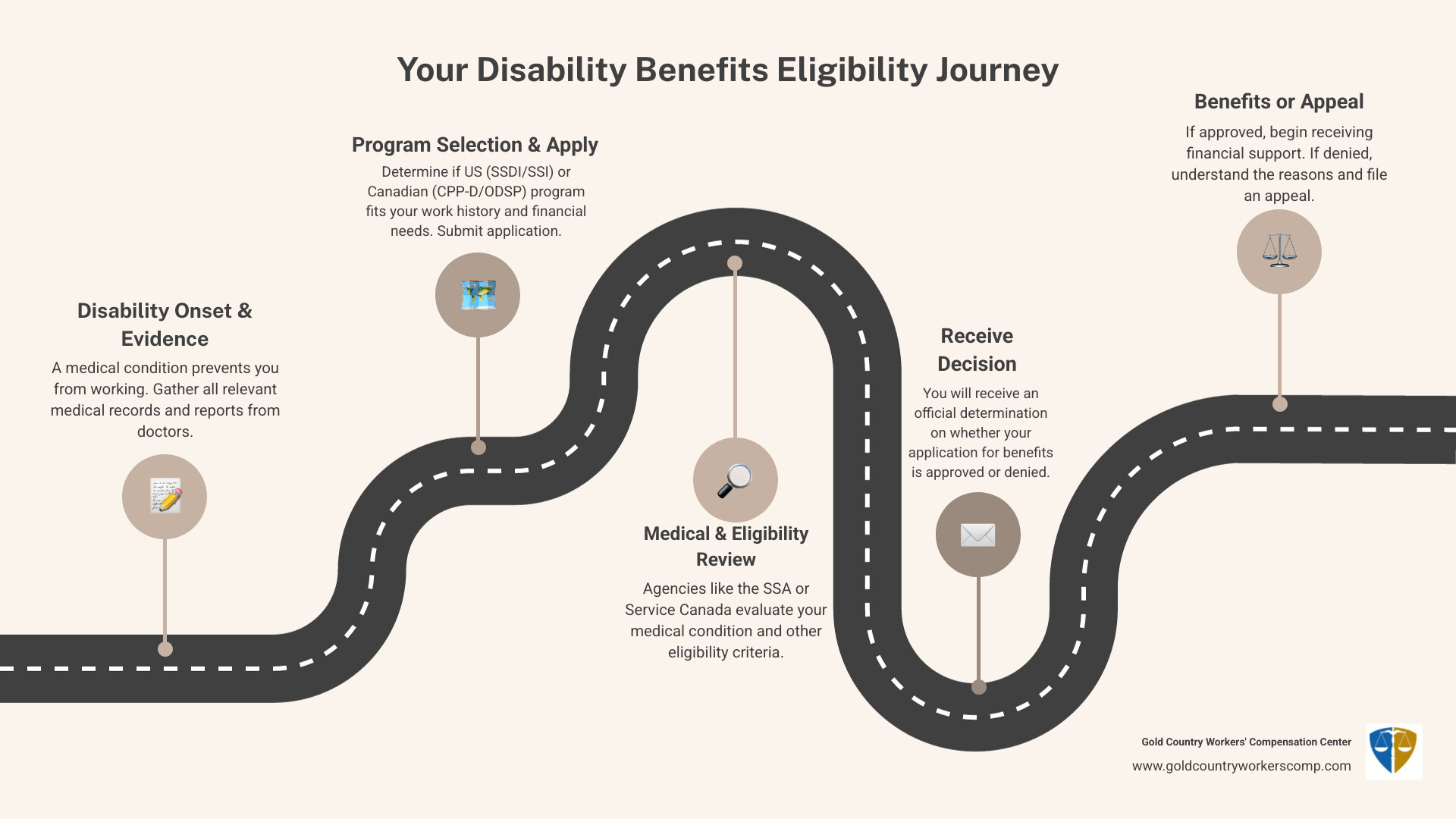
A denial is not the end of the road. Many initial applications are denied, but the appeals process offers a chance for approval. You generally have 60 days from receiving a denial letter to file an appeal.
The US SSA appeals process includes several stages:
- Reconsideration: A new examiner reviews your case and any new evidence.
- Hearing by an Administrative Law Judge (ALJ): This is a critical stage where you can present your case in person. Many claims are won at this level.
- Appeals Council Review: The Council can review the ALJ’s decision.
- Federal District Court: The final step is to file a lawsuit in federal court.
Deadlines are strict at every stage. In Canada, the process differs by program. For CPP-D, you have 90 days to request a reconsideration, followed by an appeal to the Social Security Tribunal. For provincial programs like ODSP, you start with an internal review.
Special Rules for Terminal or Grave Conditions
Both the US and Canadian systems have programs to fast-track applications for individuals with terminal or exceptionally severe conditions.
In the US, the Compassionate Allowances program identifies conditions (like certain cancers, ALS, or early-onset Alzheimer’s) that obviously meet disability standards, allowing for processing in days or weeks. The Quick Disability Determinations (QDD) system also flags cases with a high probability of approval.
In Canada, CPP terminal illness applications and cases meeting a grave condition definition under programs like ODSP receive expedited processing. It is essential that this information is clearly stated in your application and supported by medical documentation.
Frequently Asked Questions about Disability Benefits Eligibility
We’ve helped hundreds of Californians steer the complexities of disability benefits eligibility. Here are answers to some of the most common questions we hear in our Grass Valley office.
What is the main difference between US and Canadian disability benefits?
The primary difference lies in their structure. US SSDI is a work-based insurance program funded by payroll taxes. Canada’s CPP-D is also contribution-based, but the overall system relies more heavily on a mix of federal and provincial needs-based programs, like Ontario’s ODSP (similar to the US SSI program).
Definitions of disability also vary. The US requires an inability to perform any substantial gainful work, while Canada’s CPP-D focuses on a “severe and prolonged” disability that prevents any regularly pursued substantially gainful occupation. This creates an extra layer of complexity for Canadians who may need to steer both federal and provincial systems.
How important is the Disability Tax Credit (DTC) in Canada?
The DTC is crucial in Canada. It’s more than a tax credit; it’s a gateway credential to other essential programs. DTC approval is required to access the new Canada Disability Benefit (CDB), which provides up to $2,400 annually (starting in 2025), and it allows you to open a Registered Disability Savings Plan (RDSP) with government matching grants. Even if you don’t owe income tax, securing DTC approval should be a priority. You can apply for the DTC through the Canada Revenue Agency.
Can I work while receiving disability benefits?
Yes, both the US and Canadian systems have provisions that encourage returning to work. The goal is to provide support when you cannot work at full capacity, not to prevent you from working altogether.
In the US, the SSA offers work incentives like the Trial Work Period, which lets you work for up to nine months with no earnings limit while still receiving full SSDI benefits. After that, earnings are measured against the Substantial Gainful Activity (SGA) limit. For SSI, benefits are reduced based on earnings, but you don’t automatically lose them.
Canada’s CPP-D also has allowable earnings thresholds. The most important rule in both countries is to report all work activity and earnings immediately to the appropriate agency (SSA or Service Canada). Failure to do so can lead to overpayments and serious penalties.
If you’re in California and find these rules confusing, our team at Gold Country Workers’ Comp can help. Our early intervention can be key to keeping your benefits secure while you explore returning to work.
Conclusion: Finding Your Way to Financial Support
Navigating the maze of disability benefits eligibility—from work credits and SGA limits to medical evidence and appeals—is complex, but it is not impossible.
The key is having the right information and support. Your claim’s foundation is strong medical evidence from your doctors that details how your condition prevents you from working. If you receive a denial, don’t despair. Many initial applications are denied, and the appeals process exists for this reason. With the right strategy, many cases are won at the hearing stage.
Here in California, especially in the Roseville, Nevada City, or Grass Valley areas, you don’t have to do this alone. At Gold Country Workers’ Comp, we have nearly 50 years of experience helping people steer the SSA’s 5-step evaluation process and the appeals system.
Our commitment is to early intervention. The sooner we get involved, the better we can help you build a strong claim from the start. We don’t charge for an initial consultation because you shouldn’t have to worry about legal fees during an already difficult time.
Whether you are just considering applying or have already been denied, we are here to help you secure the financial support you deserve.


