AME vs. QME in California Workers’ Comp: Who Decides Your Medical Case

AME vs. QME in California Workers' Comp: Who Decides Your Medical Case — Gold Country Workers Comp Center, Nevada City California

One Doctor, One Report, and Most of Your Case

California workers’ compensation cases are not usually decided by a dramatic day in court. They are decided by a medical report. When your treating doctor and the insurance company disagree about your injury — whether it’s work-related, how badly you’re hurt, whether you can go back to your old job — the dispute gets sent to a medical-legal evaluator. That evaluator writes a report, and that report drives nearly everything that follows: your permanent disability rating, your future medical care, and what your case is ultimately worth.

There are two kinds of evaluator in this system, and the difference between them is one of the most consequential things a hurt worker never gets told.

The short version:

  • QME — a Qualified Medical Evaluator, drawn from a random panel of three names issued by the state.
  • AME — an Agreed Medical Evaluator, a doctor your attorney and the insurance company both agree to use.
  • You can only use an AME if you have an attorney. Unrepresented workers get the QME panel process.

How a QME Gets Chosen

The QME process is built around randomness, on the theory that neither side should be able to hand-pick the doctor.

It works roughly like this. One party requests a panel from the Division of Workers’ Compensation Medical Unit and specifies a medical specialty — orthopedics, neurology, psychiatry, internal medicine, and so on. The Medical Unit generates a panel of three QMEs in that specialty who practice within a reasonable distance of where you live. From there:

  • If you are unrepresented, you select one of the three doctors and schedule your own appointment.
  • If you are represented, each side strikes one name from the list. The doctor left standing performs the evaluation.

Two things about that process deserve attention. First, the specialty matters enormously, and whoever requests the panel usually gets to name it. A shoulder injury evaluated by an orthopedist and the same shoulder injury evaluated by a physical medicine specialist can produce meaningfully different reports. Second, the panel is random, which cuts both ways — sometimes you draw a fair, thorough evaluator, and sometimes you draw one with a well-earned reputation for minimizing every injury that walks through the door.

You get one strike. You do not get to keep asking for a new panel because you don’t like the doctor you’re left with.

How an AME Gets Chosen — and Why It’s Different

An Agreed Medical Evaluator is not random at all. It’s the opposite: your attorney and the insurance company’s attorney sit down and negotiate over which doctor will evaluate you, and they proceed only if they can agree on a name.

That sounds like it should favor the insurance company, and sometimes it does. But experienced comp attorneys on both sides develop a working knowledge of which evaluators write careful, defensible reports and which ones don’t. An AME is typically a doctor with a long track record of being reasonable — because a doctor who reliably favored one side would never get agreed to by the other.

The practical consequence: an AME report is very hard to move. It isn’t technically binding, but because both parties selected the evaluator, a workers’ compensation judge will give the report substantial weight. Challenging an AME opinion you don’t like is an uphill fight.

That cuts in both directions, and it is exactly why the decision to agree to a particular AME is not a formality. It’s a strategic call that should be made by someone who knows the local evaluators.

What the Evaluation Actually Decides

Whichever route your case takes, the evaluator’s report generally addresses a standard set of questions:

  • Causation — is this injury actually work-related, in whole or in part?
  • Permanent and stationary status — has your condition stabilized to the point that it isn’t expected to improve further with treatment?
  • Permanent impairment — rated under the AMA Guides to the Evaluation of Permanent Impairment, Fifth Edition, which is the standard California uses.
  • Apportionment — how much of your current disability is attributable to the work injury versus prior injuries, degenerative conditions, or other non-industrial causes. Apportionment can reduce an award substantially, and it is one of the most heavily litigated pieces of any comp case.
  • Future medical care — what ongoing treatment your injury will require.
  • Work restrictions — what you can and cannot do, which in turn drives whether your employer can return you to work and whether you qualify for a job displacement voucher.

Read that list again and notice how much of your case is contained in it. This is why the evaluation is not a routine doctor’s appointment to be squeezed in between other obligations.

Preparing for the Evaluation

A medical-legal evaluation is a one-shot event. A few things consistently matter:

  • Be accurate, complete, and consistent. Describe your symptoms on a normal day, not on your best day or your worst. Evaluators are trained to notice inconsistencies between what you report, what’s in your records, and what they observe.
  • Disclose prior injuries. Hiding a previous back problem does not make apportionment go away — it makes you look untruthful when the evaluator finds it in your records, which they will.
  • Describe your actual job. “Warehouse worker” tells the evaluator nothing. How much weight, how many times an hour, on what surface, in what temperature.
  • Bring your history. Prior treatment, imaging, and the medications you’ve tried.
  • Say what you can’t do anymore. Not just pain levels — the specific tasks at work and at home you’ve lost.

If the report comes back and you believe it got something materially wrong, there are procedural avenues — supplemental reports, depositions of the evaluator, and in some circumstances a request for a replacement panel. Those avenues are time-limited and technical, which is the practical argument for having someone watching the deadlines.

So Which One Is Better?

There is no universal answer, and anyone who gives you one isn’t paying attention to your case.

An AME offers predictability. You know the evaluator’s reputation and general approach going in, and a well-chosen AME can resolve a disputed case efficiently without years of litigation. The tradeoff is that the report is hard to challenge if it lands badly.

A QME panel offers a roll of the dice with a strike to protect you. In a case where the insurance company is pushing hard for a particular evaluator, taking the random panel can be the better play.

The choice depends on your specific injury, your medical history, which evaluators are available in your specialty in the Sierra foothills and Sacramento region, and what the insurance company is trying to accomplish. That’s a judgment call built on local experience — knowing which orthopedist in this area writes fair reports on knee injuries and which one apportions half of every case to “degenerative changes.”

Frequently Asked Questions

What is the difference between an AME and a QME?

A QME is a state-certified evaluator assigned from a random three-name panel issued by the DWC Medical Unit. An AME is a doctor both sides voluntarily agree on. Only represented workers can use an AME.

Can I use an AME if I don’t have a lawyer?

No. The AME process requires an agreement between your attorney and the claims administrator. Unrepresented workers go through the QME panel process.

What happens if I don’t like the QME I’m left with?

You generally cannot request a new panel simply because you’re unhappy with the assigned doctor. There are narrow grounds for a replacement panel, and they are time-sensitive, which is why the strike decision matters.

Is the AME’s report binding on the judge?

Not technically. But because both parties chose the evaluator, judges give AME reports substantial weight, and overcoming one is difficult.

Who pays for the evaluation?

The medical-legal evaluation is paid for through the workers’ compensation system, not out of your pocket. Your travel to and from the appointment is also reimbursable — the mileage rate for medical and medical-legal travel is 72.5 cents per mile for travel on or after January 1, 2026, regardless of your date of injury.

Before Your Evaluation Is Scheduled

The panel request, the specialty selection, and the strike are all decisions that get made early — often before an injured worker understands that a decision is being made at all. By the time the report arrives, the leverage is gone.

Kim LaValley and Kyle Adamson have spent decades handling California workers’ compensation claims in Nevada County, Placer County, and throughout the Sierra foothills. If you have a panel request in front of you, or a report that came back wrong, a conversation costs nothing. Call 530-362-7188.

You can also read more about how the California workers’ compensation case process works from start to finish.


This article is general information about California workers’ compensation law and is not legal advice. Every claim turns on its own facts and deadlines. For advice about your specific situation, speak with a workers’ compensation attorney. Authoritative source material: the California Division of Workers’ Compensation and the Department of Industrial Relations.

Claim Your Care: Your Guide to Filing a Workers’ Comp Claim

claim for work injury

Why Filing Your Workers’ Comp Claim Correctly Matters

If you’ve been hurt at work, filing a claim for work injury is your path to receiving medical care and replacing lost wages. Here’s what you need to know right away:

Quick Steps to File Your Claim:

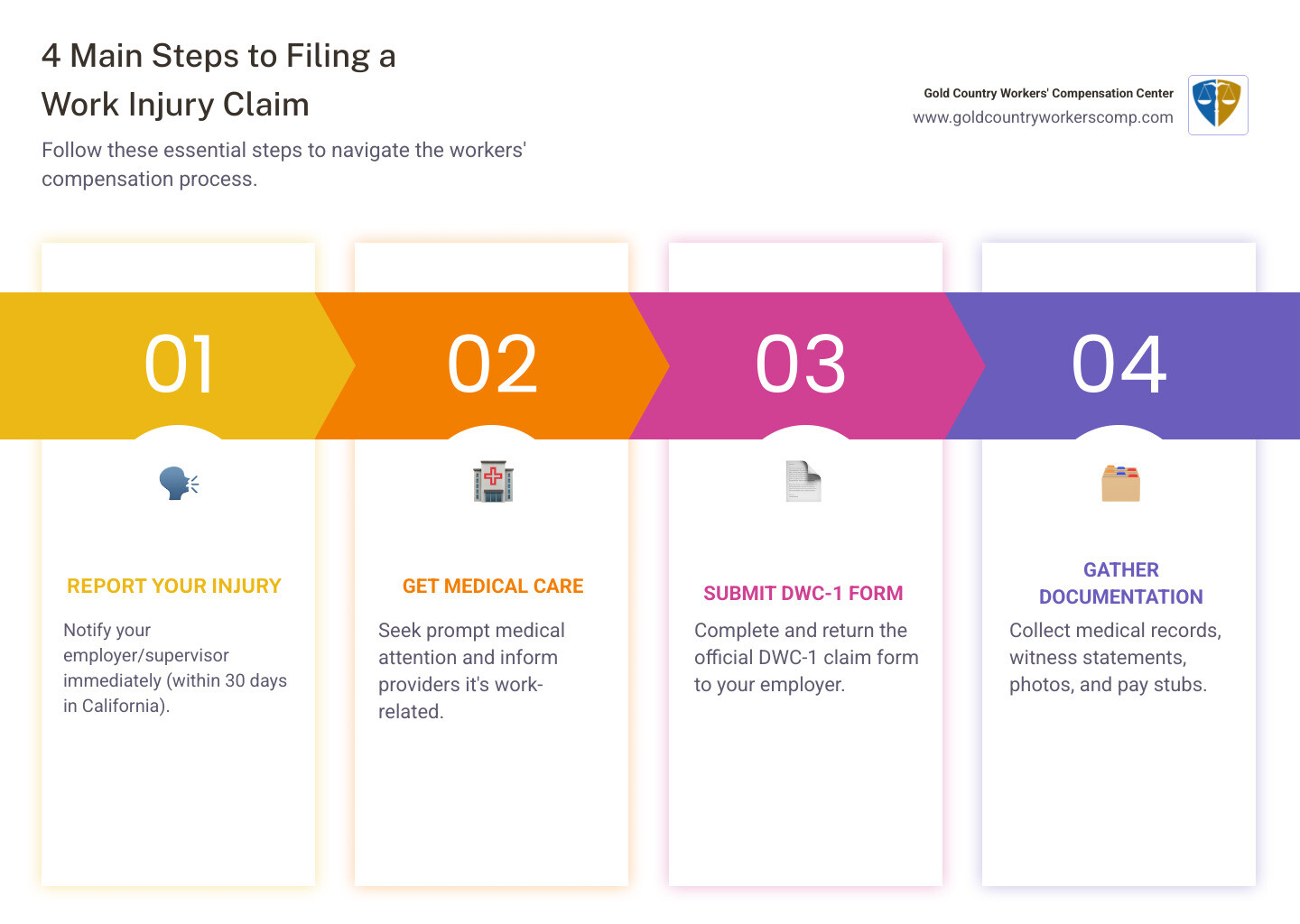
  1. Report your injury to your supervisor immediately (within 30 days in California).
  2. Get medical treatment and tell providers it’s work-related.
  3. Complete the DWC-1 form your employer must give you within one working day.
  4. Return the form to your employer and keep a copy for yourself.

The workers’ compensation system helps you recover without worrying about fault. In California, employers must provide a claim form within one business day of learning about your injury and authorize up to $10,000 in medical treatment while your claim is reviewed.

Getting hurt at work is confusing. You’re dealing with pain, medical bills, and lost wages, all while navigating a complex legal process. The good news is that filing a claim doesn’t have to be overwhelming if you understand the steps and your rights. Most importantly, you cannot be fired or punished for filing a claim; California law protects you from retaliation.

This guide breaks down the process into simple steps so you can focus on your recovery.

Infographic showing 4 main steps to filing a work injury claim: 1. Report injury to employer within 30 days, 2. Seek medical treatment from approved providers, 3. Complete and submit DWC-1 claim form, 4. Gather documentation including medical records and pay stubs - claim for work injury infographic pillar-4-steps

Understanding Your Rights and Coverage

California’s workers’ compensation system is a no-fault safety net your employer is legally required to provide. It covers your medical care and lost wages if you get injured or sick because of your job. In return, your employer is protected from lawsuits.

The system works on a “no-fault” basis. This means it doesn’t matter who caused the accident; if your injury is work-related, you are entitled to benefits. Most employees in California are covered, including full-time, part-time, and temporary workers. Crucially, undocumented workers have the same rights to workers’ compensation as everyone else.

Your employer must carry workers’ comp insurance and provide a safe workplace. You have the right to file a confidential complaint with OSHA if you see hazards. You are also protected from retaliation. It is illegal for your employer to fire, demote, or punish you for filing a claim for work injury. If they do, under Labor Code section 132a, they can be ordered to reinstate you and pay lost wages.

What Injuries and Illnesses Are Covered?

Workers’ compensation covers more than just obvious accidents. The key is that the injury or illness must be work-related.

  • Accidental injuries: These are single-incident events, like a slip and fall, a car accident while driving for work, or an injury from lifting a heavy object.
  • Repetitive motion injuries: These develop over time from repeated movements, such as carpal tunnel syndrome from typing or hearing loss from a noisy work environment.
  • Occupational diseases: These arise from exposure to harmful substances or conditions at work, like breathing problems from inhaling fumes or a skin condition from handling chemicals.
  • Mental health injuries: Conditions like anxiety, depression, or PTSD caused by extreme job stress, harassment, or a traumatic event at work can also be covered.

The Step-by-Step Process to File a Claim for Work Injury

Now that you understand your rights, let’s walk through the four steps to file your claim for work injury.

person filling out a DWC-1 form - claim for work injury

Step 1: Report Your Injury to Your Employer

Tell your supervisor about your injury as soon as possible. While you have 30 days in California to report it, doing so immediately helps establish a clear timeline. Follow up any verbal report with a written one (like an email) and document who you spoke to and when. This creates a crucial paper trail.

Step 2: Get Prompt Medical Attention

Your health is the priority. For emergencies, go to the nearest ER or urgent care. For non-emergencies, you’ll likely see a doctor in your employer’s Medical Provider Network (MPN). In either case, tell all medical staff that your injury is work-related. This is vital for billing and documentation. You can also predesignate your personal doctor for work injuries by filing paperwork in advance.

While your claim is under review, your employer is required to authorize up to $10,000 in medical care, so you can get treatment without delay.

Step 3: Complete and Submit the Official Claim Form

This step officially starts your claim. Your employer must give you a DWC-1 claim form within one working day of learning about your injury. If they don’t, you can download it from the Division of Workers’ Compensation website.

Carefully fill out the ’employee’ section and return it to your employer. Consider sending it by certified mail for proof of delivery. Most importantly, make and keep a copy for your records.

Step 4: Gather Key Documentation for Your Claim for Work Injury

Organized records will make your claim process smoother. Start a file and collect the following:

  • Medical Records: Doctor’s notes, test results, prescriptions, and bills. Pay attention to notes on your work restrictions.
  • Witness Information: Get contact details and a brief statement from anyone who saw the accident.
  • Photos: If safe, photograph the accident scene, any hazards, or broken equipment.
  • Pay Stubs: These are used to calculate your wage replacement benefits.
  • Communications: Keep copies of all emails, letters, and notes from conversations with your employer about the injury.

What Happens After You File? The Claim Lifecycle

After you submit the DWC-1 form, a claims administrator from your employer’s insurance company will review your case. They have 14 days to send you a letter about your claim’s status (accepted, denied, or delayed for investigation).

Under California’s 90-day presumption rule, if the administrator doesn’t deny your claim within 90 days of receiving the form, your injury is presumed to be work-related. This shifts the burden of proof to them if they later decide to challenge it.

Understanding Your Workers’ Compensation Benefits

If your claim for work injury is approved, you are entitled to several benefits:

  • Medical Care: Covers all reasonable and necessary treatment, including doctor visits, surgery, physical therapy, and prescriptions.
  • Wage Replacement: Temporary or permanent disability benefits to compensate for lost income.
  • Vocational Rehabilitation: A Supplemental Job Displacement Benefit (SJDB) voucher (up to $6,000) for retraining if you can’t return to your old job.
  • Death Benefits: Financial support for dependents if a work injury is fatal.

Here is a quick comparison of the two types of disability benefits:

Benefit Type Description
Temporary Disability (TD) Payments made while you are recovering and unable to work. They are roughly two-thirds of your average weekly wage, paid until you return to work or your condition stabilizes.
Permanent Disability (PD) Payments made if your injury results in a lasting impairment that reduces your future earning capacity. The amount is based on a disability rating determined by a doctor.

Your Responsibilities During the Claim Process

To ensure a smooth process, you must actively participate in your claim:

  • Attend all medical appointments. This is crucial for your recovery and for documenting your injury.
  • Cooperate with reasonable requests from the claims administrator.
  • Immediately report any return to work or other earnings, as this affects your benefits. Failure to do so is considered fraud.
  • Follow your doctor’s treatment plan and work restrictions.

Sometimes, even when you do everything right, you may face challenges with your claim for work injury. A roadblock isn’t a dead end, and you have options.

person looking concerned while reviewing paperwork - claim for work injury

What to Do if Your Claim for Work Injury is Denied

A denial letter is not the final word. Claims can be denied for many reasons, such as a belief the injury isn’t work-related or a lack of medical evidence. Your next step is to file an appeal with the Workers’ Compensation Appeals Board (WCAB), the court that handles these disputes.

Appeals have strict deadlines, and the process is formal. Missing a deadline can mean losing your right to challenge the denial. This is a critical stage where an experienced attorney can be invaluable.

If you believe your employer retaliated against you for filing, you can file a separate complaint. Learn more at How to File a Whistleblower Complaint.

Workers’ Compensation Fraud

Honesty is essential from all parties. Employee fraud, such as faking or exaggerating an injury to collect benefits, is a felony in California. Conviction can lead to fines up to $150,000 and five years in jail.

Employer fraud is also a serious crime. This includes underreporting payroll to lower insurance costs or illegally retaliating against workers who file claims. These actions are also felonies with significant fines and potential jail time. Fraud undermines the entire system, which is designed to protect genuinely injured workers.

Frequently Asked Questions about Work Injury Claims

We’ve helped injured workers in Nevada City, Grass Valley, and throughout California for nearly 50 years. Here are answers to some of the most common questions about filing a claim for work injury.

Can my employer fire me for filing a workers’ compensation claim?

No. It is illegal for an employer to fire, demote, or otherwise retaliate against you for filing a claim. California Labor Code section 132a specifically protects you. If an employer violates this law, they can be ordered to reinstate you and pay lost wages. If you believe you’ve been retaliated against, contact us immediately.

How does workers’ comp interact with other benefits like State Disability (SDI)?

If your workers’ comp claim is delayed or denied, you may be able to receive State Disability Insurance (SDI) benefits from the EDD. Think of SDI as a temporary bridge. If your workers’ comp claim is later approved, you will likely have to repay the SDI benefits you received to avoid duplicate payments. We can help you steer this coordination.

Do I need a lawyer to file a claim?

You can file a claim for work injury on your own, especially for simple, undisputed cases. However, the system is complex. An attorney becomes crucial if your claim is denied, your employer disputes the injury, or complications arise.

Your employer’s insurance company has a team of professionals working for them; having your own advocate levels the playing field. At Gold Country Workers’ Compensation Center, we offer early intervention with no initial consultation fee. With nearly 50 years of experience, we can provide professional guidance from the start, ensuring your rights are protected.

Secure the Benefits You Deserve

When you’re dealing with a work injury, acting quickly and following the correct procedures is critical to your claim for work injury. We understand that navigating this system while in pain is overwhelming, but you don’t have to do it alone.

At Gold Country Workers’ Compensation Center, we have spent nearly 50 years helping injured workers in Roseville, Nevada City, and throughout California get the benefits they deserve. We know the tactics insurers use and how to counter them.

Our approach is early intervention, and we offer it with no initial consultation fee. This means you get experienced legal guidance from the start without worrying about upfront costs. We handle the legal complexities so you can focus on your recovery.

Don’t let confusion or fear stop you from getting the help you need. The workers’ compensation system exists to protect you, and we exist to make sure it does.

Ready to talk? Get help from an experienced Nevada City workers’ comp attorney today. We’re here to fight for the benefits you’ve earned.

Workers’ Comp Woes? Locate Your Local Legal Lifeline

workers comp lawyer near me

When Workplace Injuries Strike: Finding Your Path to Recovery

Getting hurt on the job is stressful, and navigating the claims process alone can be overwhelming. If you’re searching for a workers comp lawyer near me, you need immediate access to legal help to protect your rights.

To find a qualified workers’ compensation attorney in your area:

  1. Search online directories for California-certified specialists.
  2. Ask for referrals from coworkers, union reps, or medical providers.
  3. Schedule free consultations to compare attorneys.
  4. Verify credentials through the State Bar of California.
  5. Choose a lawyer who works on contingency and has relevant case experience.

California’s workers’ compensation system is supposed to provide medical care and financial support, but insurance companies often prioritize minimizing payouts. With over 163,000 claims in Los Angeles County alone in 2022, thousands of workers face this challenge annually. You have 30 days to report your injury and one year to file a formal claim.

A local workers’ comp lawyer acts as your advocate, countering insurance company tactics and navigating complex state laws. They work on a contingency basis, so you don’t pay unless you win. Whether facing a denied claim or a low settlement offer, early legal guidance is key to securing the benefits you deserve.

Infographic showing 5 immediate steps after a workplace injury: 1) Report the injury to your supervisor within 30 days, 2) Seek immediate medical attention even if injury seems minor, 3) Document the accident scene with photos and witness information, 4) Request a DWC-1 claim form from your employer, 5) Contact a workers' compensation lawyer for a free consultation to protect your rights - workers comp lawyer near me infographic

Understanding Your Rights and the California Workers’ Comp System

If you’re hurt at work in California, the law is set up to protect you. Every employer must carry workers’ compensation insurance, which acts as a safety net for employees who get injured or ill because of their job.

California’s system is “no-fault,” meaning you are generally covered if your injury happened while performing your job, regardless of who was to blame. This removes the stress of proving employer negligence to get benefits.

As an injured worker, you have several key rights:

  • Medical Treatment: You are entitled to all necessary medical care, including doctor visits, hospital stays, prescriptions, and physical therapy.
  • Disability Benefits: If you can’t work, you may receive temporary disability payments to replace a portion of your lost wages. For lasting impairments, you may be eligible for permanent disability benefits.
  • Job Protection: California Labor Code section 132a makes it illegal for your employer to fire or retaliate against you for filing a workers’ comp claim.
  • Vocational Rehabilitation: If you can’t return to your old job, you may qualify for a Supplemental Job Displacement Benefit to help with retraining.

Workers’ Compensation vs. Personal Injury Claims

It’s important to understand the difference between workers’ compensation and personal injury claims. Workers’ comp is a no-fault insurance system that covers your medical bills and a portion of lost wages but typically excludes pain and suffering. A personal injury claim, however, requires proving that a third party’s negligence caused your injury. While harder to prove, a PI claim allows you to seek broader damages, including pain and suffering.

Sometimes, an injury can lead to both types of claims. For example, a delivery driver hit by a negligent motorist can file a workers’ comp claim with their employer and a personal injury claim against the at-fault driver. An experienced workers comp lawyer near me can help steer this complex situation.

Feature Workers’ Compensation (WC) Claim Personal Injury (PI) Claim
Basis No-fault system Fault-based (negligence of a third party)
Who you sue Employer’s insurance (cannot sue employer directly) Negligent third party (e.g., driver, manufacturer)
Benefits Medical care, lost wages (2/3), permanent disability Medical care, lost wages (full), pain & suffering, emotional distress
Purpose Cover work-related injuries/illnesses Compensate for injuries due to another’s negligence
Complexity Administrative process, regulated by state Litigation, court rules, often involves negotiation
Statute of Limitations Generally 1 year from injury findy (CA) Generally 2 years from injury date (CA)

What Types of Injuries and Illnesses Are Covered?

California’s workers’ comp system covers a broad range of health issues caused or aggravated by your job duties, not just sudden accidents.

Common covered injuries and illnesses include:

  • Sudden Accidents: Slips and falls, car accidents on the job, construction site incidents, or being struck by an object.
  • Repetitive Motion Injuries (RMIs): Conditions like carpal tunnel syndrome, tendinitis, and back strains from repetitive tasks.
  • Toxic Exposure: Illnesses from exposure to chemicals, fumes, or other hazardous materials, which can lead to long-term conditions like occupational cancers.
  • Work-Related Stress: Mental health conditions arising from significant job stress or a hostile work environment.
  • Aggravated Pre-Existing Conditions: If work duties worsen an existing injury or medical condition, it is still coverable.
  • Specific and Occupational Diseases: This includes everything from hearing loss and chronic lung conditions to neck and spine injuries, traumatic brain injuries (TBI), burns, fractures, and amputations.

If your job caused your injury or illness, it is likely covered. However, even small paperwork errors can lead to a denial, making it crucial to document everything correctly from the start.

The California Claim Process: A Step-by-Step Guide

Navigating the California workers’ compensation process can feel daunting, but understanding the steps can make it manageable. With the right support from a workers comp lawyer near me, you can confidently move forward.

Calendar highlighting key workers' compensation deadlines - workers comp lawyer near me

Here’s a brief walkthrough of the claim process:

  1. Report Your Injury: You must inform your employer within 30 days. Failing to do so can jeopardize your claim.
  2. Seek Medical Attention: Get medical care immediately, even for minor injuries. Medical records are crucial evidence.
  3. Document Everything: If possible, take photos of your injuries and the accident scene, and collect contact information from any witnesses.
  4. File the DWC-1 Form: Your employer must provide a DWC-1 claim form within one working day of being notified. Fill it out and return it to them promptly. They will forward it to their insurance carrier.

Workplace injuries can happen anywhere, from high-risk construction sites and factories to seemingly safe office environments where slips, falls, and repetitive stress injuries are common.

Critical Deadlines You Cannot Miss

Timing is everything in a workers’ comp case. Missing a deadline can result in a complete loss of benefits.

  • 30-Day Reporting Window: You must notify your employer of your injury within 30 days.
  • One-Year Statute of Limitations: You must file an “Application for Adjudication of Claim” with the Workers’ Compensation Appeals Board (WCAB) within one year from the date of injury.

Meeting these deadlines is non-negotiable, and a lawyer can ensure all paperwork is filed correctly and on time.

What to Expect After You File Your Claim

After you file, one of several things will happen. The best-case scenario is claim acceptance, where the insurance company agrees your injury is work-related and begins paying benefits. However, claims are often denied or delayed while the insurer investigates.

A claims administrator will be assigned to your case. Their loyalty is to the insurance company. During a delay, the insurer is typically required to authorize up to $10,000 in medical treatment.

If your doctor confirms you cannot work, you may begin receiving temporary disability (TD) payments. These benefits typically cover about two-thirds of your average weekly wage, up to a state-mandated maximum. Because insurance companies often try to reduce or deny claims, having an experienced workers comp lawyer near me from the start is vital to protect your interests.

Why You Need a Workers Comp Lawyer Near Me

When you’re recovering from an injury, the last thing you need is a fight with an insurance company. However, insurers are businesses focused on minimizing payouts. They use trained adjusters to deny claims, delay treatment, and push lowball settlement offers. The California workers’ compensation system is complex, with strict deadlines and procedures where a single mistake can cost you your benefits.

A workers comp lawyer near me levels the playing field. We know the insurance companies’ playbook and counter their tactics to protect your rights. We handle the legal complexities so you can focus on healing, working to maximize your benefits and ensure you receive fair compensation for your medical expenses, lost wages, and any permanent disability.

When to Hire an Attorney for Your Work Injury

While not every case requires a lawyer, certain situations make legal representation essential. Consider hiring a workers comp lawyer near me if:

  • Your claim is denied.
  • You suffer a permanent impairment and disagree with the disability rating.
  • Your employer retaliates against you for filing a claim (e.g., fires or demotes you).
  • A third party (like a negligent driver or equipment manufacturer) is involved.
  • You need to steer the Qualified Medical Evaluator (QME) process.
  • You are also applying for Social Security Disability (SSDI) benefits.
  • You receive a low settlement offer.
  • Your medical treatment is delayed or denied.

Gold Country Workers’ Compensation Center specializes in early intervention and offers a free consultation to assess your case. Getting help early often leads to better outcomes. More info about our services

How to Find the Right Workers Comp Lawyer Near Me

Choosing the right legal advocate is crucial for your recovery. Here’s what to look for:

  • Local Expertise: An attorney in areas like Grass Valley, Roseville, or Nevada City understands the local courts, doctors, and claims administrators.
  • Certified Specialists: Look for lawyers certified as specialists in workers’ compensation law by the State Bar of California, which indicates a higher level of expertise.
  • Client Testimonials: Reviews reveal an attorney’s communication style, dedication, and success rate.
  • Free Consultations: Reputable lawyers offer free initial consultations to discuss your case without financial commitment.
  • Contingency Fee: Most work on a contingency basis, meaning you pay no upfront costs. Fees, typically 10-15%, are taken from the settlement only if you win.
  • Case Experience: Ask about their track record with injuries like yours. Our firm has nearly 50 years of combined experience handling thousands of cases.
  • Personalized Attention: You need a lawyer who listens and provides compassionate support. At Gold Country Workers’ Compensation Center, Kim LaValley and Kyle Adamson founded our firm on the principle of providing both excellent legal representation and genuine human compassion.

Maximizing Your Claim and Overcoming Challenges

Filing a claim is just the beginning. Securing fair compensation requires a strategic approach to maximize every benefit you are legally entitled to.

Lawyer advocating for a client in a professional setting - workers comp lawyer near me

One of the most critical elements is your permanent disability rating, a percentage that measures your impairment and directly determines the value of your settlement. Insurance companies often push for low ratings to save money. We fight to ensure your rating accurately reflects your condition, often using independent medical evaluations to counter biased assessments.

When settling, you may choose between a lump-sum settlement or structured settlements paid over time. We help you weigh the pros and cons to make the best decision for your future. Our legal strategy is built on meticulous evidence gathering, including comprehensive medical reports, vocational assessments, and witness statements to build a strong case.

How a Lawyer Maximizes Your Settlement

An experienced workers comp lawyer near me does more than just file paperwork; we actively work to increase your compensation. We do this by:

  • Ensuring an Accurate Disability Rating: We challenge low ratings from insurance company doctors and secure independent evaluations.
  • Calculating Future Medical Costs: Your settlement must account for all future medical needs, including therapy, medication, and potential surgeries.
  • Negotiating with Adjusters: We know their tactics and counter lowball offers to secure a settlement that reflects your true losses.
  • Appealing Denied Benefits: We handle the appeals process to overturn unfair denials of medical treatment or disability payments.
  • Pursuing Third-Party Claims: If another party’s negligence caused your injury, we can file a separate personal injury claim to recover damages for pain and suffering and full lost wages.

Problems frequently arise in workers’ comp cases. We are prepared to handle them.

  • Challenging Low Disability Ratings: We use Qualified Medical Evaluator (QME) reports from independent doctors to fight for a fair rating.
  • Fighting Premature Return-to-Work Orders: We advocate for your right to recover fully before returning to work to prevent re-injury.
  • Dealing with Biased IMEs: We prepare you for Independent Medical Examinations (IMEs) and challenge unfavorable reports with evidence from your treating physicians.
  • Countering Delay Tactics: We aggressively pursue responses from insurance companies to keep your case moving and ensure you receive timely benefits.
  • Addressing Employer Retaliation: If you are fired or demoted for filing a claim, we can take legal action for wrongful termination.

With thousands of claims filed annually in California, these challenges are common. You can explore workplace injury statistics here: California workplace injury data. You don’t have to face these issues alone.

Frequently Asked Questions about California Workers’ Comp

Navigating a workplace injury claim brings up many questions. Here are clear, straightforward answers to some of the most common concerns we hear from injured workers.

Can my employer fire me for filing a workers’ compensation claim?

No. It is illegal for an employer to fire, demote, or otherwise retaliate against you for filing a workers’ compensation claim. This protection is guaranteed under California Labor Code section 132a. If you believe you’ve been wrongfully terminated or treated unfairly, a workers comp lawyer near me can help you pursue legal action.

Do I get my full pay while on workers’ comp?

No, not typically. If your injury prevents you from working, you are eligible for temporary disability benefits, which generally cover two-thirds of your average weekly wage. These payments are subject to state-mandated maximums, so they do not fully replace your income. This is important for managing your financial expectations during recovery.

How much do workers’ compensation lawyers charge in California?

Most workers’ comp lawyers in California, including our firm, work on a contingency fee basis. This means you pay no upfront costs, and we only collect a fee if we win your case. The fee is a percentage of your final award, typically 10% to 15%, and is regulated by the Workers’ Compensation Appeals Board (WCAB) to ensure fairness. This “no win, no fee” structure allows you to get expert legal help without financial risk.

Your Local Lifeline for a Successful Claim

Getting hurt at work can turn your world upside down, leaving you to face pain, medical bills, and a complex legal system. The California workers’ compensation process is supposed to help, but it often feels like an obstacle course, with insurance companies focused on minimizing their payouts.

You don’t have to steer this alone. An experienced local attorney is your advocate and shield, handling the complex paperwork and fighting for the benefits you deserve. This allows you to focus on what matters most: your recovery.

At Gold Country Workers’ Compensation Center, we have nearly 50 years of combined experience helping injured workers in Grass Valley, Roseville, Nevada City, and the surrounding region. We believe in early intervention, offering a free consultation to address issues before they become major problems. This approach leads to better, more cost-effective outcomes.

Kim LaValley and Kyle Adamson founded our firm to help people resolve their workers’ comp issues with positive results. We understand the worries that come with a workplace injury and are here to provide expert guidance and compassionate support.

If you’re searching for a dedicated workers comp lawyer near me in California, let us be your local legal lifeline. Together, we can secure your benefits and get you on the road to recovery.

Get a free consultation with a California workers’ compensation lawyer

The Clock’s Ticking: When Workers’ Comp Steps In for Missed Work

will workers comp pay for missed days

When Workers’ Comp Steps In: Understanding Payment for Missed Work

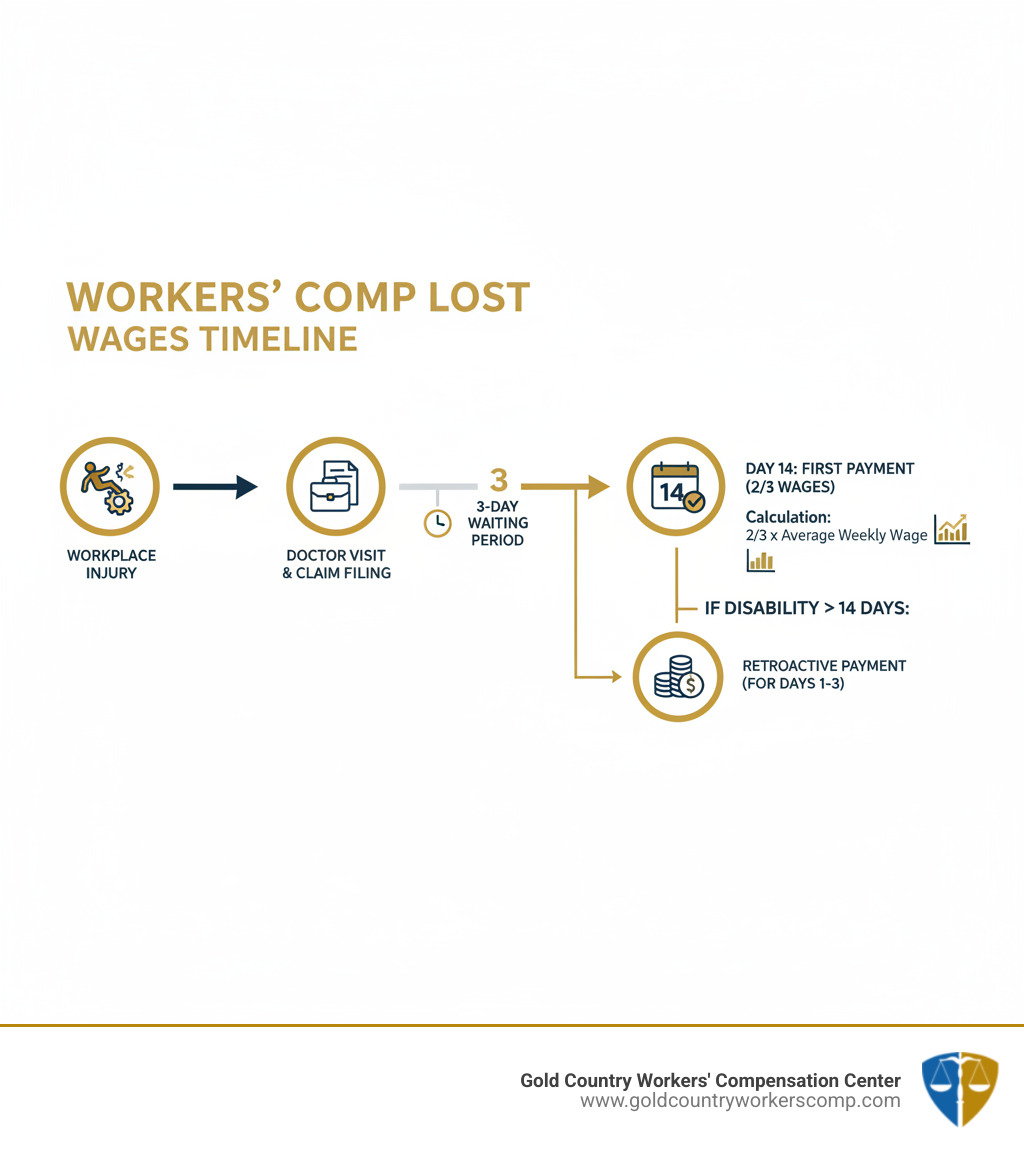
Will workers comp pay for missed days is one of the first questions injured workers ask. The short answer is yes—but only if your doctor says you can’t work and after a required waiting period.

Here’s what you need to know:

  • Workers’ compensation pays for missed days if a doctor certifies you are unable to work due to your injury.
  • In California, you must miss 3 days of work before benefits begin (other states have similar 3-7 day waiting periods).
  • If you are unable to work for 14 days or more, benefits become retroactive, meaning you get paid for the first 3 days.
  • You will receive two-thirds of your average weekly wages, not your full paycheck.
  • The first check typically arrives within 14 days after your employer is aware of your injury and disability.

When you’re injured, navigating lost wage benefits—also called indemnity or disability benefits—can be overwhelming. The workers’ compensation system is designed to replace a portion of your wages while you recover, but there are rules about when payments start, how much you’ll receive, and how long they last.

This guide breaks down exactly when workers’ comp will pay for your missed days, how much you can expect, and the steps you need to take to secure your benefits.

infographic showing timeline from workplace injury through doctor visit, claim filing, 3-day waiting period, first payment at 14 days, and retroactive payment if disability exceeds 14 days, with two-thirds wage replacement calculation - will workers comp pay for missed days infographic

Understanding Your Right to Lost Wage Benefits

When a workplace injury keeps you from earning a paycheck, workers’ compensation is there to help. In California, every employer must carry workers’ compensation insurance. It’s a no-fault system, meaning if you’re hurt on the job, you are entitled to benefits, regardless of who was at fault.

Workers’ comp provides two main types of support: coverage for all necessary medical care and lost wage benefits (also called temporary disability) when your injury prevents you from working. These benefits are a financial lifeline, but receiving them depends on your doctor’s assessment that you cannot perform your job duties.

The process begins when you report your injury to your employer, which you must do within 30 days. Your employer then has 24 hours to provide a DWC-1 claim form. Filing this form is the official first step to receiving compensation for missed days.

Under what circumstances will workers comp pay for missed days?

Payment for missed days hinges on your doctor’s medical determination. You are eligible for benefits in two main scenarios:

  • Total Disability: Your doctor determines you cannot work at all. This is called Temporary Total Disability (TTD). For example, a construction worker with a severe back injury who is told to stay home and recover would receive TTD benefits.

  • Partial Disability with Lost Wages: Your doctor clears you to return to work with restrictions (e.g., reduced hours, no heavy lifting). If these restrictions cause you to earn less than your pre-injury wages, you qualify for Temporary Partial Disability (TPD) benefits to supplement your income.

In both cases, your doctor’s authorization is essential. Without medical documentation supporting your time off or work restrictions, the insurance company will not pay.

What is the role of a doctor’s assessment?

Your doctor’s role is critical in determining if workers comp will pay for missed days. The primary treating physician creates the official record that supports your claim for financial benefits.

After your injury, your doctor will provide medical reports that detail:

  • Your Disability Status: Whether you are temporarily totally disabled, partially disabled, or have reached Maximum Medical Improvement (MMI)—the point at which your condition has stabilized.
  • Work Restrictions: Specific limitations on your activities, such as lifting weight limits or restrictions on standing. These determine what kind of work you can safely perform.
  • Return-to-Work Authorization: The doctor decides when and if you can return to your job, either in a full or modified capacity.

If the insurance company disputes your doctor’s findings, they may require you to see an Independent Medical Examiner (IME) for a second opinion. Clear and consistent documentation from your treating physician is your strongest tool for proving your need for time off and securing your benefits.

Will Workers Comp Pay for Missed Days? The Waiting Period Explained

Understanding the waiting period is crucial when asking, “will workers comp pay for missed days?” While the system is designed for timely support, there’s a short initial period where wage replacement benefits don’t apply.

How long is the waiting period before benefits are paid?

In California, there is a three-day waiting period before lost wage benefits begin. This means you will not be paid for the first three calendar days you are unable to work due to your injury. The clock starts on the first full day you miss work.

This waiting period is a standard feature in most states, though the duration varies. Once your claim is accepted, the first payment for eligible days should arrive within 14 days of your employer being notified of your injury and disability.

What if my disability lasts longer than 14 days?

If your inability to work extends beyond 14 calendar days, the waiting period becomes retroactive. This means you will be paid for the initial three days that were unpaid.

For example, if you are out of work for 10 days, you will be paid for 7 of them. However, if you are out for 15 days, you will be paid for all 15. This rule ensures that workers with more significant injuries receive more comprehensive compensation for their lost time from day one.

How Your Lost Wage Payments Are Calculated

Once you know workers comp will pay for missed days, the next question is, “How much will I receive?” Workers’ comp is designed to replace a portion of your income, not your full paycheck.

calculator with pay stubs - will workers comp pay for missed days

How is the amount of lost wage benefits determined?

In California, lost wage benefits are calculated as two-thirds of your Average Weekly Wage (AWW), which is based on your gross earnings (before taxes) in the 52 weeks prior to your injury. Your AWW includes all forms of income, such as regular wages, overtime, and earnings from other jobs (concurrent employment).

While two-thirds may seem low, these benefits are tax-free, so the amount you receive is often close to your usual take-home pay.

California also sets annual limits. For injuries occurring in 2025, the maximum Temporary Disability rate is $1,686.74 per week. Even if two-thirds of your AWW is higher, your benefit will be capped at this amount. There is also a minimum benefit to support lower-wage workers. These rates are adjusted annually, so check the current figures.

What is the difference between temporary total and temporary partial disability?

Lost wage benefits fall into two categories based on your ability to work:

  • Temporary Total Disability (TTD): You receive TTD benefits when your doctor determines you are completely unable to work. Payments are two-thirds of your AWW (up to the state maximum) and continue until you can return to work or reach Maximum Medical Improvement.

  • Temporary Partial Disability (TPD): TPD benefits apply when you can return to work but with limitations that result in reduced earnings (e.g., fewer hours or a lower-paying modified role). TPD pays two-thirds of the difference between your pre-injury and current earnings. For example, if you lost $400 in weekly wages, your TPD benefit would be approximately $267 per week.

TPD is designed to support your transition back to the workforce without financially penalizing you for working within your doctor’s restrictions.

The workers’ compensation process isn’t always simple. Certain situations can affect whether workers comp will pay for missed days, and knowing how to handle them is key.

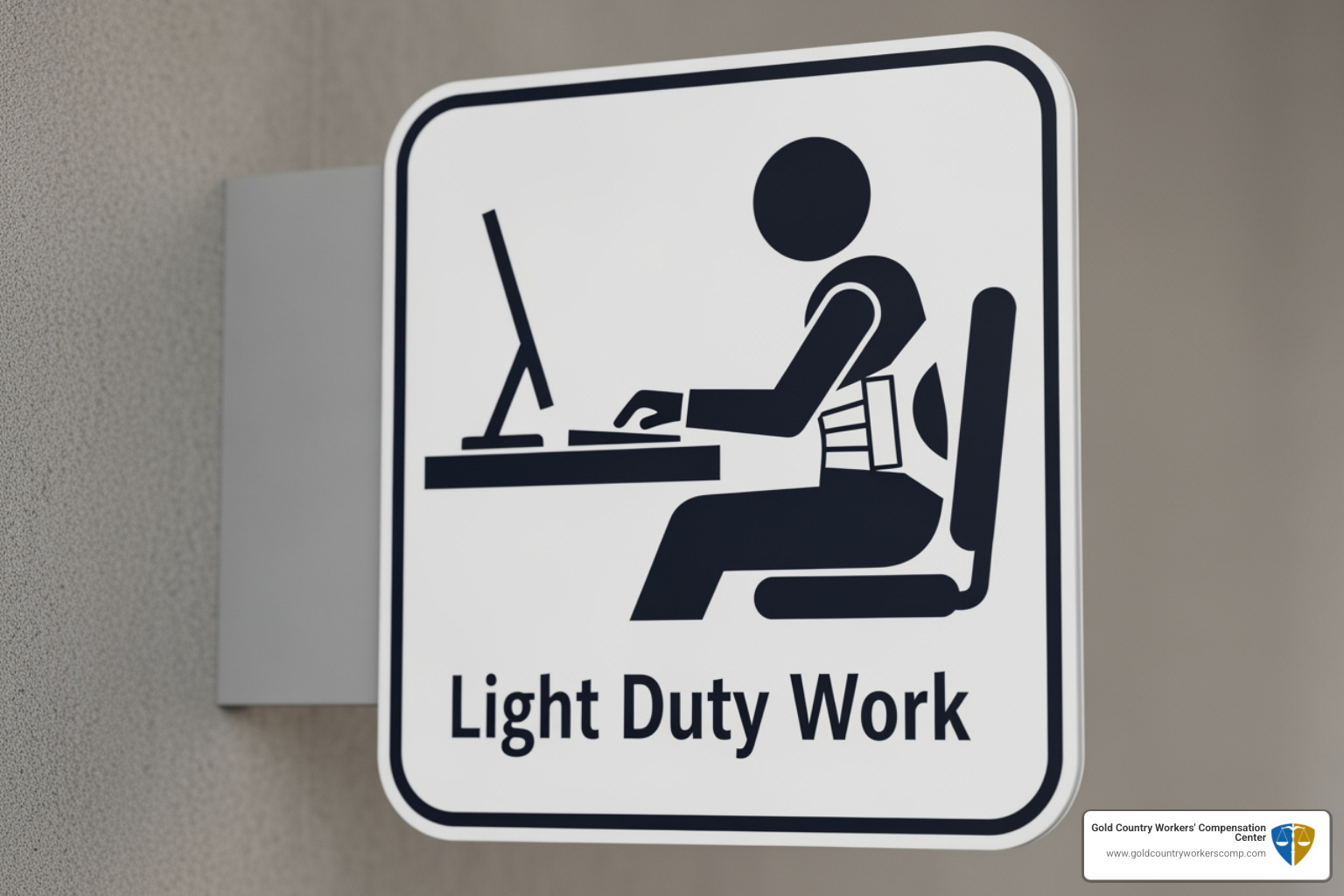
Light duty work sign - will workers comp pay for missed days

Can I receive benefits if I am offered light-duty work?

Yes. If your doctor releases you to modified or “light-duty” work and your employer offers a position that accommodates your restrictions, you may still be eligible for benefits. If the new role pays less than your pre-injury job (due to fewer hours or lower pay), you can receive Temporary Partial Disability (TPD) benefits. These payments cover two-thirds of the wage difference.

The crucial element is that the job offer must align with your doctor’s approved restrictions. Clear communication between you, your doctor, and your employer is essential.

What are the implications of refusing a modified job offer?

Refusing a suitable modified job offer can have serious consequences. If your employer offers a position that fits within your doctor’s restrictions and you decline it without a valid reason, your lost wage benefits will likely be terminated. The insurance company may argue you are voluntarily choosing not to earn available income.

However, there can be valid reasons to refuse, such as if the job does not truly meet your medical restrictions or is otherwise unsuitable. If you are unsure about a light-duty offer, it is critical to seek legal advice to protect your benefits.

Are there situations where will workers comp pay for missed days is not an option?

Yes, there are circumstances where you may not be eligible for lost wage benefits. These include:

  • Injury is Not Work-Related: The injury must arise out of and in the course of your employment.
  • Waiting Period Not Met: If you are disabled for three days or less, you will not receive wage benefits for that time.
  • Refusing a Suitable Job Offer: As discussed above, turning down appropriate modified work can end your benefits.
  • Claim Denial: If the insurer denies your claim, benefits will not be paid unless you successfully appeal the decision. Denials can happen for many reasons, including late reporting or disputes over the cause of the injury.
  • Fraud: Intentionally misrepresenting your injury or ability to work will result in a denial and potential legal penalties.
  • Pre-existing Conditions: Workers’ comp does not cover pre-existing conditions unless your work duties significantly aggravated or worsened the condition. Proving this requires strong medical evidence.

The Long-Term Outlook: From Temporary to Permanent Benefits

When you’re first injured, your focus is on immediate recovery. But for some, injuries have lasting effects, and the workers’ compensation system shifts from temporary support to addressing permanent impairments.

How long can I receive temporary lost wage benefits?

In California, you can generally receive Temporary Disability benefits for up to 104 weeks (two years) within a five-year period from your injury date. For certain severe injuries, such as severe burns or chronic lung disease, this limit extends to 240 weeks.

Temporary benefits end when your doctor clears you to return to your usual job or you reach Maximum Medical Improvement (MMI). MMI means your condition has stabilized and is not expected to improve further with treatment, even if you still have limitations.

What are permanent disability benefits?

If your injury results in a permanent impairment after you reach MMI, you may qualify for Permanent Disability (PD) benefits. Unlike temporary benefits that replace wages, PD benefits compensate you for the permanent loss of function and its impact on your future earning capacity.

Your level of impairment is assigned a percentage rating by a doctor, which determines the value of your PD benefits. Unfortunately, the maximum weekly PD payment rate has been capped at $290 per week since 2014 and has not been adjusted for inflation. These benefits can be paid in weekly installments or as a lump-sum settlement, which may close out your rights to future medical care.

In rare cases of catastrophic injury resulting in permanent total disability, you may be entitled to lifetime benefits. For more details, the California Department of Industrial Relations offers information on Permanent Disability (PD) benefits.

How do workers’ comp benefits differ from Social Security?

It’s common to confuse workers’ compensation with Social Security Disability, but they are separate programs:

  • Workers’ Compensation: A state-mandated insurance program paid by your employer. It covers medical care and lost wages specifically for work-related injuries and illnesses. Benefits can begin after a short waiting period.

  • Social Security Disability (SSD): A federal program funded by your payroll taxes. It provides income to individuals with a severe, long-term disability (expected to last at least 12 months or result in death) that prevents them from performing any substantial work, regardless of whether the disability is work-related. The application process is often lengthy.

You may be eligible for both programs, but receiving workers’ comp can reduce your Social Security benefit amount. Navigating these systems can be complex, and legal guidance is often necessary to secure all the benefits you are entitled to. You can learn more from the Social Security Administration.

Frequently Asked Questions about Lost Wages

Many injured workers share the same questions and concerns about lost wages. Here are answers to some of the most common ones we hear.

What happens if my employer continues to pay my wages while I’m out?

If your employer pays your full salary while you recover—through sick leave, vacation time, or a salary continuation plan—you will not receive separate lost wage benefits from the workers’ comp insurer for that same period. You cannot be paid twice for the same time off. However, your employer can often seek reimbursement from the insurer for the wages they paid you. It’s important to keep clear records to avoid any overpayment issues.

What happens if my workers’ compensation claim for lost wages is denied?

A denial is not the final word. The insurer must provide a written explanation for the denial, which could be due to a dispute over whether the injury is work-related, a lack of medical evidence, or a procedural error. The insurer has up to 90 days to investigate and potentially deny a claim.

You must act quickly to appeal a denial. In California, this involves filing an Application for Adjudication of Claim. This is a critical moment where an experienced attorney can make a significant difference. At Gold Country Workers’ Compensation Center, we review denial letters, gather necessary evidence, and represent our clients before a judge to fight for the benefits they deserve. Our early intervention approach, with no initial consultation fee, is designed to build the strongest possible case from the start.

What benefits are available for dependents if a worker dies?

When a worker dies from a work-related injury, California’s workers’ compensation system provides death benefits to support their dependents. These benefits include:

  • Burial Expenses: A payment up to a statutory maximum to cover funeral costs.
  • Weekly Payments: Eligible dependents (typically a surviving spouse and minor children) receive weekly payments, usually calculated as two-thirds of the deceased worker’s average weekly wage.

The duration of these payments depends on the dependent. Children generally receive benefits until age 18. A surviving spouse may receive benefits for life or until they remarry, at which point they typically receive a final lump-sum payment. Calculating these benefits is complex, and compassionate legal guidance can ensure a family receives the full support they are entitled to during a difficult time.

Conclusion

You now have a clearer understanding of when and how workers comp will pay for missed days in California. While the system can feel complex, knowing your rights is the first step toward securing the financial support you need.

The key takeaways are that your doctor’s medical opinion is paramount, a short waiting period applies but is paid retroactively for longer disabilities, and benefits are calculated as two-thirds of your average weekly wage, tax-free. Whether you are completely out of work or on light duty with reduced pay, the system is designed to bridge the financial gap.

If your claim is denied or you face roadblocks, you have the right to appeal. The journey from a temporary injury to a permanent one involves different types of benefits, and navigating each stage requires knowledge and persistence.

At Gold Country Workers’ Compensation Center, our team, led by Kim LaValley and Kyle Adamson, has nearly 50 years of combined experience helping injured workers in Grass Valley, Nevada City, Roseville, and the greater Sacramento area. We are committed to early intervention and personalized attention.

If you are struggling with your claim or simply want to ensure you’re receiving all your benefits, we are here to help. We don’t charge for initial consultations because you deserve to understand your options without financial risk. Don’t let confusion or intimidation prevent you from getting the benefits you’ve earned. Reach out to us for a free consultation to understand your full range of workers’ comp benefits. Your focus should be on healing—let us handle the legal complexities.

Beyond the Claim: Navigating Lawsuits and Harassment on Workers’ Comp

suing your employer for workers comp

Understanding Your Rights When Injured at Work

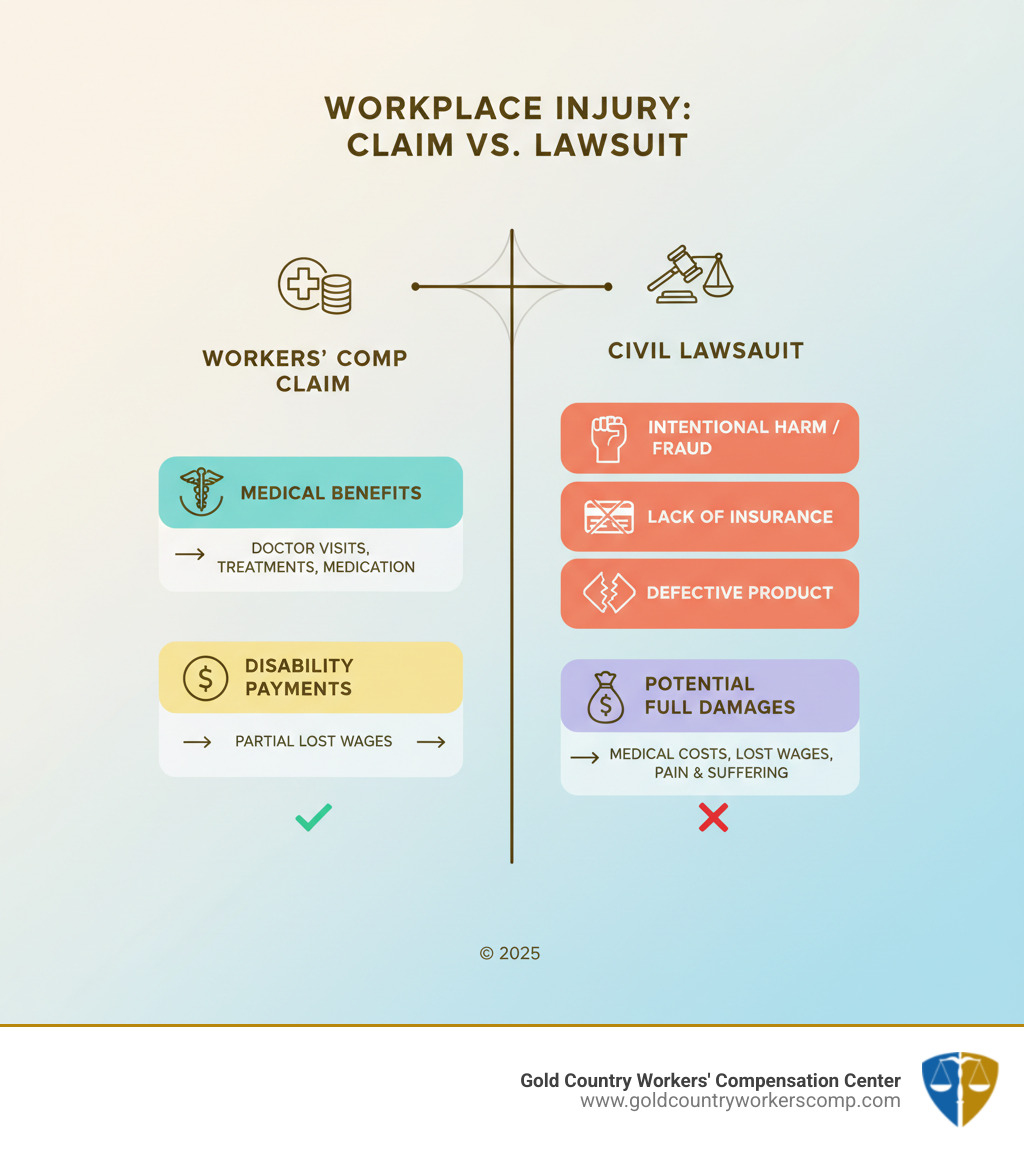
Suing your employer for workers comp is generally not allowed in California due to the “exclusive remedy rule.” This rule limits most injured workers to the workers’ compensation system, which provides benefits regardless of fault. However, you can file a civil lawsuit against your employer in specific, narrow situations:

  • Your employer intentionally injured you or committed assault.
  • Your employer fraudulently concealed a workplace hazard that caused your injury.
  • Your employer manufactured a defective product that injured you (dual capacity doctrine).
  • Your employer doesn’t carry workers’ compensation insurance as required by law.
  • A third party (not your employer or coworker) caused your injury.

When you’re hurt on the job, it’s easy to feel overwhelmed by medical bills, lost wages, and a complex legal system. The workers’ comp system is designed to help, but it’s often a maze of forms and deadlines. Crucially, it does not allow you to sue for pain and suffering or recover your full lost wages.

Understanding the exceptions to the exclusive remedy rule is critical. The difference between a workers’ comp claim and a civil lawsuit is significant, affecting the compensation you can receive and what you need to prove. While workers’ comp offers guaranteed medical care and partial wage replacement, a lawsuit can provide far greater compensation but requires proving your employer’s intentional wrongdoing or that another exception applies.

infographic showing two paths: left side shows workers comp claim process with medical benefits and disability payments, right side shows civil lawsuit path with requirements for intentional harm, fraudulent concealment, or lack of insurance, leading to potential full damages including pain and suffering - suing your employer for workers comp infographic

Understanding the “Exclusive Remedy” Rule in California

When you get hurt at work in California, the “exclusive remedy” rule is the foundation of your case. It’s why suing your employer for workers comp is not an option in most cases.

California’s workers’ compensation system is a trade-off. You receive guaranteed, no-fault benefits for medical treatment and lost wages. In exchange, your employer gets immunity from most lawsuits related to workplace injuries. This system provides a critical safety net, but the benefits are limited. You won’t receive compensation for pain and suffering, emotional distress, or punitive damages. Understanding these boundaries is essential. To learn more about how this system protects your rights, visit our page on California Workers Compensation Lawyer.

Can I sue my employer if they were just negligent?

This is a common question. If your employer was guilty of ordinary negligence—like failing to put out a warning sign for a wet floor—you generally cannot sue them. The exclusive remedy barrier applies even if their mistake led to your injury.

The line between ordinary negligence and gross negligence (a severe lack of care or reckless disregard for safety) can be blurry. Proving fault at this higher level is difficult and requires showing that your employer’s actions went far beyond simple carelessness. An experienced attorney can help determine if your case involves more than just ordinary negligence. For information on damages like pain and suffering, see our guide on Can Sue Pain Suffering.

Can I sue a coworker who caused my injury?

Generally, you cannot sue a coworker who injures you while acting within the scope of employment. The workers’ compensation system’s coworker liability shield protects them, just as it protects your employer.

However, exceptions exist. If a coworker intentionally assaults you or their actions were completely unrelated to their job duties, a civil lawsuit may be possible. These complex cases require careful investigation to determine if the coworker’s actions fall outside the protections of the workers’ comp system. If you’re unsure about your case, it’s best to consult an attorney. You can learn more about finding legal help on our Work Injury Attorney Near Me page.

When is Suing Your Employer for Workers Comp a Viable Option?

The exclusive remedy rule has several important exceptions. These are your legal pathways to suing your employer for workers comp outside the standard system. They are narrow and difficult to prove, but they can dramatically change your potential recovery.

gavel and hard hat - suing your employer for workers comp

These exceptions exist for employer conduct so egregious that limiting recovery to workers’ comp benefits would be unjust. Our Workers Compensation Attorneys California team can evaluate your case to see if you have grounds for a civil lawsuit.

Exception 1: Intentional Injury or Assault

If your employer deliberately hurts you, the exclusive remedy rule does not apply. This includes willful physical assault or creating a situation where injury is practically certain to occur. The challenge is proving intent—that your employer acted with a conscious desire to cause harm. If proven, you can sue for full damages, including pain and suffering and punitive damages. A Hurt at Work Lawyer can help you understand your options.

Exception 2: Fraudulent Concealment

You may have grounds for a lawsuit if your employer knew about a dangerous condition, deliberately hid it from you, and that concealment caused your injury. This is more than just failing to warn; it’s active deception, such as falsifying safety reports about toxic substances like asbestos. Proving fraudulent concealment requires showing your employer had actual knowledge of the hidden danger and intentionally concealed it.

Exception 3: Defective Product (Dual Capacity Doctrine)

Sometimes, your employer is also the manufacturer of a product that injured you. Under the dual capacity doctrine, you may be able to sue them for product liability as a manufacturer, separate from their role as your employer. This is common with defective machinery, such as power presses where safety guards were knowingly removed. These cases require proving the injury stemmed from a product defect, not just a workplace condition. A Workplace Injury Lawyer can help steer this complex doctrine.

What if My Employer Lacks Insurance? The Path to Suing Your Employer for Workers Comp

California law requires all employers to carry workers’ comp insurance. If your employer is uninsured, the exclusive remedy rule does not protect them. This is a clear situation where suing your employer for workers comp is a viable option.

You can still receive benefits through the Uninsured Employers Benefit Trust Fund (UEBTF). Crucially, you can also file a civil lawsuit against your uninsured employer for full damages, including pain and suffering. In such a lawsuit, the burden of proof may shift to your employer, and they face severe penalties. Our Workers Comp Lawsuit Help resources can guide you through this process.

Exception 4: Suing a Negligent Third Party

Even if you can’t sue your employer, you may have a claim against a negligent third party. A third party is anyone other than your employer or a coworker. Common examples include:

  • A general contractor or subcontractor on a construction site.
  • The manufacturer of defective equipment that caused your injury.
  • An at-fault driver in a car accident that occurred while you were working.

A third-party lawsuit allows you to recover damages like pain and suffering, which workers’ comp doesn’t cover. While your employer’s insurer may place a lien on your recovery to be reimbursed for benefits paid, a third-party claim often results in a significantly higher total recovery. A Workplace Accident Attorney can help manage both claims.

Workers’ Comp Benefits vs. Lawsuit Damages: A Comparison

Understanding the difference between workers’ compensation benefits and civil lawsuit damages is crucial for your financial future. Workers’ comp provides a valuable but limited safety net. A lawsuit, if you qualify, can provide much fuller compensation.

Think of it this way: workers’ comp covers immediate needs with caps on recovery, while a lawsuit can address the total impact of your injury, including pain and suffering.

Feature Workers’ Compensation Benefits Civil Lawsuit Damages
Proof of Fault Not required (no-fault system) Required (employer’s intentional wrongdoing, gross negligence, third-party fault)
Medical Care Covered (all reasonable and necessary treatment) Covered (all past and future medical expenses)
Lost Wages Partial (typically 2/3 of average weekly wage, up to a cap) Full (past and future lost earnings, including loss of earning capacity)
Pain & Suffering Not covered Covered
Emotional Distress Not covered Covered
Punitive Damages Not covered Possible (in cases of extreme misconduct)
Disfigurement Limited coverage (via permanent disability ratings) Covered
Loss of Consortium Not covered Covered (for spouse/family)
Legal Process Administrative claim with Workers’ Compensation Appeals Board Civil court system
Timeline Generally faster initial benefits Can be much longer and more complex

What Damages Can Be Recovered in a Lawsuit?

If you can sue your employer for workers comp under an exception or pursue a third-party claim, the available damages expand significantly.

  • Economic damages cover your financial losses, including all past and future medical bills, full lost wages, and diminished future earning capacity.
  • Non-economic damages address the human cost of your injury. This includes pain and suffering, emotional distress, disfigurement, and loss of enjoyment of life.
  • Punitive damages are rare and are meant to punish an employer for malicious or fraudulent conduct, not to compensate you for losses.

The difference between these damages and standard workers’ comp benefits can be life-changing. Our team can help you Sue for Damages as a Result of Your Injury.

Common Defenses Employers Use in Injury Lawsuits

When you file a lawsuit, expect the defense to fight back. Common defense strategies include:

  • Comparative negligence: Arguing you were partially at fault to reduce your compensation.
  • Employee misconduct: Claiming you were injured because you violated safety rules.
  • Intoxication defense: Alleging that drugs or alcohol caused the accident.
  • Injury outside scope of employment: Arguing you weren’t “on the clock” when the injury occurred.
  • Statute of limitations: Claiming you missed the legal deadline to file your lawsuit.
  • Lack of intent or knowledge: Denying they knew about a hazard or intended to cause harm in cases involving exceptions to the exclusive remedy rule.

Navigating these defenses requires an experienced legal team that knows how to build a compelling case and counter defense tactics.

After a work injury, the steps you take immediately are critical for protecting your rights, whether you file a standard workers’ comp claim or have grounds to sue your employer for workers comp.

person filling out DWC-1 form - suing your employer for workers comp

Missing a step can jeopardize your claim, so act swiftly.

1. Report Your Injury Immediately

This is the most important first step. You must notify your employer in writing within 30 days of your injury. Even minor injuries should be reported, as they can worsen over time.

  • Notify your supervisor or designated representative.
  • Request and fill out an official incident report.
  • Provide accurate details: when, where, and how the injury occurred.
  • Get contact information for any witnesses.

Prompt reporting establishes a clear timeline for your claim. For more on this, see our First Step Take Injury Important page.

2. Seek Prompt Medical Treatment

Your health is the priority. Get medical attention right away, even if the injury seems minor. A doctor’s diagnosis and treatment plan create the official medical records that are critical evidence for your claim.

  • Go to the emergency room for severe injuries.
  • Follow all of your doctor’s instructions and restrictions.
  • Keep detailed records of all appointments, diagnoses, and treatments.
  • Tell every provider that your injury is work-related.

Delaying treatment can make it harder to prove your injury was work-related. If you’ve been denied care, learn about your options on our Medical Treatment Denied page.

3. File an Official Claim Form

Your employer must give you a Workers’ Compensation Claim Form (DWC-1) within one working day of you reporting your injury.

  • Fill out the DWC-1 form accurately and return it to your employer promptly.
  • Your employer then forwards it to their insurance carrier.
  • The insurer has 90 days to accept or deny your claim. During this time, they must authorize up to $10,000 in medical care.

This form officially starts your claim. If your employer fails to provide it, you can find the official DWC-1 form on the state’s website. Learn more about Making a Workers Comp Claim.

Frequently Asked Questions about Suing an Employer in California

Navigating a work injury claim raises many questions, especially about legal action beyond standard workers’ compensation. Here are answers to some of the most common concerns.

What is the statute of limitations for suing my employer for a work injury?

Filing deadlines are strict and vary by claim type.

  • For a workers’ compensation claim, you generally have one year from the date of injury to file the DWC-1 form. You should also report the injury to your employer within 30 days.
  • For a personal injury lawsuit against your employer (under an exception) or a third party, you typically have two years from the date of injury to file in civil court.

The “findy rule” can sometimes extend these deadlines if your injury or its connection to work wasn’t immediately apparent, but relying on this is risky. The best course of action is to act promptly to protect your rights.

Do I lose my workers’ comp benefits if I file a lawsuit?

No. Filing a civil lawsuit does not automatically disqualify you from receiving workers’ comp benefits. You can often pursue both claims at the same time (concurrent claims). You can receive medical care and disability payments from workers’ comp while your lawsuit proceeds.

However, California law prevents “double recovery.” If you win a settlement or judgment in your lawsuit, the workers’ comp insurance carrier has a right to be reimbursed for the benefits they paid. This is called an employer’s lien. While this reduces your net lawsuit recovery, the total compensation is often still much higher than from workers’ comp alone.

What evidence is needed for a successful lawsuit against an employer?

The burden of proof is on you when you sue your employer for workers comp under an exception. A strong case is built on solid evidence, including:

  • Medical Records: To document the extent of your injuries and connect them to the workplace incident.
  • Accident Reports: Official reports filed with your employer or other agencies create a contemporaneous record of the event.
  • Witness Statements: Testimony from coworkers who saw the incident or can speak to workplace hazards.
  • Photos and Videos: Visual evidence of the accident scene, defective equipment, or your injuries.
  • Employer’s Records: Internal emails, safety reports, or maintenance logs can prove your employer’s knowledge of a hazard.
  • Expert Testimony: Medical, safety, or engineering experts can provide professional opinions to support your claim.
  • Employment Records: Your job description and wage history help establish your financial losses.

Gathering this evidence can be overwhelming. An experienced legal team knows what to look for and how to use it to build the strongest possible case.

The legal landscape for workplace injuries in California is complex. Between the “exclusive remedy” rule and its narrow exceptions, it’s easy to feel overwhelmed while also dealing with pain and financial stress.

The truth is that early legal guidance makes a significant difference. The sooner you consult with an experienced attorney, the better your chances of meeting critical deadlines and pursuing all available compensation, whether through a workers’ comp claim or a civil lawsuit.

That’s where we come in. At Gold Country Workers’ Compensation Center, Kim LaValley and Kyle Adamson have nearly 50 years of combined experience helping injured workers in Roseville, Nevada City, and throughout California. We are committed to ensuring you understand your rights and receive the compensation you deserve.

We believe in early intervention. By contacting us soon after your injury, we can help you avoid common mistakes, gather crucial evidence, and build a strong case from the start. We offer a no-fee initial consultation to give you honest answers about your situation without any upfront cost.

Don’t let uncertainty prevent you from exploring your options. For more information, visit our comprehensive guide: California Workers Compensation Lawyer.

If you have questions about a work injury, contact us today. We’re here to help you move forward with confidence.